
Rights and Benefits of Future Musical Creators
Article Sidebar
Main Article Content
Abstract
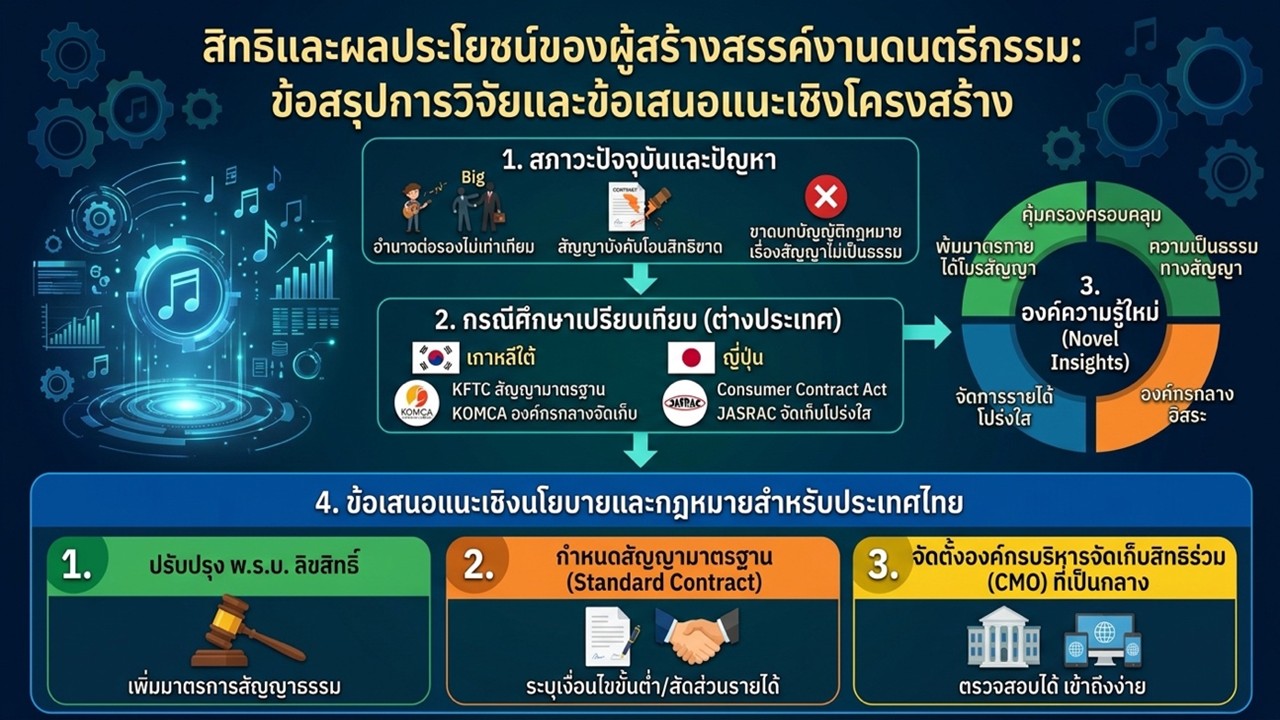
The research on measures to protect musical creators in disadvantaged business situations aims to: Examine the problem of unfair contracts between musical creators and entrepreneurs under Thai copyright law; Study the legal measures for copyright protection under Japanese and Korean law to identify mechanisms that safeguard musical creators in similar situations; and Propose guidelines for improving Thai copyright law and mechanisms to ensure fairness and adequate protection for creators. The research findings indicate that Thai law remains vague in providing protection for musical creators who are in disadvantaged business positions. Although the Thai Copyright Act B.E. 2537 (1994) and its subsequent amendments formally recognize the rights of musical creators, the law lacks clarity regarding protection against unfair contractual practices and lacks effective mechanisms to maintain balance between parties. Therefore, it is crucial to prioritize the dissemination of knowledge to musical creators about their legal rights and fair contracting practices, enabling them to better protect their interests. Additionally, legislation should be enacted to support the establishment of a centralized, independent, transparent, and accountable agency responsible for collecting and distributing royalties. This would ensure that creators receive fair compensation for the use of their works. The study further suggests that legal measures from Japan and South Korea can serve as useful models for Thailand. In particular, the establishment of a central organization to protect creators and manage royalties, as well as the implementation of standard contract provisions and mechanisms for reviewing contractual terms and conditions, should be considered to promote fairness and balance in the music industry.
Keywords: Rights and Benefits, Musical Creators, Future
Article Details

This work is licensed under a Creative Commons Attribution-NonCommercial-NoDerivatives 4.0 International License.
References
กรมทรัพย์สินทางปัญญา. (2559). คู่มืองานดนตรีกรรม [Online], 29 กุมภาพันธ์ 2559. แหล่งที่มา https://www.ipthailand.go.th/index.php?option=com_content&view=article&id=512:2014-04-24-08-03-13&catid=99&Itemid=408
จรัญ ภักดีธนากุล. (2541). สรุปสาระสำคัญพระราชบัญญัติว่าด้วยข้อสัญญาที่ไม่เป็นธรรม พ.ศ. 2540. ดุลพาห, 45(1), 1-13.
ไชยยศ เหมะรัชตะ. (2545). คำอธิบายกฎหมายลิขสิทธิ์ (พิมพ์ครั้งที่ 3). นิติธรรม.
พระราชบัญญัติลิขสิทธิ์ พ.ศ. 2537. (2537, 27 ธันวาคม). ราชกิจจานุเบกษา. เล่ม 111 ตอนที่ 53 ก. หน้า 1.
Japanese Law Translation. (2022). Consumer Contract Act (Act No. 61 of 2000). https://www.japaneselawtranslation.go.jp/en/laws/view/4624/en
Japanese Society for Rights of Authors, Composers and Publishers. (2022). Annual report 2022.
Korea Music Copyright Association. (2021). Annual report 2021. https://indd.adobe.com/view/8d3c4873-384c-418b-9202-5e47f2426e9a
Owen, R., & O'Dair, M. (2020). How blockchain technology can monetize new music ventures: An examination of new business models. Journal of Risk Finance, 21(4), 333–353. https://doi.org/10.1108/JRF-03-2020-0053
