
Guidelines for Developing Educational Institution Management in the Digital Era for Schools under the Pathum Thani Provincial
Article Sidebar
Main Article Content
Abstract
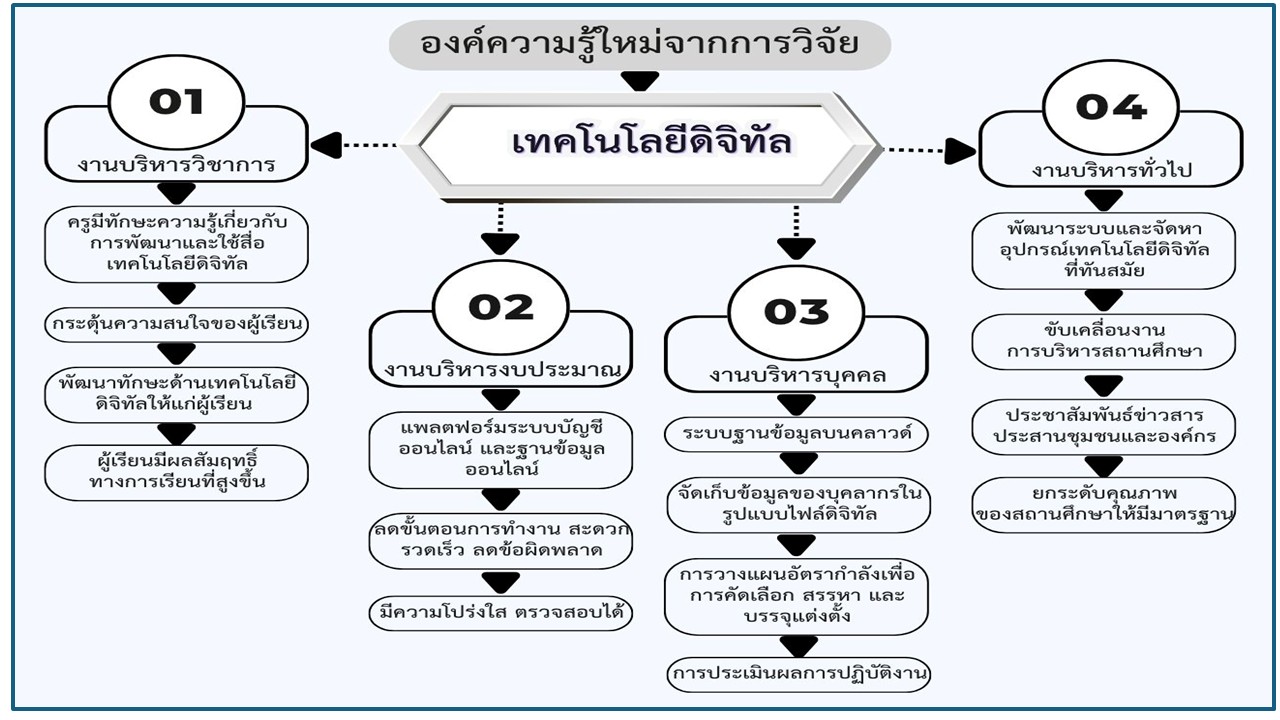
The objective of this research was to evaluate the current state, desirable state, priority needs, and recommend guidelines for the advancement of educational institution management in the digital era for schools within the Pathum Thani Provincial Administrative Organization. A mixed-methods research design was implemented in the investigation. The Pathum Thani Provincial Administrative Organization employed 157 government teachers and assistant teachers under mission-based contracts in schools. The population was composed of this group. A five-point rating scale questionnaire was implemented as the research instrument for data acquisition. Frequency distribution, percentage, mean, standard deviation, and the Modified Priority Needs Index (PNImodified ) were the statistics employed for data analysis. In addition, content analysis was employed to analyze the qualitative data, and semi-structured interviews were conducted. The research results indicated that 1) the current and desirable conditions for the development of educational institution management in the digital era for schools under the Pathum Thani Provincial Administrative Organization were, in general, at a high level. The budget administration was the current condition with the highest mean score, and the general administration was the desirable condition with the highest mean score. It was at the highest level. The area that required the most attention was academic administration. 2) There were a total of 12 development guidelines for the four aspects of educational institution management in the digital era for schools under the Pathum Thani Provincial Administrative Organization: 1) academic administration with four development guidelines, 2) personnel administration with two development guidelines, 3) general administration with three development guidelines, and 4) budget administration with three development guidelines.
Keywords: Educational Institution Management, Educational Institutions in the Digital Era, Schools
Article Details

This work is licensed under a Creative Commons Attribution-NonCommercial-NoDerivatives 4.0 International License.
References
กระทรวงศึกษาธิการ. (2550) กฎกระทรวงกำหนดหลักเกณฑ์และวิธีการกระจายอำนาจกาบริหารและการจัดการศึกษา พ.ศ. 2550. ราชกิจจานุเบกษา เล่ม 124 ตอนที่ 24 ก หน้า 29-36 ประกาศใช้ 16 พฤษภาคม 2550.
กรมส่งเสริมการปกครองท้องถิ่น กระทรวงมหาดไทย. (2568). การกำหนดโครงสร้างการบริหารงานของโรงเรียนและศูนย์พัฒนาเด็กเล็ก สังกัดองค์กรปกครองส่วนท้องถิ่น. สืบค้นจาก https://www.dla.go.th/downoad/
Upload/document/type2/2568/1/33012_1_1737531352249.pdf?notDownload=Y
กอข้าว เพิ่มตระกูล. (2566). ความแตกต่างของ Generation ของแต่ละช่วงวัย. สืบค้นจาก https://winestrehab. com/the-different-between-generations/#:~:text=Generation%20X%3A%20
กุลชลี จงเจริญ. (2567). การบริหารสถานศึกษาในยุคดิจิทัล กรณีศึกษาสถานศึกษาที่ประสบความสำเร็จในการบูรณาการเทคโนโลยีดิจิทัลสู่การพัฒนาคุณภาพของผู้เรียน. วารสารบัณฑิตวิจัย. 15(1), 13-26.
จิตติมา วรรณศรี. (2564). การบริหารจัดการศึกษายุคดิจิทัล. พิมพ์ครั้งที่ 1. รัตนสุวรรณการพิมพ์.
ณัชพล เอี่ยมสะอาด และธนกฤต สิทธิราช. (2568). แนวทางการพัฒนางานบริหารบุคคลของสถานศึกษายุคดิจิทัล กลุ่มโอฆะบุรี สังกัดสำนักงานเขตพื้นที่การศึกษาประถมศึกษาพิจิตร เขต 1. Journal of Buddhist Education and Research. 11(2), 654-666.
ณัฎฐธิดา จงมี. (2567). แนวทางการบริหารงานวิชาการในยุคดิจิทัลของโรงเรียนรัษฎา สังกัดสำนักงานเขตพื้นที่การศึกษามัธยมศึกษาตรัง กระบี่ (Unpublished Master’s thesis). มหาวิทยาลัยมหาจุฬาลงกรณราชวิทยาลัย, พระนครศรีอยุธยา.
ณัฐฐินันท์ นิ่มสุดใจ และลำพอง กลมกูล. (2566). แนวทางการพัฒนาการบริหารงานงบประมาณในยุคดิจิทัลตามหลักสุจริต 3 โรงเรียนสังกัดสำนักงานเขตพื้นที่การศึกษามัธยมศึกษาพระนครศรีอยุธยา. วารสารปารมิตา ศูนย์วิจัยธรรมศึกษา สำนักเรียนวัดอาวุธวิกสิตาราม. 5(2), 194-211.
ทินกร เผ่ากันทะ และกัลยารัตน์ เมธีวีรวงศ์. (2565). แนวทางการบริหารสถานศึกษาในยุคดิจิทัล. วารสารสมาคมพัฒนาวิชาชีพการบริหารการศึกษาแห่งประเทศไทย, 4(2), 37-45.
ธนัชชนม์ มาตระออ. (2564). แนวทางการบริหารสถานศึกษายุคดิจิทัลสำหรับโรงเรียนขนาดเล็ก สังกัดสำนักงานเขตพื้นที่การศึกษาประถมศึกษาในจังหวัดเชียงใหม่ (Unpublished Master’s thesis). มหาวิทยาลัยเชียงใหม่, เชียงใหม่.
นิสสรณ์ แสวงการ และวานิช ประเสริฐพร. (2568). แนวทางการพัฒนาการบริหารงานบุคคลในยุคดิจิทัลของสถานศึกษาสังกัดสำนักงานเขตพื้นที่การศึกษาประถมศึกษาขอนแก่น เขต 1. วารสารการบริหารการศึกษาและภาวะผู้นำ มหาวิทยาลัยราชภัฎสกลนคร. 13(51), 135-144
ปุณณิฐฐา มาเชค. (2565). การบริหารองค์กรทางการศึกษาในยุคดิจิทัล. สืบค้นจาก https://ed-adm.buu.ac.th/
Public/backend/upload/ed-adm.buu.ac.th/document/file/document16662338 1159360600.pdf
พระปลัดสมเกียรติ อํสุธโธ, อินถา ศิริวรรณ และระวิง เรืองสังข์. (2564). การบริหารงานบุคคลในยุคดิจิทัล. บัณฑิตศึกษาปริทรรศน์ วิทยาลัยสงฆ์นครสวรรค์. 9(1), 71-84.
พระมหาปริญญา เตชปญฺโญ. (2564). การบริหารงานบุคคลในยุคดิจิทัล. วารสารการสอนสังคมศึกษา. 3(2), 185-195.
พัชรียา มัทธนัง. (2566). แนวทางการพัฒนาการบริหารงานบุคคลในโรงเรียนขนาดเล็ก สังกัดสำนักงานเขตพื้นที่การศึกษาประถมศึกษาปทุมธานี เขต 2 (Unpublished Master’s thesis). มหาวิทยาลัยรังสิต, ปทุมธานี.
มลฤดี เพ็งสง่า และมัทนา วังถนอมศักดิ์. (2566). การบริหารสถานศึกษายุคดิจิทัล. วารสารวิชาการศึกษาศาสตร์ ศรีนครินทรวิโรฒ. 24(2), 162-175.
วิชญะ น้อยมาลา. (2564). ทักษะจำเป็นของการทำงานในศตวรรษที่ 21. วารสารวิชาการรัตนบุศย์. 3(1). 45-57.
ศรัญญา สตานิคม และวิเชียร รู้ยืนยง. (2566). ความต้องการจำเป็นในการพัฒนาการบริหารงานทั่วไปในยุคดิจิทัลของสถานศึกษาสังกัดสำนักงานเขตพื้นที่การศึกษาประถมศึกษามหาสารคาม เขต 3. Journal of Buddhist Philosophy Evolved. 7(2), 59-69.
สุนทรีย์ วรรณไพเราะ และฑัยศิกานต์ญา เบณติยานนท์. (2566). แนวทางการบริหารจัดการสถานศึกษาในยุคดิจิทัล. วารสารสหวิทยาการมนุษย์และสังคมศาสตร์, 6(6), 3278-3293.
อาทิตย์ พิมพ์โคตร และศิริรัตน์ ทองมีศรี. (2566). แนวทางการบริหารงานวิชาการในยุคดิจิทัลให้มีประสิทธิภาพของสถานศึกษาสังกัดสำนักงานส่งเสริมการศึกษานอกระบบและการศึกษาตามอัธยาศัยจังหวัดชลบุรี. Journal of Modern Learning Development. 8(3), 250-269.
Creswell, J.W. (2015). A Concise Introduction to Mixed Methods Research.SAGE.
Journals, Q. (2021). Role of Human Resource Management in Education. Journal of Research in Humanities and Social Science. 9(11), 27-31.
Maulida, B. Z. A., Sakina, E., Aulia, L., Adawiyah, R., Hidayat, W. & Rohini, R.. (2025). The Role of Socialization in improving the Quality of Education in Digital Age. Socio-Economic and Humanistic Aspects for Township and Industry. 3(1), 59-65.
Qurtubi, Ahmad. (2024). Transforming Education Management in the Digital Age: Strategic Innovation to Improve Education Quality and Efficiency. Jurnal of Pedagogi: Jurnal Pendidikan. 1(6), 156-166.
