
Documentary Synthesis for Developing a Desirable Graduate Attributes Framework for the Master’s Degree Program in Curriculum and Instruction
Article Sidebar
Main Article Content
Abstract
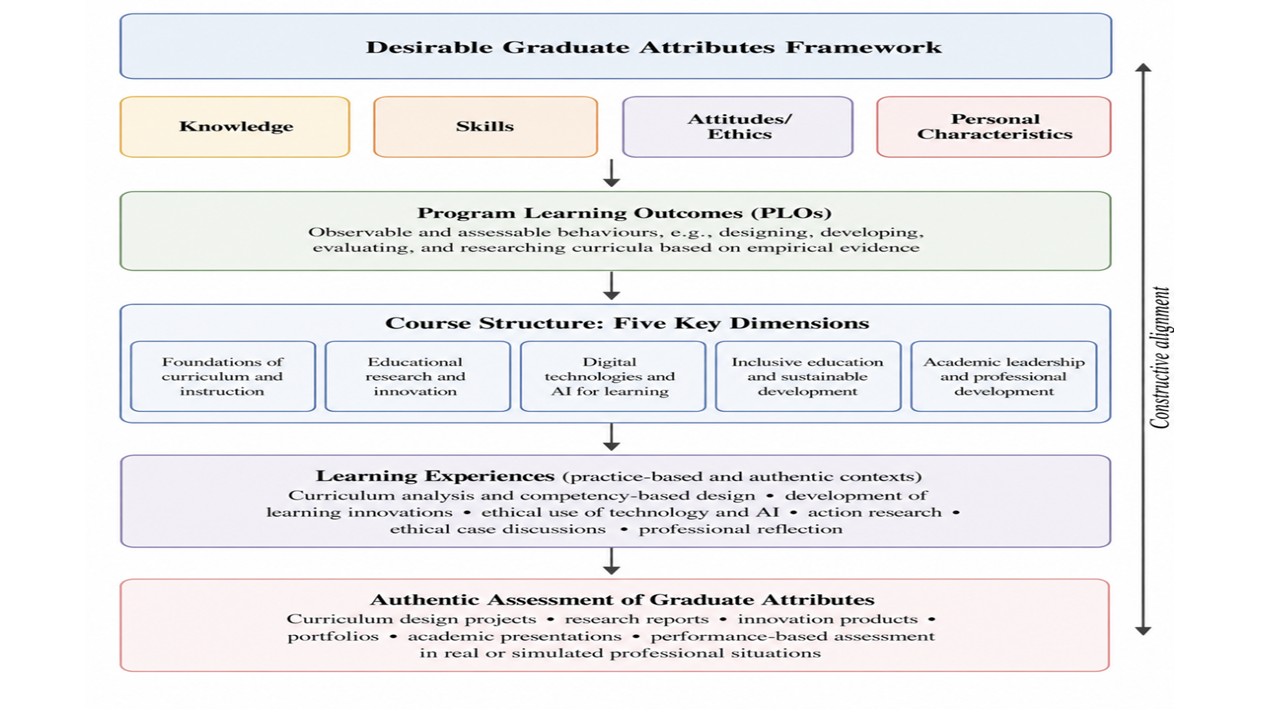
This study aimed to synthesize the desirable graduate attributes for the Master of Education program in Curriculum and Instruction by integrating Thai policy and standards documents with contemporary international research and academic frameworks published from 2020 onward. A qualitative documentary research design was combined with an integrative literature synthesis. Two groups of sources were analyzed: (1) Thai policy and standards documents, including the National Education Act, the announcement of the Higher Education Standards Committee on learning outcomes, the regulations of the Teachers’ Council of Thailand (Khurusapha), and the National Strategy; and (2) international research and competency frameworks addressing graduate attributes, curriculum and instruction competencies, teachers’ digital and artificial intelligence (AI) competencies, inclusive education, and education for sustainable development. Documents were examined through qualitative content analysis combining deductive and inductive coding, guided by an a priori framework of four attribute domains. Trustworthiness was supported by criterion-based document selection, source triangulation across document types, an audit trail, and reflexive interpretation. The synthesis indicated four domains of desirable attributes: (1) deep, integrated knowledge of curriculum, instruction, research, digital technology and AI, inclusive education, and sustainability; (2) skills in designing, implementing, evaluating, and researching curricula in authentic contexts; (3) professional ethics, responsibility to learners, and educational equity; and (4) academic leadership, lifelong learning, creativity, and adaptability. The findings provide a basis for formulating program learning outcomes and for designing courses, learning experiences, and assessment aligned with professional standards, the needs of Thai society, and global educational trends.
Keywords: Graduate Attributes, Curriculum and Instruction, Master of Education, Document Analysis, Learning Outcomes
Article Details

This work is licensed under a Creative Commons Attribution-NonCommercial-NoDerivatives 4.0 International License.
References
Bowen, G. A. (2009). Document analysis as a qualitative research method. Qualitative Research Journal, 9(2), 27–40. https://doi.org/10.3316/QRJ0902027
Elo, S., & Kyngäs, H. (2008). The qualitative content analysis process. Journal of Advanced Nursing, 62(1), 107–115. https://doi.org/10.1111/j.1365-2648.2007.04569.x
European Agency for Special Needs and Inclusive Education. (2022). Profile for inclusive teacher professional learning: Including all education professionals in teacher professional learning for inclusion (A. De Vroey, A. Lecheval, & A. Watkins, Eds.). European Agency for Special Needs and Inclusive Education.
Higher Education Standards Committee. (2022, September 9). Announcement of the Higher Education Standards Committee on details of learning outcomes according to the higher education qualification standards B.E. 2565 (2022). Royal Thai Government Gazette, 139(Special Part 212 Ngor), 35–40. [In Thai]
Imara, K., & Altinay, F. (2021). Integrating education for sustainable development competencies in teacher education. Sustainability, 13(22), Article 12555. https://doi.org/10.3390/su132212555
Kart, M., & Şimşek, H. (2024). Defining competencies in curriculum and instruction and developing a new competency model. Humanities and Social Sciences Communications, 11, Article 1514. https://doi.org/10.1057/s41599-024-03917-2
Lincoln, Y. S., & Guba, E. G. (1985). Naturalistic inquiry. Sage.
National Education Act B.E. 2542. (1999, August 19). Royal Thai Government Gazette, 116(Part 74 Gor), 1–23. [In Thai]
National Education Act (No. 2) B.E. 2545. (2002, December 19). Royal Thai Government Gazette, 119(Part 123 Gor), 16–21. [In Thai]
National Education Act (No. 3) B.E. 2553. (2010, July 22). Royal Thai Government Gazette, 127(Part 45 Gor), 1–3. [In Thai]
National Education Act (No. 4) B.E. 2562. (2019, May 1). Royal Thai Government Gazette, 136(Part 57 Gor), 49–53. [In Thai]
National Strategy B.E. 2561–2580. (2018, October 13). Royal Thai Government Gazette, 135(Part 82 Gor), 1–74. [In Thai]
Skantz-Åberg, E., Lantz-Andersson, A., Lundin, M., & Williams, P. (2022). Teachers’ professional digital competence: An overview of conceptualisations in the literature. Cogent Education, 9(1), Article 2063224. https://doi.org/10.1080/2331186X.2022.2063224
Snyder, H. (2019). Literature review as a research methodology: An overview and guidelines. Journal of Business Research, 104, 333–339. https://doi.org/10.1016/j.jbusres.2019.07.039
Teachers’ Council of Thailand. (2022, December 15). Teachers’ Council of Thailand regulation on professional licenses B.E. 2565 (2022). Royal Thai Government Gazette, 139(Special Part 292 Ngor), 24–32. [In Thai]
Torraco, R. J. (2005). Writing integrative literature reviews: Guidelines and examples. Human Resource Development Review, 4(3), 356–367. https://doi.org/10.1177/1534484305278283
UNESCO. (2024). AI competency framework for teachers. UNESCO. https://doi.org/10.54675/ZJTE2084
Whittemore, R., & Knafl, K. (2005). The integrative review: Updated methodology. Journal of Advanced Nursing, 52(5), 546–553. https://doi.org/10.1111/j.1365-2648.2005.03621.x
Wong, B., Chiu, Y.-L. T., Copsey-Blake, M., & Nikolopoulou, M. (2022). A mapping of graduate attributes: What can we expect from UK university students? Higher Education Research & Development, 41(4), 1340–1355. https://doi.org/10.1080/07294360.2021.1882405
