
Model for Teacher Professional Development of Phrapariyattidhamma Schools, General Education Section, Region 7
Article Sidebar
Main Article Content
Abstract
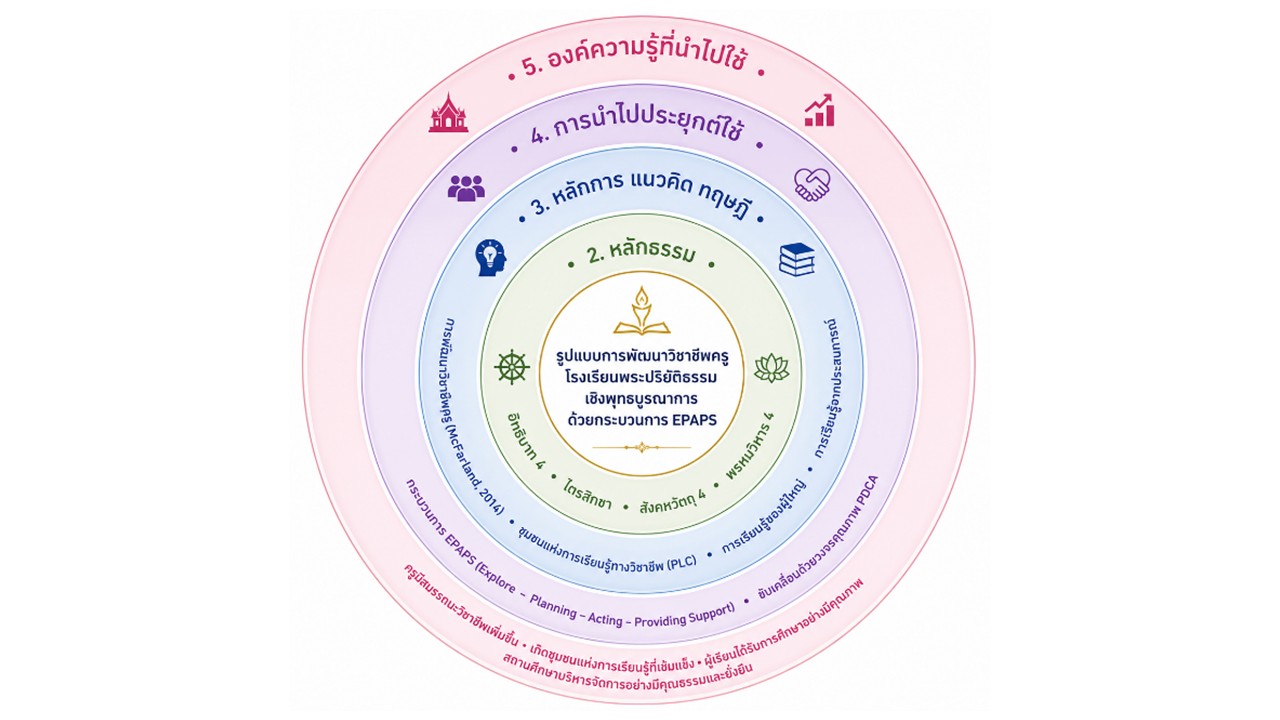
This research aimed to: (1) examine the current state, the desirable state, and the priority needs for teacher professional development in Phrapariyattidhamma Schools, General Education Section, Region 7; (2) develop a model for teacher professional development in these schools; and (3) evaluate the developed model. The study employed a multiphase mixed methods design consisting of three phases: needs assessment, model development, and model evaluation. The quantitative sample comprised 218 administrators and teachers from Phrapariyattidhamma Schools, General Education Section, Region 7, selected through proportional stratified random sampling. Research instruments included a questionnaire, in-depth interview guidelines, focus group discussion guidelines, and a model evaluation form. Quantitative data were analyzed using frequency, percentage, mean, standard deviation, and the Modified Priority Needs Index (PNI Modified), while qualitative data were analyzed using content analysis. The findings revealed that: (1) the overall current state of teacher professional development was at a moderate level, whereas the overall desirable state was at a high level, with an overall PNI Modified value of 0.32. The highest priority need was collaborative professional practice, followed by addressing individual teachers' professional needs and student and teacher learning, respectively. The most critical need identified was the opportunity for teachers to engage in collaborative discussions on instructional practices and teaching outcomes. (2) The developed model comprised five components: principles, objectives, implementation procedures, evaluation, and success conditions. The implementation was driven by the EPAPS process (Explore–Planning–Acting–Providing Support), which integrates the teacher professional development framework with Buddhist principles and the PDCA quality cycle to promote systematic professional development that is responsive to the unique context of Phrapariyattidhamma Schools. (3) The experts' evaluation indicated that the model achieved the highest level of appropriateness, feasibility, and utility in all aspects, demonstrating that the developed model is of high quality and can be effectively implemented to enhance teacher professional development in Phrapariyattidhamma Schools, General Education Section, Region 7.
Article Details

This work is licensed under a Creative Commons Attribution-NonCommercial-NoDerivatives 4.0 International License.
References
บุญฤทธิ์ ปิยะศรี. (2556). รูปแบบการพัฒนาวิชาชีพครูเพื่อเสริมสร้างสมรรถนะการสอนที่เน้นความแตกต่างระหว่างบุคคล [วิทยานิพนธ์ปริญญาปรัชญาดุษฎีบัณฑิต, มหาวิทยาลัยศิลปากร].
นุชรัตน์ ประสิทธิศิลป์ชัย. (2555). การพัฒนาโมเดลบูรณาการระหว่างการพัฒนาสมรรถนะวิชาชีพครูกับการนิเทศอย่างมีส่วนร่วม [ดุษฎีนิพนธ์ปรัชญาดุษฎีบัณฑิต, มหาวิทยาลัยขอนแก่น].
พระครูนิรุติวรโสภณ (วชิรเมธีวรฉัตร). (2566). กลยุทธ์การพัฒนาสมรรถนะวิชาชีพของครูโรงเรียนพระปริยัติธรรม แผนกสามัญศึกษา เขต 4. วารสารวิจัยวิชาการ, 6(4), 1.
พระพรหมคุณาภรณ์ (ป. อ. ปยุตฺโต). (2559). พุทธธรรม (ฉบับปรับขยาย). ผลิธัมม์.
มหาวิทยาลัยมหาจุฬาลงกรณราชวิทยาลัย. (2539). พระไตรปิฎกภาษาไทย ฉบับมหาจุฬาลงกรณราชวิทยาลัย. โรงพิมพ์มหาจุฬาลงกรณราชวิทยาลัย.
สุมณฑา จุลชาต. (2555). การพัฒนารูปแบบการพัฒนาวิชาชีพแบบร่วมมือโดยเน้นครูเป็นสำคัญเพื่อส่งเสริมสมรรถนะการจัดการเรียนรู้ที่ส่งเสริมทักษะการคิดวิเคราะห์ของครูโรงเรียนประถมศึกษา [ปริญญานิพนธ์ปริญญาดุษฎีบัณฑิต, มหาวิทยาลัยศิลปากร].
สุวิมล ว่องวาณิช. (2558). การวิจัยประเมินความต้องการจำเป็น. สำนักพิมพ์แห่งจุฬาลงกรณ์มหาวิทยาลัย.
วสันต์ ปานทอง. (2556). รูปแบบการพัฒนาครูเพื่อศิษย์ในสถานศึกษา สังกัดสำนักงานเขตพื้นที่การศึกษาประถมศึกษา. วารสารศึกษาศาสตร์ มหาวิทยาลัยนเรศวร, 15(ฉบับพิเศษ), 193–205.
อภิสิทธิ์ สมศรีสุข. (2556). โมเดลสมการโครงสร้างประสิทธิผลการพัฒนาวิชาชีพครูในสถานศึกษาขั้นพื้นฐาน [วิทยานิพนธ์ปริญญาปรัชญาดุษฎีบัณฑิต, มหาวิทยาลัยขอนแก่น].
Acquarelli, K., & Mumme, J. (1998). Linking professional development to student learning. WestEd.
Best, J. W. (1981). Research in education (4th ed.). Prentice-Hall.
Clark, D. (2005). Professional development for teachers: A guide to improving instruction. Pearson.
Creswell, J. W., & Plano Clark, V. L. (2018). Designing and conducting mixed methods research (3rd ed.). SAGE.
Darling-Hammond, L., Hyler, M. E., & Gardner, M. (2017). Effective teacher professional development. Learning Policy Institute.
Desimone, L. M. (2009). Improving impact studies of teachers' professional development: Toward better conceptualizations and measures. Educational Researcher, 38(3), 181–199. https://doi.org/10.3102/0013189X08331140
DuFour, R., & Eaker, R. (1998). Professional learning communities at work: Best practices for enhancing student achievement. Solution Tree.
Guskey, T. R. (2000). Evaluating professional development. Corwin Press.
Hord, S. M. (1997). Professional learning communities: Communities of continuous inquiry and improvement. Southwest Educational Development Laboratory.
Knowles, M. S. (1984). The adult learner: A neglected species (3rd ed.). Gulf Publishing.
Kolb, D. A. (1984). Experiential learning: Experience as the source of learning and development. Prentice Hall.
Krejcie, R. V., & Morgan, D. W. (1970). Determining sample size for research activities. Educational and Psychological Measurement, 30(3), 607–610. https://doi.org/10.1177/001316447003000308
McFarland, E. S. (2014). Teachers' perception of professional development: What do teachers really want that makes them willing to change professional practice? [Doctoral dissertation, North Carolina State University].
Planning and Evaluation Service. (2000). Teachers who learn: Kids who achieve: A look at schools with model professional development. U.S. Department of Education.
Rosebery, A. S., & Warren, B. (2000). Professional development and children’s understanding of force and motion: Assessment results. Cambridge, MA: TERC, Cheche Konnen Center.
