
Guidelines to Enhance Professional Competency of Child Care Teachers at Child Development Centers under Local Government Organizations
Article Sidebar
Main Article Content
Abstract
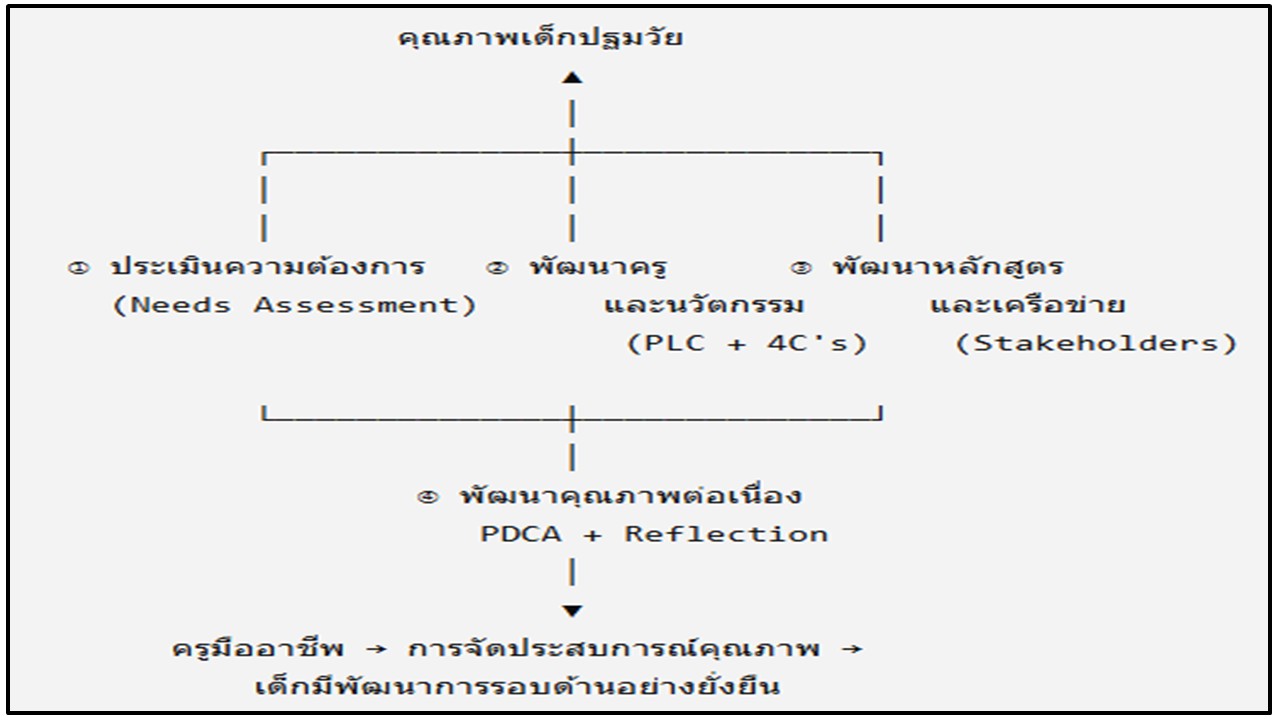
The research objectives were to conduct a needs assessment, determine needs priorities, and propose suggestions for professional competency development for child care teachers at child development centers under local government organizations. Study sample comprised 397 child care teachers. The reliability of the questionnaire was determined using Cronbach's alpha coefficient, yielding an overall value of 0.96, and a focus group discussion guideline. Data analysis employed techniques such as frequency distribution, percentages, means, standard deviations, the Modified Priority Needs Index, and content analysis. Research results are the following: 1. indicating the needs for child care teacher for all dimensions of professional competency development; 2) needs priority for development in descending order are learner's development, curriculum and teaching management, quality service, and morality and ethics; 2. key suggestions for competency development are 1) teacher development enabling actual new learning process management techniques suitable for the 21st Century such as Web-Based Learning, Project-Based Learning, Student-Center Learning, Self-Directed Learning, Collaborative Learning, and Problem-Based Learning; 2) development on learning and innovation skills suitable for real life 21st Century -- 4C's: creativity and innovation, critical thinking and problem solving, communication, and collaboration, and 3) development of curriculum and learning as (1) vision formulation oriented to 4C's, (2) community of collaboration building among stakeholders to feel ownership by shared vision design, (3) child develop center system building for shared vision towards 4C's; (4) making 4C's as professional development framework, (5) injecting 4C's in curriculum and evaluation, (6) encouraging all teachers to instruct according to 4C's, and (7) building sustainable 4C's development culture.
Article Details

This work is licensed under a Creative Commons Attribution-NonCommercial-NoDerivatives 4.0 International License.
References
กนกพร จันทร์สุวรรณ. (2566). แนวทางการพัฒนาวิชาชีพครูปฐมวัยขององค์กรปกครองส่วนท้องถิ่น. วารสารการบริหารการศึกษา, 17(2), 45–60.
ณัฐภัสสร ชื่นสุขสมหวัง. (2556). การประเมินความต้องการจำเป็นเพื่อพัฒนาสมรรถนะทางวิชาชีพของครูปฐมวัย. วิทยานิพนธ์ปริญญาครุศาสตรมหาบัณฑิต สาขาวิชาการศึกษาปฐมวัย ภาควิชาหลักสูตรและการสอน คณะครุศาสตร์ จุฬาลงกรณ์มหาวิทยาลัย.
ผู้จัดการออนไลน์. (2554). ครูปฐมวัยมีปัญหาอื้อ แนะปรับตามสิ่งแวดล้อม. Retrieved 20/1/2555 http://www.manager.co.th/.
พิมพันธ์ เดชะคุปต์ และพรทิพย์ แข็งขัน. (2551). รายงานการวิจัย สมรรถนะครูและแนวทางพัฒนา ครูในสังคมที่เปลี่ยนแปลง. กรุงเทพมหานคร: พริกหวานกราฟฟิค.
เยาวมาลย์ วิเศษ. (2548). ปัญหาและความต้องการพัฒนาของครูปฐมวัยโรงเรียนในสังกัดคณะ นักบวชในเขตอัครสังฆมณฑลกรุงเทพฯ. วิทยานิพนธ์ปริญญามหาบัณฑิต สาขาการศึกษาปฐมวัย มหาวิทยาลัย ศรีนครินทรวิโรฒ.
สถาบันพัฒนาครู คณาจารย์และบุคลากรทางการศึกษา. (2549). การประเมินสมรรถนะครูและบุคลากรทางการศึกษาเพื่อจัดทำแผนพัฒนาตนเอง (ID-PLAN) และแผนพัฒนาความก้าวหน้าทางวิชาชีพ (CAREER PLAN). นครปฐม: ฝ่ายวิชาการโครงการพัฒนาระบบการพัฒนาครูและบุคลากรทางการศึกษา.
สำนักงานเลขาธิการคุรุสภา. (2548). มาตรฐานวิชาชีพทางการศึกษา. กรุงเทพมหานคร: โรงพิมพ์คุรุสภาลาดพร้าว.
สำนักงานเลขาธิการสภาการศึกษา. (2557). สภาวะการศึกษาไทย ปี 2555/2556 ปัญหาความเสมอภาคและคุณภาพของการศึกษาไทย. กรุงเทพมหานคร: วี.ที.ซี. คอมมิวนิเคชั่น.
อรุษา ผดุงตรา, ปวีณา นนทสุวรรณ, และชนิดา ภูมิวัฒนา. (2565). สมรรถนะสำคัญของครูปฐมวัยในศตวรรษที่ 21. วารสารวิทยาการศึกษา, 16(1), 88–102.
Darling-Hammond, L., Hyler, M. E., & Gardner, M. (2022). Effective teacher professional development. Learning Policy Institute.
Friessen S. and Gifford P. (2012). Handbook of Demonstrations and Activities in the Teaching of Psychology. Lawrence Erlbaum Associates , Inc., Publishers.
Fullan, M. (2023). The new meaning of educational change (6th ed.). Teachers College Press.
Lee, J., & Kim, H. (2023). Effects of project-based learning on young children's problem-solving skills and collaboration. Early Childhood Education Journal, 51(2), 345–358.
OECD. (2023). Early childhood education and care policy review: Building strong systems for all. OECD Publishing.
Office of Early Childhood Development Virginia Department of Social Services. (2008). Competencies for early childhood professionals virginia’s early childhood development alignment project. Virginia: Office of Early Childhood Development Virginia Department of Social Services.
Omotuyole, C., & Okudo, A. R. (2014). Professional development of early childhood and language education teachers for sustainable development. IORS Journal of Research & Method in Education(Mar-Apr 2014), 1-16.
SEMAO INNOTECH. (2012). RSU : Contract signing on UNESCO EFA study Project. Retrieved January 10,2013 from http://www.seameo-innotech.org/contents/news?id=112011-SiIc.
UNESCO. (2023). Global report on teachers: The teaching profession in the age of AI and digitalization. UNESCO Publishing.
