
The Development of an Integrated Proactive Management Model Using a Digital System to Promote Reading Habits among Students in Schools under the Chonburi Primary Educational Service Area Office 2
Article Sidebar
Main Article Content
Abstract
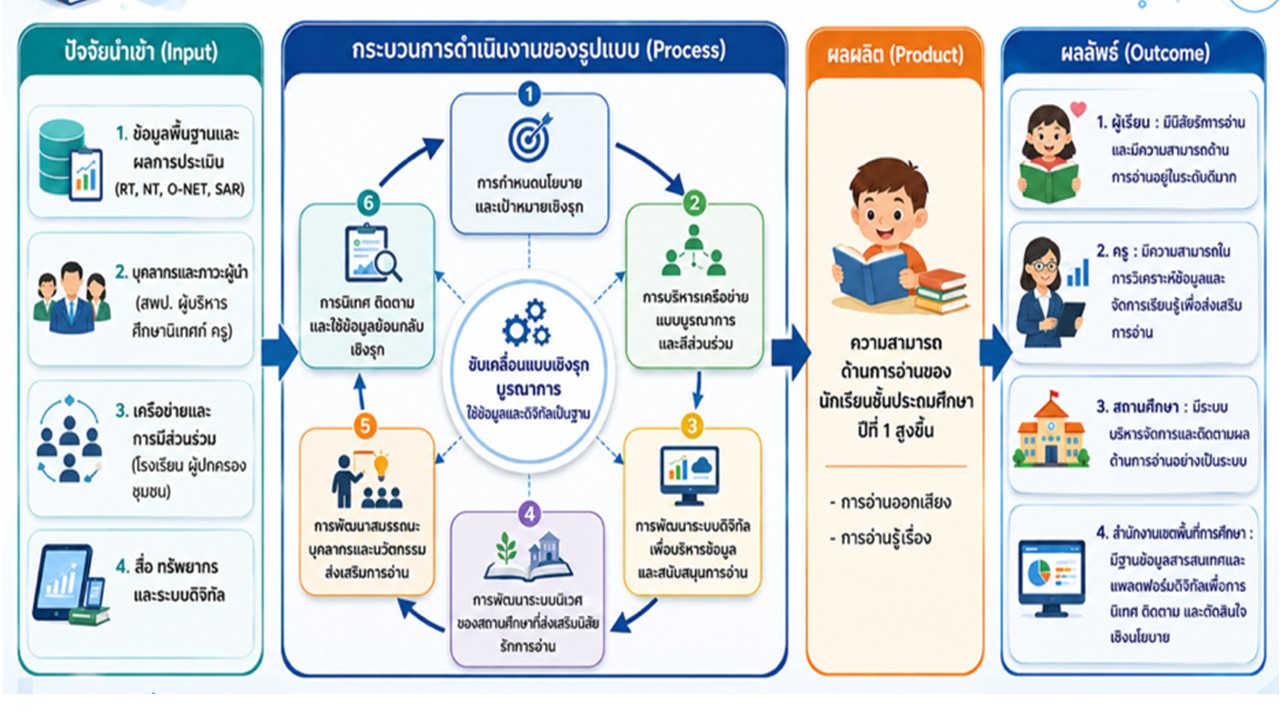
This research aimed to: (1) examine the current and desired conditions for the development of an integrated proactive management model using a digital system; (2) develop an integrated proactive management model using a digital system; (3) investigate the results of implementing the model; and (4) evaluate and refine the implementation of the model to promote reading habits among students in schools under the Chonburi Primary Educational Service Area Office 2. The participants consisted of 232 educational supervisors, school administrators, and Thai language teachers from schools under the Chonburi Primary Educational Service Area Office 2, selected through purposive sampling. The study employed a research and development methodology comprising four phases: (1) examining the current and desired conditions; (2) developing the model; (3) investigating the results of the model implementation; and (4) evaluating and refining the model implementation. The research instruments included a rating-scale questionnaire, a semi-structured interview protocol, and a model evaluation form assessing accuracy, appropriateness, feasibility, and utility. The data were analyzed using frequency, percentage, mean, standard deviation, and PNImodified. The findings were as follows: 1. The integrated proactive management model using a digital system to promote reading habits among students in schools under the Chonburi Primary Educational Service Area Office 2 consisted of six components, ranked according to their priority needs for development: 1) Development of digital systems for data management and reading support; 2) Proactive supervision, monitoring, and feedback; 3) Proactive policy and goal setting; 4) Integrated and participatory network management; 5) Development of personnel competencies and reading-promotion innovations; and 6) Development of a school ecosystem that fosters a love of reading. 2. The developed model comprised four input factors, six process factors, and a performance component consisting of five output dimensions and four outcome dimensions. The overall evaluation results regarding the accuracy and feasibility of the model were at the highest level. 3. The results of the model implementation revealed that all six output dimensions and four outcome dimensions achieved the predetermined target values. 4. The overall evaluation results following the implementation and refinement of the model, in terms of appropriateness, utility, and stakeholder satisfaction, were at the highest level.
Keywords: Integrated Proactive Management, Digital System, Reading Habits, Educational Administration
Article Details

This work is licensed under a Creative Commons Attribution-NonCommercial-NoDerivatives 4.0 International License.
References
กระทรวงศึกษาธิการ. (2551). หลักสูตรแกนกลางการศึกษาขั้นพื้นฐาน พุทธศักราช 2551. กรุงเทพฯ: โรงพิมพ์ชุมนุมสหกรณ์การเกษตรแห่งประเทศไทย.
พระราชบัญญัติการศึกษาแห่งชาติ พ.ศ. 2542. (2542, 19 สิงหาคม). ราชกิจจานุเบกษา, 116(74 ก), 1–23.
พระราชบัญญัติการศึกษาแห่งชาติ (ฉบับที่ 2) พ.ศ. 2545. (2545, 19 ธันวาคม). ราชกิจจานุเบกษา, 119(123 ก), 16–21.
สำนักงานคณะกรรมการการศึกษาขั้นพื้นฐาน. (2565). แนวทางการจัดกิจกรรมส่งเสริมการอ่าน เพื่อแก้ปัญหาภาวะถดถอยทางการเรียนรู้และส่งเสริมสนับสนุนการเรียนการสอน. กรุงเทพฯ: สำนักวิชาการและมาตรฐานการศึกษา.
สำนักงานเขตพื้นที่การศึกษาประถมศึกษาชลบุรี เขต 2. (2566). สรุปผลการประเมินความสามารถด้านการอ่านของผู้เรียน (Reading Test: RT) ชั้นประถมศึกษาปีที่ 1 ปีการศึกษา 2565. ชลบุรี: ผู้แต่ง.
Anderson-Butcher, D., Bates, S., Lawson, H. A., Childs, T. M., & Iachini, A. L. (2022). The community collaboration model for school improvement: A scoping review. Education Sciences, 12(12), 918. doi:10.3390/educsci12120918
Crant, J. M. (2000). Proactive behavior in organizations. Journal of Management, 26(3), 435–462. doi:10.1177/014920630002600304
Damschroder, L. J., Reardon, C. M., Opra Widerquist, M. A., & Lowery, J. (2022). The updated Consolidated Framework for Implementation Research based on user feedback. Implementation Science, 17, 75. doi:10.1186/s13012-022-01245-0
Darling-Hammond, L., Hyler, M. E., & Gardner, M. (2017). Effective teacher professional development. Palo Alto, CA: Learning Policy Institute.
Delgado, P., Vargas, C., Ackerman, R., & Salmerón, L. (2018). Don’t throw away your printed books: A meta-analysis on the effects of reading media on reading comprehension. Educational Research Review, 25, 23–38. doi:10.1016/j.edurev.2018.09.003
Graham, C. R. (2006). Blended learning systems: Definition, current trends, and future directions. In C. J. Bonk & C. R. Graham (Eds.), The handbook of blended learning: Global perspectives, local designs (pp. 3–21). San Francisco, CA: Pfeiffer.
Kraft, M. A., Blazar, D., & Hogan, D. (2018). The effect of teacher coaching on instruction and achievement: A meta-analysis of the causal evidence. Review of Educational Research, 88(4), 547–588. doi:10.3102/0034654318759268
Mandinach, E. B., Honey, M., & Light, D. (2006, April). A theoretical framework for data-driven decision making. Paper presented at the annual meeting of the American Educational Research Association, San Francisco, CA.
Mandinach, E. B., & Schildkamp, K. (2021). Misconceptions about data-based decision making in education: An exploration of the literature. Studies in Educational Evaluation, 69, 100842. doi:10.1016/j.stueduc.2020.100842
Organisation for Economic Co-operation and Development. (2019). PISA 2018 assessment and analytical framework. Paris, France: OECD Publishing. doi:10.1787/b25efab8-en
Organisation for Economic Co-operation and Development. (2023). OECD digital education outlook 2023: Towards an effective digital education ecosystem. Paris, France: OECD Publishing. doi:10.1787/c74f03de-en
Parker, S. K., Bindl, U. K., & Strauss, K. (2010). Making things happen: A model of proactive motivation. Journal of Management, 36(4), 827–856. doi:10.1177/0149206310363732
Ryan, R. M., & Deci, E. L. (2000). Self-determination theory and the facilitation of intrinsic motivation, social development, and well-being. American Psychologist, 55(1), 68–78. doi:10.1037/0003-066X.55.1.68
Sankaran, S., & Saad, N. (2022). Evaluating the Bachelor of Education program based on the context, input, process, and product model. Frontiers in Education, 7, 924374. doi:10.3389/feduc.2022.924374
Schildkamp, K. (2019). Data-based decision-making for school improvement: Research insights and gaps. Educational Research, 61(3), 257–273. doi:10.1080/00131881.2019.1625716
Troyer, M., Kim, J. S., Hale, E., Wantchekon, K. A., & Armstrong, C. (2019). Relations among intrinsic and extrinsic reading motivation, reading amount, and comprehension: A conceptual replication. Reading and Writing, 32(5), 1197–1218.
United Nations Educational, Scientific and Cultural Organization. (2006). Education for all global monitoring report 2006: Literacy for life. Paris, France: UNESCO.
van der Sande, L., van Steensel, R., Fikrat-Wevers, S., & Arends, L. (2023). Effectiveness of interventions that foster reading motivation: A meta-analysis. Educational Psychology Review, 35, 21. doi:10.1007/s10648-023-09719-3
Vial, G. (2019). Understanding digital transformation: A review and a research agenda. The Journal of Strategic Information Systems, 28(2), 118–144. doi:10.1016/j.jsis.2019.01.003
Weiner, B. J., Lewis, C. C., Stanick, C., Powell, B. J., Dorsey, C. N., Clary, A. S., … Halko, H. (2017). Psychometric assessment of three newly developed implementation outcome measures. Implementation Science, 12, 108. doi:10.1186/s13012-017-0635-3
Wenger, E. (1998). Communities of practice: Learning, meaning, and identity. Cambridge, England: Cambridge University Press.
