
กระบวนการบริหารในยุคพลิกผัน
Article Sidebar
Main Article Content
บทคัดย่อ
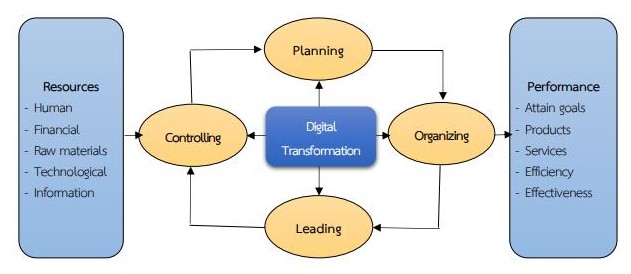
กระบวนการบริหารในยุคพลิกผันเป็นการขับเคลื่อนการดำเนินงานที่มุ่งเน้นการประยุกต์ใช้เทคโนโลยีดิจิทัลโดยใช้กระบวนการเปลี่ยนแปลงสู่องค์การดิจิทัล ได้แก่ ความชัดเจน ความร่วมมือ ความสามารถ และวัฒนธรรมดิจิทัลเป็นกลไกสำคัญในการวางแผน การจัดองค์การ การนำ และการควบคุม เพื่อนำไปสู่การบรรลุเป้าหมายองค์การได้อย่างมีประสิทธิภาพและประสิทธิผล
Article Details
เอกสารอ้างอิง
กมลวรรณ จันทร และศัลสนีย์ จะสุวรรณ์. (2564). การบริหารสถานศึกษายุคโลกพลิกผัน ฉลาดรู้เท่าทันดิจิทัล. เอกสารการประชุมวิชาการนำเสนอผลงานวิจัยระดับชาติและนานาชาติ ครั้งที่ 14 "Global Goals, Local Actions: Looking Back and Moving Forward 2021" http://journalgrad.ssru.ac.th/index.php/8thconference/article/view/2524
วิจิตร ศรีสอ้าน และคณะ. (2535). หลักและระบบบริหารการศึกษา. กรุงเทพฯ: มหาวิทยาลัยสุโขทัยธรรมาธิราช.
วิชัย จันทร์จำรูญ, บุญจักรวาล รอดบำเรอ, วิราภรณ์ ส่งแสง, และสุกิจ โพธิ์ศิริกุล (2565). แนวทางการเรียนรู้แบบผสมผสาน: การหลอมรวมเทคโนโลยีและการสอน. วารสารครุศาสตร์ปัญญา, 4(5), 69-78.
วิโรจน์ สารรัตนะ. (2557). แนวคิด ทฤษฎี และประเด็นเพื่อการบริหารทางการศึกษา. กรุงเทพฯ: สํานักพิมพ์ซีเอ็ดบุ๊คเซ็นเตอร์.
สัมฤทธิ์ กางเพ็ง. (2560). ภาวะผู้นำทางหลักสูตร: กลยุทธ์การพัฒนาและนำหลักสูตรไปใช้. พิมพ์ครั้งที่ 2. มหาสารคาม: อภิชาติการพิมพ์.
สำนักงานกองทุนสนับสนุนการสร้างเสริมสุขภาพ (สสส.). (2563). ความลาดทางดิจิทัล (DQ Digital Intelligence). ปทุมธานี : วอล์ค ออน คลาวด์. http://cclickthailand.com/wp-content/uploads/2020/04/dq_FINAL.pdf
อาภาพร สิงหราช และไสว ฟักขาว. (2565). บทบาทใหม่ของนักการศึกษาในโลกที่พลิกผัน. วารสารธรรมศาสตร์, 41(1), 242-261.
Addarich, J.R. (2022). Academic Challenges of Virtual Classes During the Pandemic: Elementary ESL Teacher’s Perspective. In S.Charles Malka, and Robert H. Tiell (Eds.), Back to a New Normal: Search of Stability in an Era of Pandemic Disruption-Insight From Practitioners and Academics. Charlotte: Age Publishing.
Bartol, K., Martin, D., Tein, M., & Matthews, G. (1998). Management: A Pacific rim focus. 2nded. Roseville NSW: McGrawHill.
Daft, R.L. (2012). Management. 10thed. Mason, OH: South-Western.
Drucker, P.F. (1999). The Effective Executive. Oxford: Butterworth-Heinemann.
Good, A. (1979). Dictionary of Education. New York: McGraw – Hill.
Griffin, R.W. (2013). Management. 11thed. Mason, OH: South-Western.
Hersey, P., Blanchard, K.H., and Johnson, D.E. (2001). Management of Organizational Behavior: Leading Human Resources. 8thed. New Jersey: Prentice Hall.
Lunenburg, F.C., & Ornstein, A.C. (2004). Educational administration: Concepts and practices. 4thed. Belmont: Wadworth.
Lussier, R.N. (2012). Management Fundamentals: Concepts, application, skill development. Mason, OH: South-Western.
Owens, R.G. (2001). Organizational Behavior in Education: Instructional Leadership and school Reform. 7thed. Boston: Allyn and Bacon.
Robbins, S.P. and Coulter, M. (2012). Management. 11thed. New Jersey: Prentice Hall.
Samson, D. & Daft, R.L. (2012). Management. Fourth Asia Pacific edition. Mason, OH: South-Western.
Schermerhorn, J.R. (2011). Management. 11thed. Hobogen, NJ: John Wiley & Sons.
Sergiovanni T.J., Burlingame, M. and Coomb, F.S. (1992). Educational Governance and Administration, 3rd ed., Needham Heights, MA: Allyn and Bacon.
Simon, H.A. (1997). Administrative behavior: a study of decision-making processes in administrative organizations. 4thed. New York: Free Press.
