
แนวทางการออกแบบลำดับการสอนของนักศึกษาครูในชั้นเรียนคณิตศาสตร์ ที่ใช้วิธีการแบบเปิด
Article Sidebar
Main Article Content
บทคัดย่อ
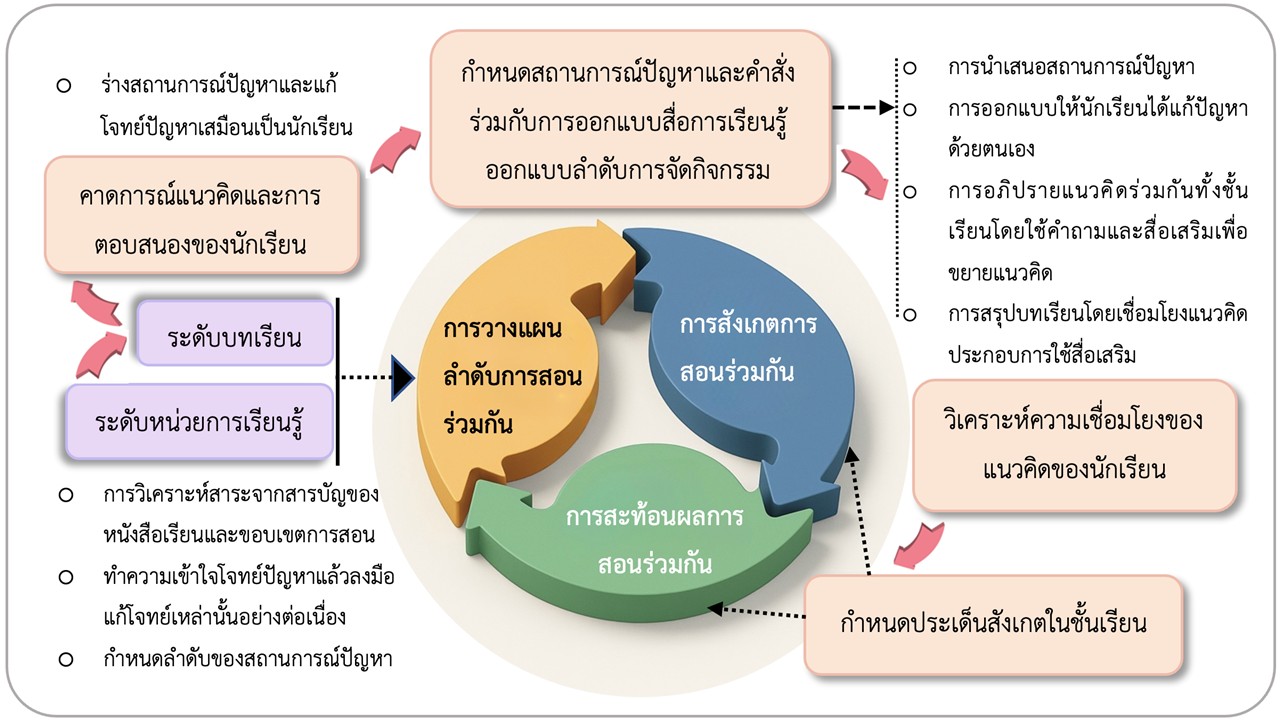
การวิจัยนี้ใช้ระเบียบวิธีวิจัยเชิงคุณภาพเพื่อวิเคราะห์แนวทางการออกแบบลำดับการสอนในชั้นเรียนคณิตศาสตร์ที่ใช้วิธีการแบบเปิด กลุ่มเป้าหมายคือ นักศึกษาครูชั้นปีที่ 4 สาขาวิชาคณิตศาสตร์ คณะครุศาสตร์ จำนวน 4 คน เก็บข้อมูลด้วยการสังเกตแบบมีส่วนร่วม การสัมภาษณ์เชิงลึก การบันทึกวีดิทัศน์ และการวิเคราะห์เอกสาร วิเคราะห์และนำเสนอข้อมูลด้วยการวิเคราะห์เนื้อหาตามแนวคิดเคียวไซเคงคิวและตรวจสอบข้อมูลสามเส้าด้านวิธีรวบรวมข้อมูล ผลการวิจัยพบว่า แนวทางการออกแบบลำดับการสอนของนักศึกษาครูแบ่งเป็น 2 ระดับของการปฏิบัติ ได้แก่ 1) ระดับหน่วยการเรียนรู้ เริ่มจากการวิเคราะห์สาระจากสารบัญของหนังสือเรียน ทำความเข้าใจโจทย์ปัญหาแล้วลงมือแก้โจทย์เหล่านั้นอย่างต่อเนื่อง จากนั้นจึงกำหนดลำดับของสถานการณ์ปัญหาที่จะใช้ในหน่วยการเรียนรู้นั้น 2) ระดับบทเรียน เริ่มจากการกำหนดสถานการณ์ปัญหาพร้อมคำสั่งที่ชัดเจน คาดการณ์แนวคิดและการตอบสนองของนักเรียน วิเคราะห์ความเชื่อมโยงของแนวคิดระหว่างบทเรียน และออกแบบกิจกรรมการเรียนรู้เป็นช่วงตาม 4 ขั้นตอน ได้แก่ การนำเสนอสถานการณ์ปัญหาที่เชื่อมโยงกับประสบการณ์ของนักเรียน การออกแบบให้นักเรียนได้แก้ปัญหาด้วยตนเอง การอภิปรายแนวคิดร่วมกันทั้งชั้นเรียนโดยใช้คำถามและสื่อเสริมเพื่อขยายแนวคิด และการสรุปบทเรียนโดยเชื่อมโยงแนวคิดประกอบการใช้สื่อเสริม จากนั้น กำหนดประเด็นสังเกตในชั้นเรียนโดยมุ่งเน้นไปที่การตอบสนองของนักเรียนต่อสถานการณ์ปัญหา
Article Details

อนุญาตภายใต้เงื่อนไข Creative Commons Attribution-NonCommercial-NoDerivatives 4.0 International License.
เอกสารอ้างอิง
ไกรวุฒิ เทศประสิทธิ์ และนฤมล ช่างศรี. (2566). การพัฒนาแผนการจัดการเรียนรู้ เรื่องน้ำหนักตาม กระบวนการ KYOZAI KENKYU ของนักเรียนชั้นประถมศึกษาปีที่ 3. วารสาร มจร สังคมศาสตร์ ปริทรรศน์, 12(1), 55-67.
เจนสมุทร แสงพันธ์ และพีระกฤตย์ กันไชยศักดิ์. (2560). จากโลกกายภาพสู่โลกสัญลักษณ์: กระบวนการ
เรียนรู้เรื่องการบวกของนักเรียนชั้นประถมศึกษาปีที่ 1 ในชั้นเรียนที่สอนด้วยวิธีการแบบเปิด. ศึกษาศาสตร์สาร มหาวิทยาลัยเชียงใหม่, 1(1), 53–67.
ไมตรี อินทร์ประสิทธิ์ และคณะ. (2553). คณิตศาสตร์ระดับชั้นประถมศึกษา ชั้นประถมศึกษาปีที่ 3 เล่ม 1 (ฉบับแปลภาษาไทย). คลังนานาวิทยา.
ไมตรี อินทร์ประสิทธิ์. (2557). กระบวนการแก้ปัญหาในคณิตศาสตร์ระดับโรงเรียน. เพ็ญพริ้นติ้ง.
ไมตรี อินทร์ประสิทธิ์. (2561). พื้นฐานการจัดการเรียนการสอนคณิตศาสตร์สำหรับศตวรรษที่ 21 ระดับ ประถมศึกษา. สถาบันวิจัยและพัฒนาวิชาชีพครูสำหรับอาเซียน.
สำนักงานเลขาธิการสภาการศึกษา. (2561). การพัฒนากลไกขับเคลื่อนระบบการผลิตและพัฒนาครูสมรรถนะ สูงสำหรับประเทศไทย 4.0. พริกหวานกราฟฟิค จำกัด.
เริงนภา อำทะวงษ์, เกียรติ แสงอรุณ และสัมพันธ์ ถิ่นเวียงทอง. (2565, เมษายน-มิถุนายน). การวิเคราะห์ องค์ประกอบการออกแบบแผนการจัดการเรียนรู้ที่เน้นแนวคิดของนักเรียนในการปฏิบัติการสอนที่ใช้ การศึกษาชั้นเรียนและวิธีการแบบเปิดเพื่อเรียนรู้แนวคิดของนักเรียน. วารสารวิชาการธรรมทรรศน์, 22(2), 97-112.
Doig, B., & Groves, S. (2011). Japanese lesson study: Teacher professional development through communities of inquiry. Mathematics Teacher Education and Development, 13(1), 77-93.
Fujii, T. (2016). Designing and adapting tasks in lesson planning: A critical process of lesson study. ZDM Mathematics Education, 48(4), 411–423.
Intaros, P., & Inprasitha, M. (2019). How students’ mathematical ideas emerged through flow of lesson in classroom using lesson study and open approach. Psychology, 10(6),
-876.
Inprasitha, M. (2011). One feature of adaptive lesson study in Thailand: Learning Unit. Journal of Science and Mathematics Education in Southeast Asia, 34(1), 47-66.
Inprasitha, M. (2022), Lesson study and open approach development in Thailand: a longitudinal study, International Journal for Lesson and Learning Studies, 11(5), 1-15.
Isoda, M., & Katagiri, S. (2012). Mathematical thinking: How to develop it in the classroom. World Scientific Publishing.
Melville, M. D., & Corey, D. L. (2021). Kyouzaikenkyuu: An exploration of Japanese mathematics teachers’ daily planning practices. Journal of Mathematics Teacher Education, 25(3), 371-383.
Shinno, Y., & Mizoguchi, T. (2021). Theoretical approaches to teachers’ lesson designs involving the adaptation of mathematics textbooks: Two cases from kyouzai kenkyuu in Japan. ZDM Mathematics Education, 53(6), 1387–1402.
Stigler, J.W. & Hiebert, J. (1999). The teaching gap: best ideas from the world’s teacher for improving education in the classroom. The Free Press.
Takahashi, A., Watanabe, T., Yoshida, M., & Wang-Iverson, P. (2005). Improving content and pedagogical knowledge through kyouzaikenkyu. In P. Wang-Iverson & M. Yoshida (Eds.), Building our understanding of lesson study (pp. 101-110). Philadelphia, PA: Research for Better Schools Inc.
Tall, D. (2004). Thinking through three worlds of mathematics. In M. J. Høines & A. B. Fuglestad (Eds.), Proceedings of the 28th Conference of the International Group for the Psychology of Mathematics Education (PME): Vol. 4. (pp. 281–288). Bergen University College.
Thornton, S., Inprasitha, M., Ruiz, A., Isoda, M., Changsri, N., & Tripet, K. (2023). Towards a model for monitoring and evaluating curricula reforms. In Y. Shimizu & R. Vithal (Eds.), Mathematics curriculum reforms around the world: The 24th ICMI Study (pp. 261-289). Springer International Publishing.
