
Coaching Leadership on Scientific Research Team Innovation Performance in Private Undergraduate Universities in Shaanxi Province
Article Sidebar
Main Article Content
บทคัดย่อ
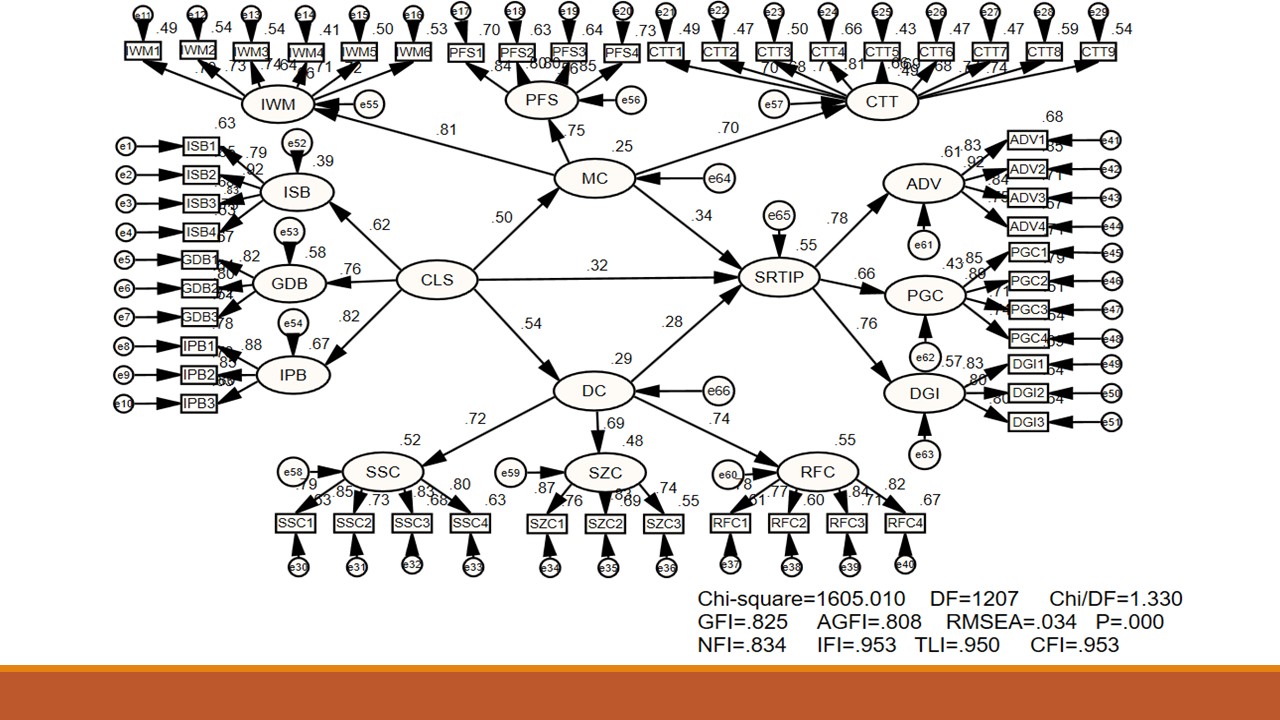
The research objectives of this dissertation were: 1) To explore the components and indicators of coaching leadership and scientific research team innovation performance. 2) To study the direct and indirect relationship between coaching leadership and scientific research team innovation performance. 3) To develop practical management guidelines to improve scientific research team innovation performance in private undergraduate universities in Shaanxi Province. This research combined quantitative and qualitative research methods. The sample comprised 283 leaders and members of research teams from 21 private undergraduate universities in Shaanxi. Stratified sampling was used to collect data through IOC tools, five-point scale questionnaires, and focus group interviews. The questionnaire recovery rate was 100% valid. Data analysis was carried out via CFA and SEM to explore the mechanism of CLS on the SRTIP.. Stratified sampling was used to collect data through IOC tools, five-point scale questionnaires, and focus group interviews. The questionnaire recovery rate was 100% valid. Data analysis was conducted using CFA and SEM to explore the mechanism by which CLS affects the SRTIP. The research findings revealed that: 1) The leadership style and scientific research team innovation performance model included four first-level components: coaching leadership, member creativity, dynamic competence, and scientific research team innovation performance, covering 12 second-level components and 51 measurement indicators; 2) CLS directly and positively impacted SRTIP, and also indirectly affected it through MC and DC; 3) Focus-group analysis revealed the management awareness of private universities in Shaanxi under institutional constraints and resource differences. The research confirmed the mechanism of CLS and mediating variables and put forward management guidelines based on this.
Keywords: Coaching Leadership, Scientific Research Team Innovation Performance, Private Undergraduate Universities, Shaanxi Province
Article Details

อนุญาตภายใต้เงื่อนไข Creative Commons Attribution-NonCommercial-NoDerivatives 4.0 International License.
เอกสารอ้างอิง
Chen,S.L.(2017).The mechanism of collectivist human resource practices on the innovation performance of research teams. Science and Technology Progress and Policy,34(5), 142-147.
Chien,S.Y.,&Tsai,C.H.(2012).Dynamic capability, knowledge, learning, and firm performance. Journal of Organizational Change Management,25(3), 434-444.
Davis.(2024).The Coaching Leadership Style (CLS). Advances in logistics, operations, and management science book series, 137-166.
Lee, P. Y., Li, C. S. J., & Wu, M. L. (2017). The roles of cross-cultural adjustment and social capital formation in dynamic capability development of multiunit organizations. Asia Pacific Management Review, 22(4), 851-862.
Meng,S.Y.(2022).The impact of flexible human resource management on the innovative performance of humanities and social science research teams in universities.(Doctoral dissertation, Liaoning University of Engineering and Technology).
Miao, R. T., Wang, B., & Liu, J. (2016). High-performance work systems and team innovation performance: A moderated mediation model. Science and Technology Management Research, 36(18), 110–115, 131.
Richard, E., Boyatzis, R. E., Liu, H., Smith, A., Zwygart, K., & Quinn, J. (2023). Competencies of coaches that predict client behavior change. The Journal of Applied Behavioral Science, 59(2), 210–230.
Schulze,D.,& Pohl,S.(2021).Finding clusters of measurement invariant items for continuous covariates.Structural Equation Modeling:A Multidisciplinary Journal,28(2),219-228.
Sun, H. (2024). Leadership style, employee job satisfaction and organizational culture: Basis for employee innovation behavior framework. International Journal of Research Studies in Management, 12(3), 45–60.
Theeboom,T., Beersma, B., & van Vianen, A. E. (2014). Does coaching work? A meta-analysis on the effects of coaching on individual level outcomes in an organizational context. The Journal of Positive Psychology,9(1), 1-18.
Wang, H. Y., & Cui, Z. S. (2018). How does coaching leadership promote employee work redesign? A multilevel moderated mediation model. Jiangsu Social Science, (2), 61–71.
Wang, M. H., & Liu, E. K. (2021). The cultivation of undergraduate top-notch innovative talents based on Makerspace: Why and what. Higher Engineering Education Research, (4), 188–194.
Wilden, R., Devinney, T. M., & Dowling, G. R. (2016). Dynamic capability and performance: Strategy, structure and environment. Long Range Planning, 49(1), 42–58.
