
Guidelines for Developing Workplace Happiness among Private University Teachers in Bangkok
Article Sidebar
Main Article Content
บทคัดย่อ
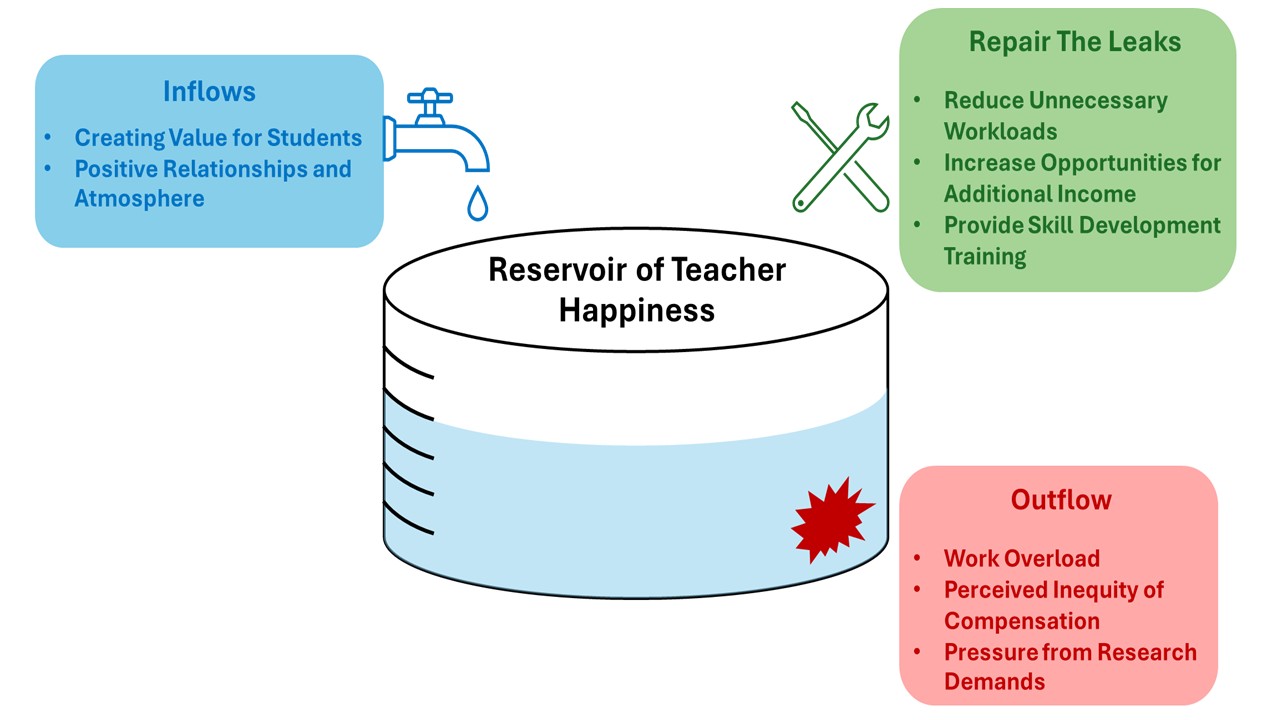
This study aims to synthesize and propose practical, evidence-based guidelines to enhance the workplace happiness of teachers at private universities in Bangkok, Thailand. The research derives actionable strategies directly from open-ended suggestions from a large sample of teachers. A qualitative approach was employed, using content analysis of responses to open-ended questions from a survey administered to 400 teachers at private universities in Bangkok. The questions were designed to identify the most significant drivers of happiness, the primary obstacles encountered, and practical recommendations for institutional improvement. The analysis of 400 responses revealed that the most crucial factors for happiness are intrinsic and social: "creating value for students" (19.68%) and "positive workplace relationships" (18.64%). Conversely, the primary obstacles are structural: "excessive workload and administrative tasks" (24.59%) and "compensation that is incongruent with the workload" (20.00%). The key recommendations provided by the teachers included "reducing unnecessary workloads" (16.57%), "providing additional skill development training" (14.53%), and "increasing opportunities for additional income" (13.66%). Based on these direct insights from 400 teachers, a five-point framework of actionable guidelines is proposed for university administrators. The recommendations focus on: 1) reviewing workload structures, 2) improving compensation, 3) fostering a positive culture, 4) recognizing the value of the teaching role, and 5) providing relevant training. This study offers a targeted, data-driven policy framework for institutions seeking to improve teacher well-being, motivation, and retention.
Keywords: Workplace Happiness, Private University, Teachers
Article Details

อนุญาตภายใต้เงื่อนไข Creative Commons Attribution-NonCommercial-NoDerivatives 4.0 International License.
เอกสารอ้างอิง
Chapman, D. W., & Hutcheson, S. M. (1982). Attrition from teaching careers: A discriminant analysis. American Educational Research Journal, 19(1), 93-105.
Chapman, D. W., & Hutcheson, S. M. (1982). Attrition from teaching careers: A discriminant analysis. American Educational Research Journal, 19(1), 93-105.
Herzberg, F. (1966). Work and the nature of man. Cleveland, OH: World Publishing Company.
Khamkhong, M. (2018). Factors affecting professional quality of life of university lecturers in Thailand. Kasetsart Journal of Social Sciences, 39(3), 566-571.
Lacy, F. J., & Sheehan, B. A. (1997). Job satisfaction among academic staff: An international perspective. Higher Education, 34(3), 305-322.
Maslow, A. H. (1943). A theory of human motivation. Psychological Review, 50(4), 370-396.
Office of the Higher Education Commission. (2019). Higher education statistics. Ministry of Higher Education, Science, Research and Innovation.
Pitanuwat, S. (2013). The happiness of private university lecturers in Thailand. Procedia-Social and Behavioral Sciences, 88, 78-83.
Pitanuwat, S. (2013). The happiness of private university lecturers in Thailand. Procedia-Social and Behavioral Sciences, 88, 78-83.
Santhong, S. (2020). Happiness in working of lecturers in private higher education institutions in Bangkok (Master's thesis). Ramkhamhaeng University, Bangkok, Thailand.
Sarros, J. C., & Sarros, A. M. (1992). Social support and job satisfaction in Australian and Canadian university staff. Higher Education, 23(3), 285-300.
