
Mediating Effect of Organizational Climate on the Relationship Between Principals’ Personality Traits and Informational Leadership in Kindergartens in Anshan City, Liaoning Province
Article Sidebar
Main Article Content
บทคัดย่อ
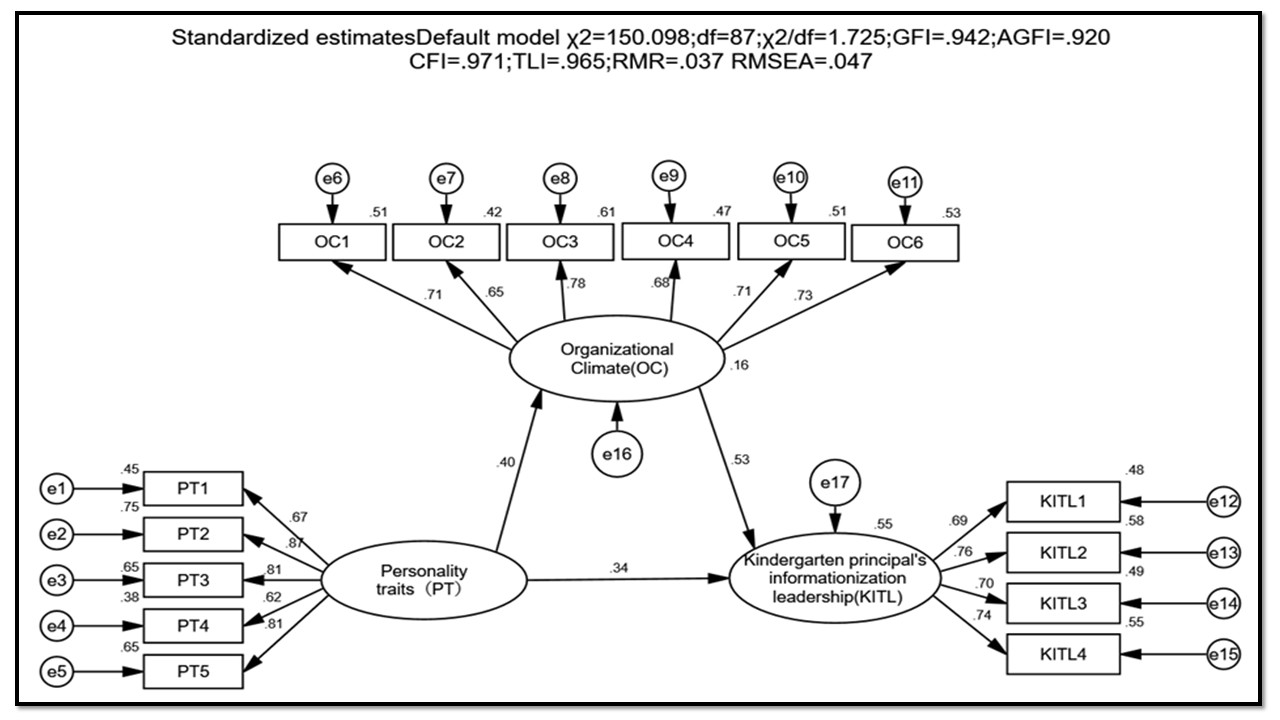
This study aimed: (1) to develop a structural equation model (SEM) explaining the relationships among principals’ personality traits, organizational climate, and informational leadership in kindergartens in Anshan City, Liaoning Province; and (2) to examine both the direct and indirect effects of principals’ personality traits on informational leadership, with particular emphasis on the mediating role of organizational climate. A mixed-methods research design was employed. The target population consisted of 2,091 kindergarten principals in Anshan City. A stratified random sampling technique was used, and a sample size of 325 was determined using a statistical power analysis program. Data were collected through a five-point Likert-scale questionnaire. Descriptive statistics, confirmatory factor analysis (CFA), and structural equation modeling (SEM) were conducted using statistical software. The findings revealed that: (1) the proposed mediating model demonstrated an acceptable fit with the empirical data (χ² = 150.098, df = 87, GFI = 0.942, AGFI = 0.920, CFI = 0.971, TLI = 0.965, RMR = 0.037, RMSEA = 0.047); and (2) principals’ personality traits had significant direct effects on both organizational climate and informational leadership. Organizational climate also exerted a significant direct effect on informational leadership. Additionally, personality traits influenced informational leadership indirectly through organizational climate, confirming its mediating role.
Keywords: Personality Traits, Organizational Climate, Informational Leadership, Kindergarten Principals
Article Details

อนุญาตภายใต้เงื่อนไข Creative Commons Attribution-NonCommercial-NoDerivatives 4.0 International License.
เอกสารอ้างอิง
Bass, B. M. (1985). Leadership and performance beyond expectations. Free Press.
Costa, P. T., & McCrae, R. R. (1992). Revised NEO Personality Inventory (NEO-PI-R) and NEO Five-Factor Inventory (NEO-FFI). Psychological Assessment Resources.
Costa, P. T., & McCrae, R. R. (2016). The five-factor model of personality and its relevance to personality disorders. Guilford Press.
Judge, T. A., & Bono, J. E. (2017). Relationship of core self-evaluation traits—Self-esteem, generalized self-efficacy, locus of control, and emotional stability—with job satisfaction and job performance: A meta-analysis. Journal of Applied Psychology, 86(1), 80–92. https://doi.org/10.1037/0021-9010.86.1.80
Makjod, S., Worapongpat, N., Kangpheng, S., & Bhasabutr, P. (2025). Academic administration of the opportunity expansion school under the Prachinburi Primary Educational Service Area Office 1. Journal of Education and Learning Reviews, 2(5), 85–94. https://so19.tci-thaijo.org/index.php/JELS/article/view/963
Schneider, B., & Reichers, A. E. (2016). The effects of climate and personality on leadership performance. Human Resource Management, 23(3), 293–309. https://doi.org/10.1002/hrm.3930230305
Schneider, B., Ehrhart, M. G., & Macey, W. H. (2011). Perspectives on organizational climate and culture. In S. Zedeck (Ed.), APA handbook of industrial and organizational psychology (Vol. 1, pp. 373–414). American Psychological Association.
Schneider, B., Ehrhart, M. G., & Macey, W. H. (2017). Organizational climate and culture. Annual Review of Psychology, 64(1), 361–388. https://doi.org/10.1146/annurev-psych-113011-143809
Stogdill, R. M. (1974). Handbook of leadership. Harvard Business Press.
Van Vianen, A. E., & De Pater, I. E. (2016). Personality traits and organizational climate in educational settings. Journal of Educational Administration, 54(2), 134–154. https://doi.org/10.1108/JEA-09-2015-0063
Wang, H., & Wang, Q. (2019). Status quo and promotion strategy of ICT leadership of primary and secondary school principals. Educational Innovation Research, 19(4), 125–139.
Worapongpat, N. (2025a). Decision-making leadership of school administrators in the Krung Nakhon Chon School Network. Journal of Patanasilpa Academic, 9(1), 1–19. https://so05.tci-thaijo.org/index.php/Patanasilpa/article/view/266292
Worapongpat, N. (2025b). Building collaboration between schools and communities: A case study of multiple schools in Luoyang District. Journal of Education and Learning Reviews, 2(3), 95–104. https://doi.org/10.60027/jelr.2025.1097
Worapongpat, N. (2025c). Integrating interdisciplinary workshop design to advance life skills and leadership among graduate students at private universities in Thailand. Liberal Arts and Social Studies International Journal (LAASSIJ), 1(2), 55–71. https://so18.tci-thaijo.org/index.php/laassij/article/view/1133
Worapongpat, N. (2025d). Building collaboration between educational institutions and communities impacting school management: A case study of Guangzhou Vocational College of Technology, Guangzhou Open University, China. Journal of Education and Learning Reviews, 2(4), 1–12. https://doi.org/10.60027/jelr.2025.1759
Worapongpat, N. (2025e). Patterns of participation in the development of life skills, environment, society, and good governance among educational personnel in public universities through a meditation program in Buddhist sacred lands. Journal of MCU Languages and Cultures, 5(1), 1–22. https://so08.tci-thaijo.org/index.php/JMLC/article/view/4734
Worapongpat, N. (2025f). Academic administration of educational institution administrators in Mueang Ranong District under the jurisdiction of the Secondary Educational Service Area Office, Phang Nga, Phuket, Ranong. KKU International Journal of Humanities and Social Sciences, 15(1), 24–45. https://so04.tci-thaijo.org/index.php/KKUIJ/article/view/270388
Worapongpat, N., & Boonmee, K. (2025). The impact of women's leadership on teachers' feelings of trust in administration in higher education institutions: Universities in Liaoning Province. KKU International Journal of Humanities and Social Sciences, 15(1), 162–197. https://so04.tci-thaijo.org/index.php/KKUIJ/article/view/274357
Worapongpat, N., & Kangpheng, S. (2025). Transformational leadership skills for executives in the digital age: China Polytechnic College. Journal of Education and Learning Reviews, 2(5), 27–44. https://doi.org/10.60027/jelr.2025.931
Worapongphat, N. (2025g). A study of learning achievement in life skills and brain competency of educational personnel in the university: A meditation practice project in the Buddhist holy land of Thailand, India, and Nepal. Khuangphaya Journal, Chiang Mai Rajabhat University, 19(2), 18–35. [in Thai] https://so06.tci-thaijo.org/index.php/khuangpaya/article/view/281757
Wu, M. L. (2018). Structural equation modeling: Operation and application of AMOS. Chongqing University Press.
Yan, J. J. (2018). Strategies for enhancing the informationization leadership of kindergarten principals. Science Press.
Yukl, G. A. (2010). Leadership in organizations (7th ed.). Tsinghua University Press.
Zhang, H. (2007). Individual differences and educational psychology. Educational Research, 28(4), 45–50.
Zhang, H. (2016). Personality traits of kindergarten principals and their impact on educational management. Modern Educational Management, 23(6), 28–32.
Zhang, H. (2017). The impact of agreeableness and openness on interpersonal relationships. Acta Psychologica Sinica, 49(2), 233–240.
Zhao, L. (2018). Information technology adoption in rural kindergartens: Leadership challenges and strategies. China ICT Education Review, 14(3), 60–76.
Zhou, L., & George, A. (2019). Leadership effectiveness and ICT integration in early childhood education. Journal of Educational Research and Development, 14(2), 78–92.
