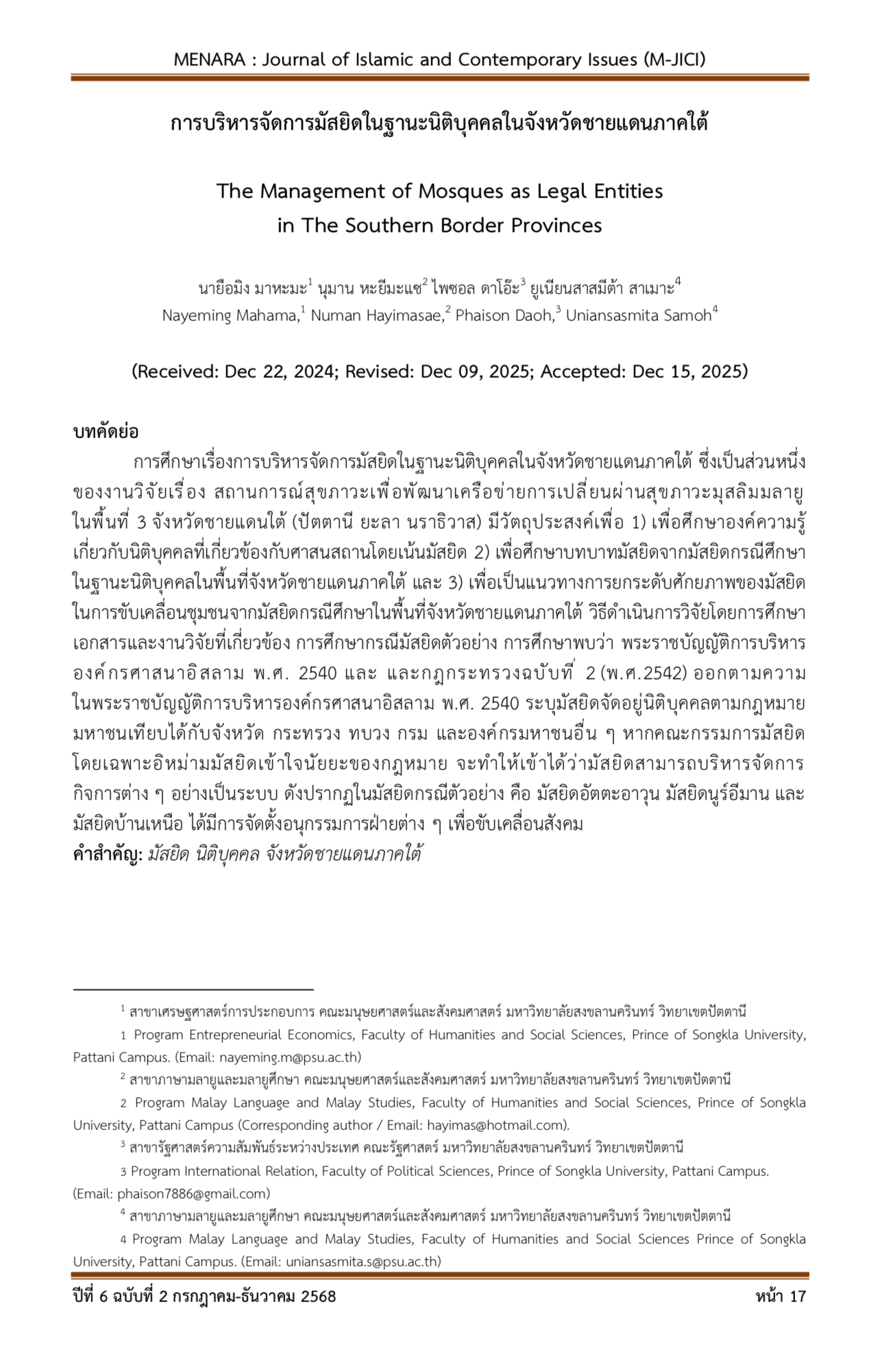
The Management of Mosques as Legal Entities in The Southern Border Provinces
Keywords:
Mosque, Legal Entity, Southern Border ProvincesAbstract
A study on the management of mosques as legal entities in the southern border provinces which is part of the research on Health situation to develop a Malay Muslim health transition network in the 3 southern border provinces (Pattani, Yala, Narathiwat). The objectives are 1) to study knowledge about juristic persons related to religious places, emphasizing mosques. 2) to study the role of mosques from mosques, case studies as juristic persons in the southern border provinces, and 3) as a guideline for upgrading the potential of mosques to drive communities from case study mosques in the southern border provinces. Research conduction had made by studying related documents and case research studies of the sample mosques. The study found that Islamic Religious Organizations Administration Act, B.E. 2540 and Ministerial Regulation No. 2 (1999) issued in accordance with the Islamic Religious Organizations Administration Act, B.E. 2540, Specifies that mosques are classified as legal entities under public law, comparable to provinces, ministries, bureaus, departments, and other public organizations. If the mosque committee, especially the imam of the mosque, understands the implications of the law. It will make it possible to understand that the mosque can manage various affairs in a systematic way. As shown in the example mosques, Taawun Mosque, An-Nur Mosque, and Ban Nuea Mosque. Various sub-committees have been established to drive society and made a lot of benefit to them
References
เอกสารอ้างอิงฉบับภาษาไทย
มะดาโอะ ปูเตะ, มะรีกี ปูเตะ และณรงค์ หัสนี. (2554). การบริหารจัดการซะกาตฟิตเราะฮฺของอิหม่ามมัสยิดในสามจังหวัดชายแดนภาคใต้สู่การสร้างชุมชนเข้มแข็ง: กรณีศึกษามัสยิดอัลอัจญ์ริดดาอิม อำเภอยี่งอ จังหวัดนราธิวาส. มหาวิทยาลัยฟาฏอนี.
มะรอแซะ เล๊าะ. (2555). บทบาทขององค์กรมัสยิดและอิหม่ามในการขับเคลื่อนการศึกษาอย่างบูรณาการของชุมชนมุสลิม: กรณีศึกษา มัสยิดกมาลุลอิสลาม แขวงทรายกองดินใต้ เขตคลองสามวา กรุงเทพมหานคร. สถาบันพระปกเกล้า.
รอฮานิ เจะอาแซ, ฮัสณาฐ์ โต๊ะพา, คอลีเยาะ เจะแว, ฟารี่ด๊ะ บิลล่าเต๊ะ, สุไฮดาร์ แวเตะ, เจ๊ะยารีเย๊าะ เจะโซ๊ะ และฉมาพร หนูเพชร. (2559). รายงานการวิจัยเรื่องรูปแบบการป้องกันยาเสพติดโดยใช้มัสยิดเป็นศูนย์กลาง : กรณีศึกษาชุมชนมัสยิดบ้านเหนือ ตำบลคูเต่า อำเภอหาดใหญ่ จังหวัดสงขลา และชุมชนมัสยิดบ้านลุ่ม ตำบลปะเสยะวอ อำเภอสายบุรี. คณะพยาบาลศาสตร์มหาวิทยาลัยสงขลานครินทร์วิทยาเขตปัตตานี.
สะสือรี วาลี, มะดาโอะ ปูเตะ, อับดุลการีม อัสมะแอ, อับดุลเลาะ อูมา และฮัสบุลเลาะ อาศิสสกุล. (2555). บทบาทคณะกรรมการอิสลามประจำมัสยิดในการดูแลเยาวชนตามวิถีแห่งศาสนาอิสลามเพื่อเสริมสร้างสันติสุข: กรณีศึกษามัสยิดตะอาวุน ตำบลบางปู อำเภอยะหริ่ง จังหวัดปัตตานี. สถาบันพระปกเกล้า.
สุไรยา หนิเร่, สุรชัย ไวยวรรณจิตร, รุ่งโรจน์ ชอบหวาน, โรฮาณีย์ ปูเต๊ะ และมูฮำหมัดราพีร์ มะเก็ง. (2567). กลไกการมีส่วนร่วมและมาตรการในการป้องกันนักสูบหน้าใหม่ในโรงเรียนของรัฐ และโรงเรียนเอกชนสอนศาสนาอิสลาม ในพื้นที่ 5 จังหวัดชายแดนภาคใต้. วารสารสหวิทยาการเพื่อการพัฒนา มหาวิทยาลัยราชภัฏอุตรดิตถ์, 14(2), 1-12. https://so06.tci-thaijo.org/index.php/GRAURU/article/view/274715
ฮัลวา ตาญี. (2554). มัสยิดบ้านเหนือ ต้นแบบสันติสุขอย่างยั่งยืนแผนงานสร้างเสริมสุขภาวะมุสลิมไทย (สสม.) มูลนิธิสร้างสุขมุสลิมไทยสำนักงานกองทุนสนับสนุนการสร้างเสริมสุขภาพ (สสส.)
เอกสารอ้างอิงฉบับภาษาต่างประเทศ
Eman Suherman. (2012). Manajemen masjid. Alfa Beta.
Sidi Gazalba. (1983). Masjid pusat ibadat dan kebudayaan Islam. Pustaka.
Syahruddin Hanafie & Abdullah Abud. (1986). Mimbar masjid. Haji Masagung.Antara.
Yusuf Al-Qaradhawi. (2000). Tuntunan membangun masjid. Gema Insani Press.
Downloads
Published
How to Cite
Issue
Section
License
Copyright (c) 2025 MENARA : Journal of Islamic and Contemporary Issues

This work is licensed under a Creative Commons Attribution-NonCommercial-NoDerivatives 4.0 International License.


