
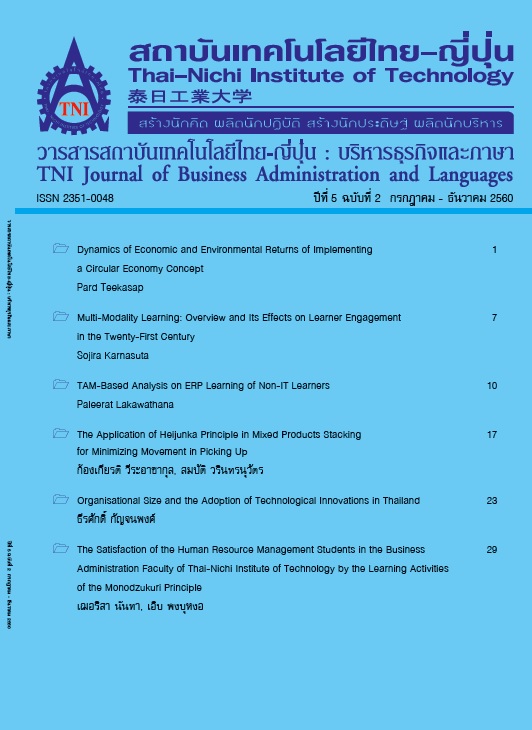
Multi-Modality Learning: Overview and Its Effects on Learner Engagement in the Twenty-First Century
Article Sidebar
Main Article Content
บทคัดย่อ
This study reviews the topic of multi-modality learning in this digital age, as well as examines the possibilities and limitations of its effect on student engagement and learning outcomes. Multimodal learning can be explained as the usage of several instructional methods in educating student; they are text, image, audio, or technology-enriched tool. Due to the increasing interest in incorporating multi-modality technique in teaching and learning, this review will include the following topics: theoretical definitions of multi-modality learning; background on multi-modality learning and methods; application and benefits of using multi-modality technology in various education fields such as language, science, medicine, and statistics; and its influences on student engagement and learning outcomes.
Article Details
นโยบายการรับบทความ
กองบรรณาธิการวารสารสถาบันเทคโนโลยีไทย-ญี่ปุ่น มีความยินดีรับบทความจากอาจารย์ นักศึกษา และผู้ทรงคุณวุฒิในสาขาบริหารธุรกิจและภาษา ที่เขียนเป็นภาษาไทยหรือภาษาอังกฤษ ซึ่งผลงานวิชาการที่ส่งมาขอตีพิมพ์ต้องไม่เคยเผยแพร่ในสิ่งพิมพ์อื่นใดมาก่อน และต้องไม่อยู่ในระหว่างการพิจารณาของวารสารอื่นที่นำส่ง ดังนั้นผู้สนใจที่จะร่วมเผยแพร่ผลงานและความรู้ที่ศึกษามาสามารถนำส่งบทความได้ที่กองบรรณาธิการเพื่อเสนอต่อคณะกรรมการกลั่นกรองบทความพิจารณาจัดพิมพ์ในวารสารต่อไป ทั้งนี้บทความที่สามารถเผยแพร่ได้ประกอบด้วยบทความวิจัย ผู้สนใจสามารถศึกษาและจัดเตรียมบทความจากคำแนะนำสำหรับผู้เขียนบทความ
การละเมิดลิขสิทธิ์ถือเป็นความรับผิดชอบของผู้ส่งบทความโดยตรง บทความที่ได้รับการตีพิมพ์ต้องผ่านการพิจารณากลั่นกรองคุณภาพจากผู้ทรงคุณวุฒิและได้รับความเห็นชอบจาก กองบรรณาธิการ
ข้อความที่ปรากฏภายในบทความของแต่ละบทความที่ตีพิมพ์ในวารสารวิชาการเล่มนี้ เป็น ความคิดเห็นส่วนตัวของผู้เขียนแต่ละท่าน ไม่เกี่ยวข้องกับสถาบันเทคโนโลยีไทย-ญี่ปุ่น และคณาจารย์ท่านอื่น ๆ ในสถาบัน แต่อย่างใด ความรับผิดชอบด้านเนื้อหาและการตรวจร่างบทความแต่ละบทความเป็นของผู้เขียนแต่ละท่าน หากมีความผิดพลาดใด ๆ ผู้เขียนแต่ละท่านจะต้องรับผิดชอบบทความของตนเองแต่ผู้เดียว
กองบรรณาธิการขอสงวนสิทธิ์มิให้นำเนื้อหา ทัศนะ หรือข้อคิดเห็นใด ๆ ของบทความในวารสารวิชาการ สถาบันเทคโนโลยีไทย-ญี่ปุ่น ไปเผยแพร่ก่อนได้รับอนุญาตจากผู้นิพนธ์อย่างเป็นลายลักษณ์อักษร ผลงานที่ได้รับการตีพิมพ์ถือเป็นลิขสิทธิ์ของวารสารสถาบันเทคโนโลยีไทย-ญี่ปุ่น
หากต้องการสอบถามข้อมูลเพิ่มเติมที่
- กองบรรณาธิการ วารสารสถาบันเทคโนโลยีไทย-ญี่ปุ่น
- ฝ่ายวิจัยและนวัตกรรม สถาบันเทคโนโลยีไทย-ญี่ปุ่น
เลขที่ 1771/1 สถาบันเทคโนโลยีไทย-ญี่ปุ่น ซอยพัฒนาการ 37-39 ถนนพัฒนาการ แขวงสวนหลวง เขตสวนหลวง กรุงเทพมหานคร 10250 ติดต่อกับคุณพิมพ์รต พิพัฒนกุล (02) 763-2752 , คุณอาริสา จิระเวชถาวร (02) 763-2600 Ext. 2704 Fax. (02) 763-2754 หรือ E-mail: JBAL@tni.ac.th
เอกสารอ้างอิง
L. Jiang and J. Luk, “Multimodal composing as a learning activity in English classrooms: inquiring into the sources of its motivational capacity,” System, vol. 59, pp. 1-11, Jul. 2016.
M. Gunel and F. Yesildag-Hasancebi, “Modal representations and their role in the learning process: a theoretical and pragmatic analysis,” Educational Sciences: Theory & Practice, vol. 16, pp. 109-126, Feb. 2016.
S. Norris, Analyzing Multimodal Interaction a methodological framework, Oxon, UK: Routledge, 2004.
A. Bourelle, T. Bourelle, A. V. Knutson, and S. Spong, “Sites of multimodal literacy: comparing student learning in online and face-to-face environments,” Computers and Composition, vol. 39, pp. 55-70, 2016.
S. Vungthong, E. Djonov, and J. Torr, “Images as a resource for supporting vocabulary learning: a multimodal analysis of Thai EFL tablet apps for primary school children,” TESOL QUARTERLY, vol. 51, no. 1, Mar. 2017.
F. L. Claman, “The impact of multiuser virtual environments on student engagement,” Nurse Education in Practice, vol. 15, pp. 13-16, 2015.
F. Kuo, P. Yu, and W. Hsiao, “Develop and evaluate the effects of multimodal presentation system on elementary student learning effectiveness: within classroom English learning activity,” Procedia – Social and Behavioral Sciences, vol. 176, pp. 227-235, Feb. 2015.
Z. I. Abrams, “Possibilities and challenges of learning German in a multimodal environment: A case study,” ReCALL, vol. 28, no. 3, pp. 343–363, Sep. 2016.
B. Gorjian, A. Hayati, and E. Barazandeh, “An evaluation of the effects of art on vocabulary learning through multi-sensory modalities,” Procedia Technology, vol. 1 (2012), pp. 345-350, 2012.
J. Chen, “The crossroads of English language learners, task-based instruction, and 3D multi-user virtual learning in Second Life,” Computers & Education, vol. 102, pp. 152-171, Nov. 2016.
J. Taljaard, “A review of multi-sensory technologies in a Science, Technology, Engineering, Arts and Mathematics (STEAM) classroom,” Journal of Learning Design, vol. 9, no. 2, pp.46-55, 2016.
W. Huang, S. Zeng, M. Wan, and G. Chen, “Medical media analytics via ranking and big learning: a multi-modality image-based disease severity prediction study,” Neurocomputing, vol. 204, pp. 125-134, Sep. 2016.
X. Yin, Y. Zhang, J. Cao, J. Wu, and S. Hadjiloucas, “Exploring the complementarity of THz pulse imaging and DCE-MRIs: toward a unified multi-channel classification and a deep learning framework,” Computer Methods and Programs in Biomedicine, vol. 137, pp. 87-114, Dec. 2016.
H. Wen, Y. Liu, I. Rekik, S. Wang, Z. Chen, J. Zhang, Y. Zhang, Y. Peng, and H. He, “Multi-modal multiple kernel learning for accurate identification of Tourette syndrome children,” Pattern Recognition, vol. 63, pp. 601-611, Mar. 2017.
Z. Zhu, Y. Chai, H. Yin, Y. Li, and Z. Liu, “A novel dictionary learning approach for multi-modality medical image fusion,” Neurocomputing, vol. 214, pp. 471-482, Nov. 2016.
A. Gynne and S. Bagga-Gupta, “Languaging in the twenty-first century: exploring varieties and modalities in literacies inside and outside learning spaces,” Language and Education, 29:6, pp. 509-526, Jun. 2015.
K. Lee and B. Kim, “Cross space: the exploration of SNS-based writing activities in a multimodal learning environment,” Educational Technology & Society, vol. 19(2), pp. 57-76, 2016.
