
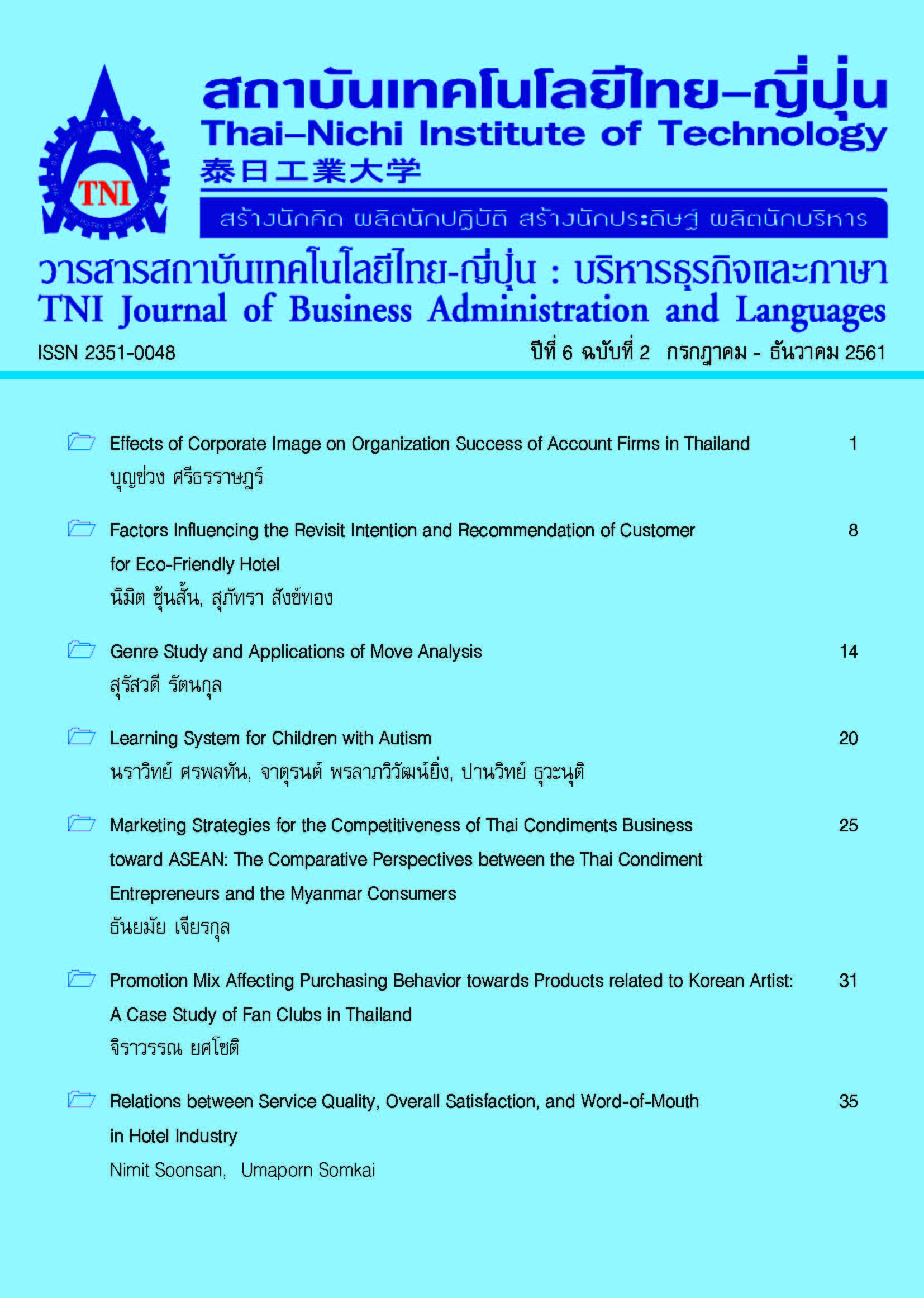
การศึกษาปริจเฉทและการประยุกต์ใช้ประโยชน์จากอัตภาควิเคราะห์
Article Sidebar
Main Article Content
บทคัดย่อ
การนำเสนอข้อมูล ความรู้ที่ไม่ได้ให้ความสำคัญกับการเรียบเรียงข้อความอย่างเพียงพอ จัดเป็นปัจจัยที่ทำให้การสื่อข้อความไม่บรรลุวัตถุประสงค์อย่างที่พึงจะเป็น อัตภาควิเคราะห์คือวิธีการศึกษาโครงสร้างของปริจเฉทหรือข้อความประเภทต่างๆ เช่น บทความวิจัย จดหมายต่อรองทางธุรกิจ สุนทรพจน์ ผลการศึกษาที่ได้จากการศึกษาปริจเฉทด้วยวิธีอัตภาควิเคราะห์คือชุดโครงสร้างอัตภาคซึ่งจะแสดงลำดับการเรียบเรียงข้อความที่ผู้พูดและผู้เขียนสามารถใช้เป็นแนวทางในการเรียบเรียงข้อความได้อย่างมีลำดับขั้นตอน บทความวิชาการนี้มีวัตถุประสงค์เพื่อนำเสนอแนวคิดการวิเคราะห์ปริจเฉทด้วยวิธีอัตภาควิเคราะห์โดยสังเขป รวมทั้งนำเสนอตัวอย่างชุดโครงสร้างอัตภาคซึ่งเป็นผลการศึกษาปริจเฉทด้วยวิธีอัตภาควิเคราะห์ ผู้เขียนมีความมุ่งหวังว่าบทความวิชาการนี้จะมีส่วนช่วยให้มีผู้สนใจนำวิธีอัตภาควิเคราะห์ไปศึกษาปริเฉทประเภทต่างๆ โดยเฉพาะผู้สอนภาษาอังกฤษและภาษาต่างประเทศ รวมทั้งผู้สอนวิชาเนื้อหาต่างๆ และสามารถออกแบบเนื้อหาวิชาเพื่อให้ผู้เรียนได้ฝึกพูด ฝึกเขียน หรือผลิตปริจเฉทประเภทต่างๆภายใต้การดูแลของผู้สอน และด้วยตนเองต่อไป ซึ่งนับเป็นการให้เครื่องมือศึกษาภาษาที่ยั่งยืน
Article Details
นโยบายการรับบทความ
กองบรรณาธิการวารสารสถาบันเทคโนโลยีไทย-ญี่ปุ่น มีความยินดีรับบทความจากอาจารย์ นักศึกษา และผู้ทรงคุณวุฒิในสาขาบริหารธุรกิจและภาษา ที่เขียนเป็นภาษาไทยหรือภาษาอังกฤษ ซึ่งผลงานวิชาการที่ส่งมาขอตีพิมพ์ต้องไม่เคยเผยแพร่ในสิ่งพิมพ์อื่นใดมาก่อน และต้องไม่อยู่ในระหว่างการพิจารณาของวารสารอื่นที่นำส่ง ดังนั้นผู้สนใจที่จะร่วมเผยแพร่ผลงานและความรู้ที่ศึกษามาสามารถนำส่งบทความได้ที่กองบรรณาธิการเพื่อเสนอต่อคณะกรรมการกลั่นกรองบทความพิจารณาจัดพิมพ์ในวารสารต่อไป ทั้งนี้บทความที่สามารถเผยแพร่ได้ประกอบด้วยบทความวิจัย ผู้สนใจสามารถศึกษาและจัดเตรียมบทความจากคำแนะนำสำหรับผู้เขียนบทความ
การละเมิดลิขสิทธิ์ถือเป็นความรับผิดชอบของผู้ส่งบทความโดยตรง บทความที่ได้รับการตีพิมพ์ต้องผ่านการพิจารณากลั่นกรองคุณภาพจากผู้ทรงคุณวุฒิและได้รับความเห็นชอบจาก กองบรรณาธิการ
ข้อความที่ปรากฏภายในบทความของแต่ละบทความที่ตีพิมพ์ในวารสารวิชาการเล่มนี้ เป็น ความคิดเห็นส่วนตัวของผู้เขียนแต่ละท่าน ไม่เกี่ยวข้องกับสถาบันเทคโนโลยีไทย-ญี่ปุ่น และคณาจารย์ท่านอื่น ๆ ในสถาบัน แต่อย่างใด ความรับผิดชอบด้านเนื้อหาและการตรวจร่างบทความแต่ละบทความเป็นของผู้เขียนแต่ละท่าน หากมีความผิดพลาดใด ๆ ผู้เขียนแต่ละท่านจะต้องรับผิดชอบบทความของตนเองแต่ผู้เดียว
กองบรรณาธิการขอสงวนสิทธิ์มิให้นำเนื้อหา ทัศนะ หรือข้อคิดเห็นใด ๆ ของบทความในวารสารวิชาการ สถาบันเทคโนโลยีไทย-ญี่ปุ่น ไปเผยแพร่ก่อนได้รับอนุญาตจากผู้นิพนธ์อย่างเป็นลายลักษณ์อักษร ผลงานที่ได้รับการตีพิมพ์ถือเป็นลิขสิทธิ์ของวารสารสถาบันเทคโนโลยีไทย-ญี่ปุ่น
หากต้องการสอบถามข้อมูลเพิ่มเติมที่
- กองบรรณาธิการ วารสารสถาบันเทคโนโลยีไทย-ญี่ปุ่น
- ฝ่ายวิจัยและนวัตกรรม สถาบันเทคโนโลยีไทย-ญี่ปุ่น
เลขที่ 1771/1 สถาบันเทคโนโลยีไทย-ญี่ปุ่น ซอยพัฒนาการ 37-39 ถนนพัฒนาการ แขวงสวนหลวง เขตสวนหลวง กรุงเทพมหานคร 10250 ติดต่อกับคุณพิมพ์รต พิพัฒนกุล (02) 763-2752 , คุณอาริสา จิระเวชถาวร (02) 763-2600 Ext. 2704 Fax. (02) 763-2754 หรือ E-mail: JBAL@tni.ac.th
เอกสารอ้างอิง
[2] K. Hyland, “A Genre Description of the Argumentative Essay,” RELC Journal, vol. 21, no. 1, pp. 66–78, Jun. 1990.
[3] K. Hyland, Genre and Second Language Writing. Ann Arbor: The University of Michigan, 2007.
[4] L. Flowerdew, “Using a genre-based framework to teach organizational structure in academic writing,” ELT Journal, vol. 54, no. 4, pp. 369–378, Oct. 2000.
[5] B. Paltridge, “Genre and English for Specific Purposes,” in The Handbook of English for Specific Purposes, B. Paltridge and S. Starfield, Eds. West Sussex: John Wiley & Sons, 2013, pp. 347-366.
[6] B. Kanoksilapatham, “Research Article Structure of Research Article Introductions in Three Engineering Subdisciplines,” IEEE Transactions on Professional Communication, vol. 55, no. 4, pp. 294–309, Dec. 2012.
[7] G. B. Halleck and U. M. Connor, “Rhetorical moves in TESOL conference proposals,” Journal of English for Academic Purposes, vol. 5, no. 1, pp. 70–86, Jan. 2006.
[8] U. Connor, “Variation in rhetorical moves in grant proposals of US humanists and scientists,” Text - Interdisciplinary Journal for the Study of Discourse, vol. 20, no. 1, pp. 1–28, 2009.
[9] H. Feng and L. Shi, “Genre analysis of research grant proposals,” LSP & Professional Communication, vol. 4, no. 1, pp. 8-30, 2004.
[10] S. Shamsudin and S. J. Ebrahimi, “Analysis of the Moves of Engineering Lecture Introductions,” Procedia - Social and Behavioral Sciences, vol. 70, pp. 1303–1311, Jan. 2013.
[11] S. Thompson, “Frameworks and contexts: A genre-based approach to analysing lecture introductions,” English for Specific Purposes, vol. 13, no. 2, pp. 171–186, Jan. 1994.
[12] J. Flowerdew and A. Wan, “Genre analysis of tax computation letters: How and why tax accountants write the way they do,” English for Specific Purposes, vol. 25, no. 2, pp. 133–153, Jan. 2006.
[13] B. Labrador, N. Ramón, H. Alaiz-Moretón, and H. Sanjurjo-González, “Rhetorical structure and persuasive language in the subgenre of online advertisements,” English for Specific Purposes, vol. 34, pp. 38–47, Apr. 2014.
[14] O. Tisapramotkul, “A genre-based study of English recruitment advertisements in Thai and British daily newspapers,” Ph.D. dissertation (Interdisciplinary Program), Chulalongkorn University., Bangkok, Thailand, 2007.
[15] P. Thaweewong, “Genre analysis of English business e-mail correspondence in internal communication between Thais and Germans in profit and non-profit organizations,” Ph.D. dissertation (Interdisciplinary International Program), Chulalongkorn University, Bangkok, Thailand, 2006.
[16] T. A. Upton and M. A. Cohen, “An approach to corpus-based discourse analysis: The move analysis as example,” Discourse Studies, vol. 11, no. 5, pp. 585–605, Oct. 2009.
[17] B. Paltridge, Genre and the Language Learning Classroom. Ann Arbor: The University of Michigan, 2001.
[18] D. Biber, U. Connor and T.A. Upton, Discourse on the Move: Using Corpus Analysis to Describe Discourse Structure. Amsterdam: John Benjamins, 2007.
[19] H. Ding, “Genre analysis of personal statements: Analysis of moves in application essays to medical and dental schools,” English for Specific Purposes, vol. 26, no. 3, pp. 368–392, Jan. 2007.
[20] V. Sadeghi and M. Samuel, “Genre analysis of the letters of appeal,” Discourse Studies, vol. 15, no. 2, pp. 229–245, Apr. 2013.
[21] T. Dudley-Evans, “Genre analysis: A key to a theory of ESP?,” Iberica, vol. 2, pp. 3-11, 2000.
[22] A. Hopkins and T. Dudley-Evans, “A genre-based investigation of the discussion sections in articles and dissertations,” English for Specific Purposes, vol. 7, no. 2, pp. 113–121, Jan. 1988.
[23] A. Cheng, “ESP Classroom Research: Basic Considerations and Future Research Questions,” in New Directions in English for Specific Purposes Research, D. Belcher, A.M. Johns and B. Paltridge, Eds. Ann Arbor: University of Michigan Press, 2011, pp. 44-72.
[24] Z.S. Yin, “Development of reading and writing abilities by teaching textual patterns,” Sino-US English Teaching, vol. 4, no. 7, pp. 21-26, 2007.
[25] A.D. Galan and M. del C.F. Perez, “The problem-solution pattern: A tool for the teaching of writing?,” Barcelona English Language and Literature Studies, vol. 12, pp. 1-10, 2003.
[26] A. Cheng, “Analyzing Genre Exemplars in Preparation for Writing: The Case of an L2 Graduate Student in the ESP Genre-based Instructional Framework of Academic Literacy,” Appl Linguist, vol. 29, no. 1, pp. 50–71, Mar. 2008.
[27] T. Miller and D. Parker, “Writing for the Reader: A Problem-Solution Approach,” English Teaching Forum, vol. 50, no. 3, pp. 21–27, 2012.
[28] A.M. Ali, “Combining problem-solution categories and communicative acts: An analysis of Malaysian and British business journalistic texts,” World Applied Sciences Journal, vol. 21, special issue of studies in language teaching and learning, pp. 174-185, 2013.
[29] K. Hyland, “Genre and writing instruction,” Language Education and Acquisition Research Network (LEARN) Journal, Special issue, pp. 40-49, 2014.
[30] J. Flowerdew, “An educational, or process, approach to the teaching of professional genres,” ELT Journal, vol. 47, no. 4, pp. 305–316, Oct. 1993.
[31] M. Hoey, Textual interaction: An introduction to written discourse analysis. London: Routledge, 2001.
