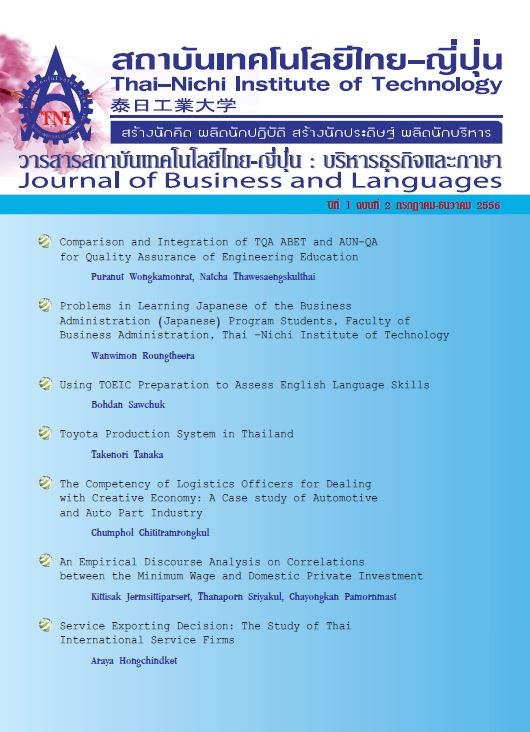
Problems in Learning Japanese of the Business Administration (Japanese) Program Students, Faculty of Business Administration, Thai-Nichi Institute of Technology
Article Sidebar
Main Article Content
บทคัดย่อ
Faculty of Business Administration, Thai-Nichi Institute of Technology, has developed the Business Administration (Japanese) Program in 2007. The content of the program mix up between Japanese Language courses and Business Administration courses. The students in this program are required to take 8 courses or 24 credits of the required basic Japanese courses, starting from their first semester. The students who fail on any of these courses are unable to go on or to continue their studies in the program. Since passing or failing in Japanese courses in this program is a very important thing to the students, TNI is trying very hard to organize a very well excellent curriculum, textbooks and teaching materials as well as providing the appropriate teaching-learning techniques and activities to the students. After one year of managing the program, the evaluation of the program is in need, in terms of a research on learning problems of the students. The main purpose of this research was to find out learning problem of the students in 3 main areas: curriculum, teaching-learning process and personal problem. 135 first year students were used as the samples of the study. Research results showed that learning problems of the students in all aspects were at low level.
Article Details
นโยบายการรับบทความ
กองบรรณาธิการวารสารสถาบันเทคโนโลยีไทย-ญี่ปุ่น มีความยินดีรับบทความจากอาจารย์ นักศึกษา และผู้ทรงคุณวุฒิในสาขาบริหารธุรกิจและภาษา ที่เขียนเป็นภาษาไทยหรือภาษาอังกฤษ ซึ่งผลงานวิชาการที่ส่งมาขอตีพิมพ์ต้องไม่เคยเผยแพร่ในสิ่งพิมพ์อื่นใดมาก่อน และต้องไม่อยู่ในระหว่างการพิจารณาของวารสารอื่นที่นำส่ง ดังนั้นผู้สนใจที่จะร่วมเผยแพร่ผลงานและความรู้ที่ศึกษามาสามารถนำส่งบทความได้ที่กองบรรณาธิการเพื่อเสนอต่อคณะกรรมการกลั่นกรองบทความพิจารณาจัดพิมพ์ในวารสารต่อไป ทั้งนี้บทความที่สามารถเผยแพร่ได้ประกอบด้วยบทความวิจัย ผู้สนใจสามารถศึกษาและจัดเตรียมบทความจากคำแนะนำสำหรับผู้เขียนบทความ
การละเมิดลิขสิทธิ์ถือเป็นความรับผิดชอบของผู้ส่งบทความโดยตรง บทความที่ได้รับการตีพิมพ์ต้องผ่านการพิจารณากลั่นกรองคุณภาพจากผู้ทรงคุณวุฒิและได้รับความเห็นชอบจาก กองบรรณาธิการ
ข้อความที่ปรากฏภายในบทความของแต่ละบทความที่ตีพิมพ์ในวารสารวิชาการเล่มนี้ เป็น ความคิดเห็นส่วนตัวของผู้เขียนแต่ละท่าน ไม่เกี่ยวข้องกับสถาบันเทคโนโลยีไทย-ญี่ปุ่น และคณาจารย์ท่านอื่น ๆ ในสถาบัน แต่อย่างใด ความรับผิดชอบด้านเนื้อหาและการตรวจร่างบทความแต่ละบทความเป็นของผู้เขียนแต่ละท่าน หากมีความผิดพลาดใด ๆ ผู้เขียนแต่ละท่านจะต้องรับผิดชอบบทความของตนเองแต่ผู้เดียว
กองบรรณาธิการขอสงวนสิทธิ์มิให้นำเนื้อหา ทัศนะ หรือข้อคิดเห็นใด ๆ ของบทความในวารสารวิชาการ สถาบันเทคโนโลยีไทย-ญี่ปุ่น ไปเผยแพร่ก่อนได้รับอนุญาตจากผู้นิพนธ์อย่างเป็นลายลักษณ์อักษร ผลงานที่ได้รับการตีพิมพ์ถือเป็นลิขสิทธิ์ของวารสารสถาบันเทคโนโลยีไทย-ญี่ปุ่น
หากต้องการสอบถามข้อมูลเพิ่มเติมที่
- กองบรรณาธิการ วารสารสถาบันเทคโนโลยีไทย-ญี่ปุ่น
- ฝ่ายวิจัยและนวัตกรรม สถาบันเทคโนโลยีไทย-ญี่ปุ่น
เลขที่ 1771/1 สถาบันเทคโนโลยีไทย-ญี่ปุ่น ซอยพัฒนาการ 37-39 ถนนพัฒนาการ แขวงสวนหลวง เขตสวนหลวง กรุงเทพมหานคร 10250 ติดต่อกับคุณพิมพ์รต พิพัฒนกุล (02) 763-2752 , คุณอาริสา จิระเวชถาวร (02) 763-2600 Ext. 2704 Fax. (02) 763-2754 หรือ E-mail: JBAL@tni.ac.th
เอกสารอ้างอิง
Airasian, P.W. (2000). Assessment in the Classroom: A concise approach. (2nd ed). CA : McGraw-Hill.
Bruner, A.J. (1966). Educational Psychology. New York: David McKey Inc.
Chanpen Chuapanich (2002). Teaching Learning and Research at Secondary School Level in Thailand. Bangkok: Chulalongkorn University Press.
Chulalongkorn University, Faculty of Arts (2009). The Japanese Education in Thailand. Retrieved on October 28, 2009.https://www.arts.chula.ac.th/_east.Japanese/activity/history.html
Krongthong Khairiree (2001). “Cooperation Model of Teaching” in Teaching strategies: The Effective ways of Teaching-Learning Process. Bangkok: Chulalongkorn University Press.
Surang Kowatrakul (2005). Educational Psychology. Bangkok: Chulalongkorn University Press.
