
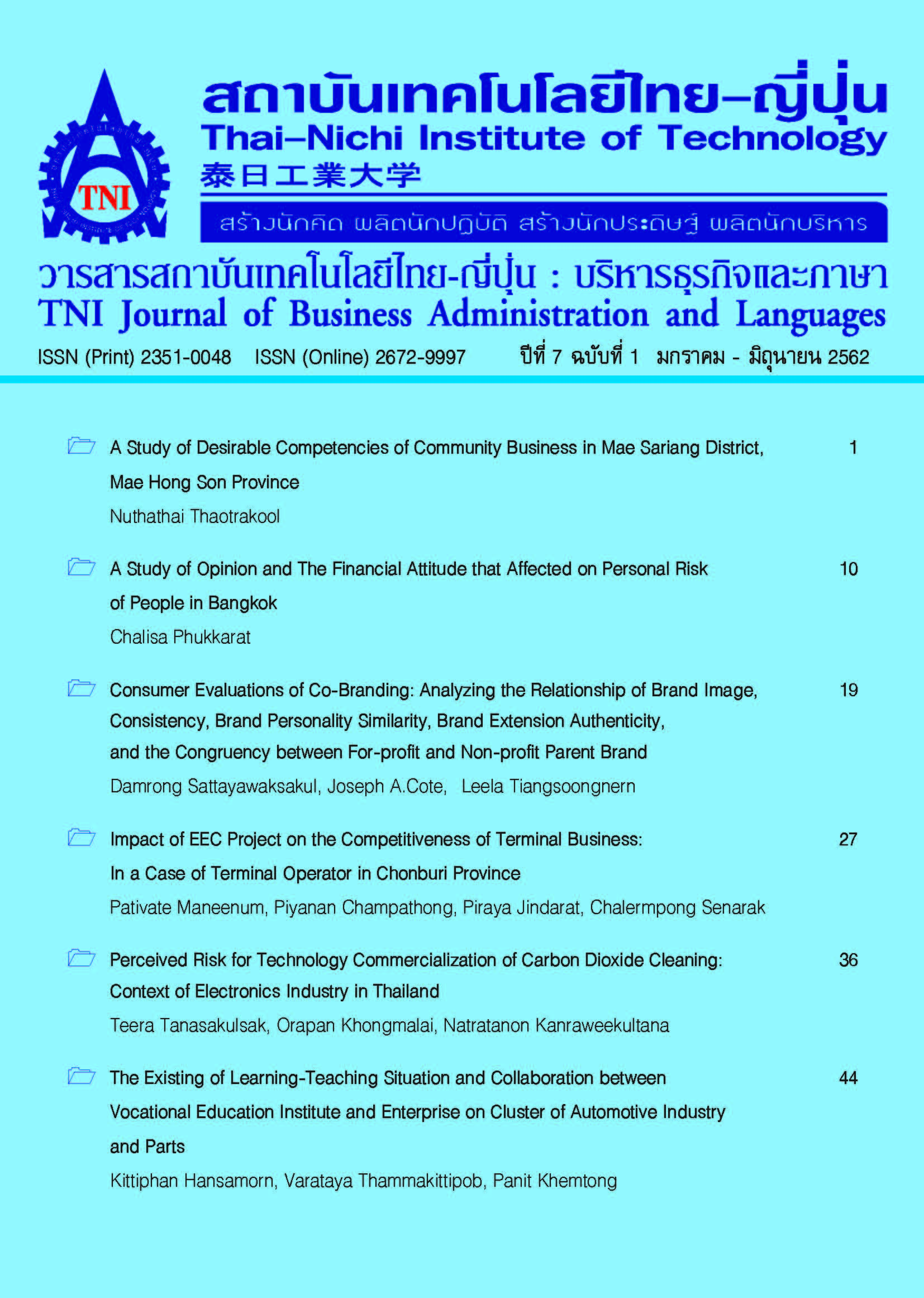
ผลกระทบของโครงการ EEC ที่มีผลต่อความสามารถในการแข่งขันของธุรกิจท่าเทียบเรือ : กรณีศึกษาผู้ประกอบการท่าเทียบเรือ จ.ชลบุรี
Article Sidebar
Main Article Content
บทคัดย่อ
งานวิจัยมีวัตถุประสงค์เพื่อศึกษาปัจจัยจากโครงการ EEC ที่ส่งผลกระทบต่อความสามารถในการแข่งขันของผู้ประกอบการท่าเทียบเรือในจังหวัดชลบุรี โดยส่งผลกระทบอย่างไร ระดับความรุนแรงเท่าใด และเปรียบเทียบความแตกต่างของปัจจัยที่ส่งผลกระทบต่อผู้ประกอบการท่าเทียบเรือทั้งสองกลุ่ม ซึ่งกลุ่มตัวอย่างแบ่งออกเป็น 2 กลุ่ม ได้แก่ กลุ่มผู้ประกอบการท่าเทียบเรือได้รับสัมปทานและไม่ได้รับสัมปทาน เครื่องมือในการเก็บข้อมูลคือ การสัมภาษณ์แบบมีโครงสร้างและเชิงลึกจากกลุ่มตัวอย่างทั้งหมด 4 ราย โดยสัมภาษณ์บุคลากรตำแหน่งผู้บริหารหรือผู้จัดการท่าเทียบเรือที่มีประสบการณ์การทำงาน 3-5 ปี
พบว่า โครงการ EEC ส่งผลต่อผู้ประกอบการท่าเทียบเรือทั้งสองกลุ่ม ในระดับความรุนแรงต่างกัน โดยการพัฒนาอุตสาหกรรมส่งผลให้ปริมาณสินค้าผ่านท่าเพิ่มขึ้น แต่ขึ้นอยู่กับสินค้าที่ให้บริการของแต่ละท่า การพัฒนาโครงสร้างพื้นฐาน ส่งผลให้การขนส่งมีความสะดวกมากขึ้นแต่จำนวนคู่แข่งเพิ่มขึ้นเช่นกัน การพัฒนาเมืองเป็นส่วนสนับสนุนการดำเนินงานของท่าเทียบเรือ ส่งผลต่อความสามารถในการแข่งขันไม่มาก และการพัฒนาด้านสิทธิประโยชน์ช่วยอำนวยความสะดวกในการดำเนินงานและลดต้นทุนด้านภาษี
Article Details
นโยบายการรับบทความ
กองบรรณาธิการวารสารสถาบันเทคโนโลยีไทย-ญี่ปุ่น มีความยินดีรับบทความจากอาจารย์ นักศึกษา และผู้ทรงคุณวุฒิในสาขาบริหารธุรกิจและภาษา ที่เขียนเป็นภาษาไทยหรือภาษาอังกฤษ ซึ่งผลงานวิชาการที่ส่งมาขอตีพิมพ์ต้องไม่เคยเผยแพร่ในสิ่งพิมพ์อื่นใดมาก่อน และต้องไม่อยู่ในระหว่างการพิจารณาของวารสารอื่นที่นำส่ง ดังนั้นผู้สนใจที่จะร่วมเผยแพร่ผลงานและความรู้ที่ศึกษามาสามารถนำส่งบทความได้ที่กองบรรณาธิการเพื่อเสนอต่อคณะกรรมการกลั่นกรองบทความพิจารณาจัดพิมพ์ในวารสารต่อไป ทั้งนี้บทความที่สามารถเผยแพร่ได้ประกอบด้วยบทความวิจัย ผู้สนใจสามารถศึกษาและจัดเตรียมบทความจากคำแนะนำสำหรับผู้เขียนบทความ
การละเมิดลิขสิทธิ์ถือเป็นความรับผิดชอบของผู้ส่งบทความโดยตรง บทความที่ได้รับการตีพิมพ์ต้องผ่านการพิจารณากลั่นกรองคุณภาพจากผู้ทรงคุณวุฒิและได้รับความเห็นชอบจาก กองบรรณาธิการ
ข้อความที่ปรากฏภายในบทความของแต่ละบทความที่ตีพิมพ์ในวารสารวิชาการเล่มนี้ เป็น ความคิดเห็นส่วนตัวของผู้เขียนแต่ละท่าน ไม่เกี่ยวข้องกับสถาบันเทคโนโลยีไทย-ญี่ปุ่น และคณาจารย์ท่านอื่น ๆ ในสถาบัน แต่อย่างใด ความรับผิดชอบด้านเนื้อหาและการตรวจร่างบทความแต่ละบทความเป็นของผู้เขียนแต่ละท่าน หากมีความผิดพลาดใด ๆ ผู้เขียนแต่ละท่านจะต้องรับผิดชอบบทความของตนเองแต่ผู้เดียว
กองบรรณาธิการขอสงวนสิทธิ์มิให้นำเนื้อหา ทัศนะ หรือข้อคิดเห็นใด ๆ ของบทความในวารสารวิชาการ สถาบันเทคโนโลยีไทย-ญี่ปุ่น ไปเผยแพร่ก่อนได้รับอนุญาตจากผู้นิพนธ์อย่างเป็นลายลักษณ์อักษร ผลงานที่ได้รับการตีพิมพ์ถือเป็นลิขสิทธิ์ของวารสารสถาบันเทคโนโลยีไทย-ญี่ปุ่น
หากต้องการสอบถามข้อมูลเพิ่มเติมที่
- กองบรรณาธิการ วารสารสถาบันเทคโนโลยีไทย-ญี่ปุ่น
- ฝ่ายวิจัยและนวัตกรรม สถาบันเทคโนโลยีไทย-ญี่ปุ่น
เลขที่ 1771/1 สถาบันเทคโนโลยีไทย-ญี่ปุ่น ซอยพัฒนาการ 37-39 ถนนพัฒนาการ แขวงสวนหลวง เขตสวนหลวง กรุงเทพมหานคร 10250 ติดต่อกับคุณพิมพ์รต พิพัฒนกุล (02) 763-2752 , คุณอาริสา จิระเวชถาวร (02) 763-2600 Ext. 2704 Fax. (02) 763-2754 หรือ E-mail: JBAL@tni.ac.th
เอกสารอ้างอิง
“Financial Tips,” Money and Banking, [Online]. Available: https://www.moneyandbanking.co.th/new/news/index/13. [Accessed: 21-Jan-2018].
“Infrastructure Overview,” Eastern Economic Corridor, [Online]. Available: https://www.eeco.or.th/en/content/infrastructure-overview. [Accessed: 21-Jan-2018].
United Nations Conference on Trade and Development, Strategic planning for port authorities: report. Geneva, Switzerland: United Nations Conference on Trade and Development, 1993.
J. L. Tongzon, “Port choice and freight forwarders,” Transportation Research Part E: Logistics and Transportation Review, vol. 45, no. 1, pp.186–195, 2009.
J. R. M. Gordon, P. M. Lee, and H. C. Lucas, “A resource-based view of competitive advantage at the Port of Singapore,” The Journal of StrategicInformation Systems, vol. 14, no. 1, pp. 69–86, Mar. 2005.
D.W. Song and G.T. Yeo, “A Competitive Analysis of Chinese ContainerPorts Using the Analytic Hierarchy Process,” in Port Management, H. E. Haralambides, Ed. London: Palgrave Macmillan UK, pp. 339–359, 2015.
J. L. Tongzon, and S. Ganesalingam, “An Evaluation of ASEAN PortPerformance and Efficiency,” Asian Economic Journal, vol. 8, no. 3, pp.317–330, 1994.
E. PaiPai, “Guidelines for Port Environmental Management,” Department of the Environment, Transport and the Regions, Report SR 554, Nov,1999.
C. Duangphastra and J. Rudjanakanoknad, “Selection of Key Performance Indices for Ports under the Port Authority of Thailand,” Journal of Transportation and Logistics, vol. 10, no. 1, pp. 55–65, 2017.
C. Angkuttipong, “Factors affecting the selection of marine transportation services Case study: Outbound transportation from Thailand to the United States.” Bangkok: Thammasat University, 2008.
The Thailand Research Fund, “Thai Port Development Strategy for Entrepreneurs,” Research Community, vol. 119, p. 86, 2017.
“General Information,” Port Authority of Thailand, [Online]. Available: https://www.bkp.port.co.th/bkp2007/dataeng/generalinfo.html.[Accessed: 21-Jan-2018].
