
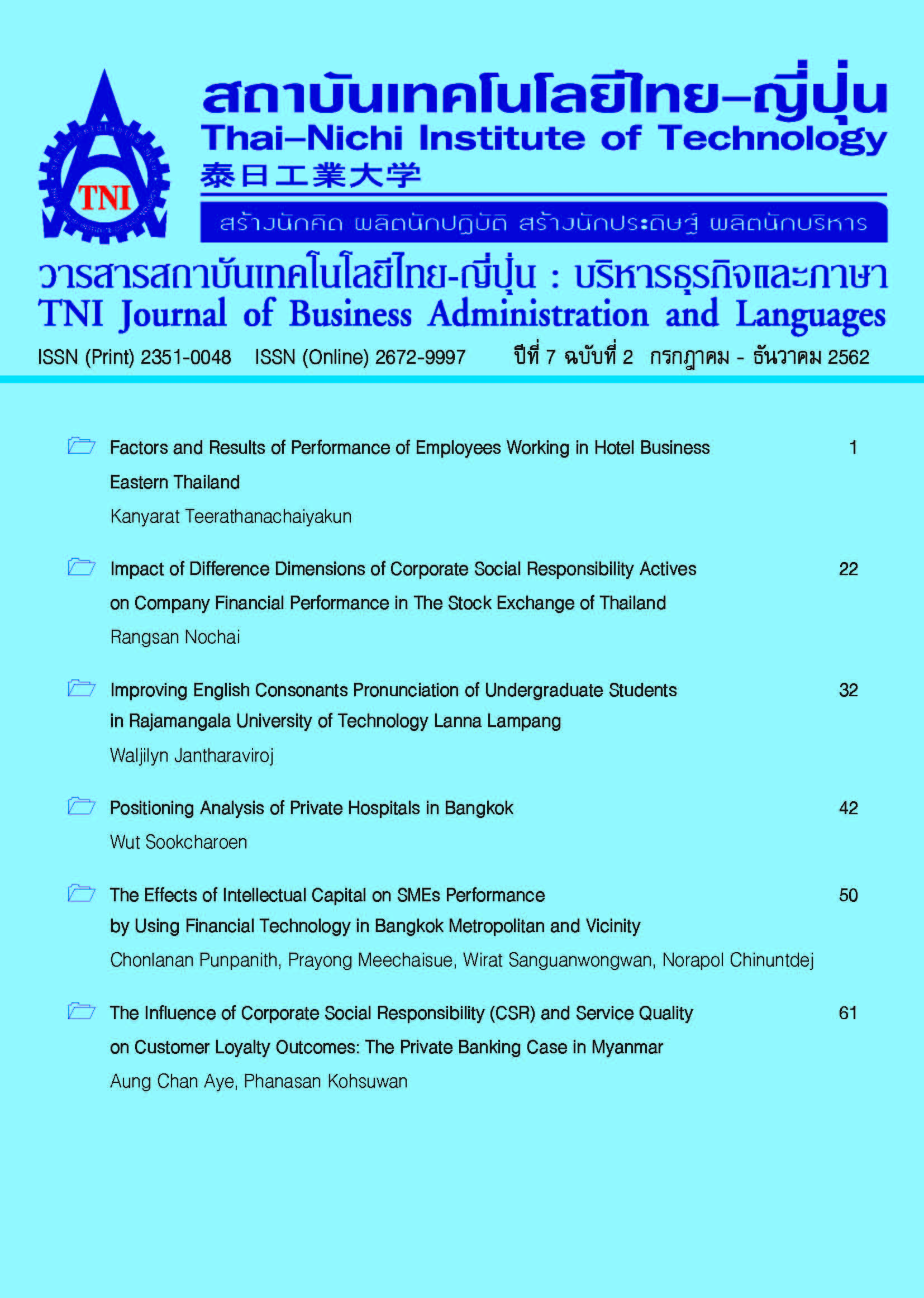
ผลกระทบของทุนทางปัญญาต่อผลการดำเนินงานของวิสาหกิจขนาดกลางและขนาดย่อมที่ใช้เทคโนโลยีทางการเงินในเขตกรุงเทพมหานครและปริมณฑล
Article Sidebar
Main Article Content
บทคัดย่อ
การวิจัยครั้งนี้มีวัตถุประสงค์เพื่อศึกษาผลกระทบของทุนทางปัญญาที่มีต่อนวัตกรรม ขีดความสามารถในการแข่งขันและผลการดำเนินงานของ SMEs อีกทั้งเพื่อศึกษาผลกระทบของนวัตกรรมที่มีต่อขีดความสามารถในการแข่งขันและผลการดำเนินงานของ SMEs และเพื่อศึกษาผลกระทบของขีดความสามารถในการแข่งขันที่มีต่องานผลการดำเนินงานของ SMEs เครื่องมือการวิจัยเป็นแบบผสมโดยการวิจัยเชิงคุณภาพใช้การสัมภาษณ์เชิงลึกผู้เชี่ยวชาญจำนวน 5 ท่านและการวิจัยเชิงปริมาณใช้การแจกแบบสอบถามความคิดเห็นจากกลุ่มตัวอย่างคือ เจ้าของกิจการหรือผู้ถือหุ้นจำนวน 400 คน จากการสุ่มกลุ่มตัวอย่างแบบแบ่งชั้นและสัดส่วน โดยประมวลผลข้อมูลเชิงปริมาณด้วยโปรแกรมคอมพิวเตอร์สำเร็จรูปวิเคราะห์สมการโครงสร้าง (Structural Equation Model : SEM) ผลการวิเคราะห์พบว่า ทุนทางปัญญามีผลกระทบทางตรงเชิงบวกต่อนวัตกรรม ขีดความสามารถในการแข่งขันและผลการดำเนินงานขององค์การ อีกทั้งนวัตกรรมมีผลกระทบทางตรงเชิงบวกต่อขีดความสามารถในการแข่งขันและผลการดำเนินงานขององค์การ และขีดความสามารถในการแข่งขันมีผลกระทบทางตรงเชิงบวกต่อผลการดำเนินงานขององค์การ จากข้อค้นพบผู้ประกอบควรกระตุ้นพนักงานให้นำความรู้ ทักษะ ประสบการณ์ที่มีมาใช้ในการพัฒนาสิ่งใหม่ ๆ อีกทั้งต้องจัดเตรียมความพร้อมด้านสินทรัพย์เพื่อดำเนินธุรกิจ เพื่อก่อให้เกิดการสร้างนวัตกรรมโดยการนำเทคโนโลยีมาช่วยสร้างสินค้าหรือบริการรูปแบบใหม่อยู่เสมอ เพื่อสร้างขีดความสามารถในการแข่งขัน นำไปสู่ผลการดำเนินงานที่ดีขึ้น
Article Details
นโยบายการรับบทความ
กองบรรณาธิการวารสารสถาบันเทคโนโลยีไทย-ญี่ปุ่น มีความยินดีรับบทความจากอาจารย์ นักศึกษา และผู้ทรงคุณวุฒิในสาขาบริหารธุรกิจและภาษา ที่เขียนเป็นภาษาไทยหรือภาษาอังกฤษ ซึ่งผลงานวิชาการที่ส่งมาขอตีพิมพ์ต้องไม่เคยเผยแพร่ในสิ่งพิมพ์อื่นใดมาก่อน และต้องไม่อยู่ในระหว่างการพิจารณาของวารสารอื่นที่นำส่ง ดังนั้นผู้สนใจที่จะร่วมเผยแพร่ผลงานและความรู้ที่ศึกษามาสามารถนำส่งบทความได้ที่กองบรรณาธิการเพื่อเสนอต่อคณะกรรมการกลั่นกรองบทความพิจารณาจัดพิมพ์ในวารสารต่อไป ทั้งนี้บทความที่สามารถเผยแพร่ได้ประกอบด้วยบทความวิจัย ผู้สนใจสามารถศึกษาและจัดเตรียมบทความจากคำแนะนำสำหรับผู้เขียนบทความ
การละเมิดลิขสิทธิ์ถือเป็นความรับผิดชอบของผู้ส่งบทความโดยตรง บทความที่ได้รับการตีพิมพ์ต้องผ่านการพิจารณากลั่นกรองคุณภาพจากผู้ทรงคุณวุฒิและได้รับความเห็นชอบจาก กองบรรณาธิการ
ข้อความที่ปรากฏภายในบทความของแต่ละบทความที่ตีพิมพ์ในวารสารวิชาการเล่มนี้ เป็น ความคิดเห็นส่วนตัวของผู้เขียนแต่ละท่าน ไม่เกี่ยวข้องกับสถาบันเทคโนโลยีไทย-ญี่ปุ่น และคณาจารย์ท่านอื่น ๆ ในสถาบัน แต่อย่างใด ความรับผิดชอบด้านเนื้อหาและการตรวจร่างบทความแต่ละบทความเป็นของผู้เขียนแต่ละท่าน หากมีความผิดพลาดใด ๆ ผู้เขียนแต่ละท่านจะต้องรับผิดชอบบทความของตนเองแต่ผู้เดียว
กองบรรณาธิการขอสงวนสิทธิ์มิให้นำเนื้อหา ทัศนะ หรือข้อคิดเห็นใด ๆ ของบทความในวารสารวิชาการ สถาบันเทคโนโลยีไทย-ญี่ปุ่น ไปเผยแพร่ก่อนได้รับอนุญาตจากผู้นิพนธ์อย่างเป็นลายลักษณ์อักษร ผลงานที่ได้รับการตีพิมพ์ถือเป็นลิขสิทธิ์ของวารสารสถาบันเทคโนโลยีไทย-ญี่ปุ่น
หากต้องการสอบถามข้อมูลเพิ่มเติมที่
- กองบรรณาธิการ วารสารสถาบันเทคโนโลยีไทย-ญี่ปุ่น
- ฝ่ายวิจัยและนวัตกรรม สถาบันเทคโนโลยีไทย-ญี่ปุ่น
เลขที่ 1771/1 สถาบันเทคโนโลยีไทย-ญี่ปุ่น ซอยพัฒนาการ 37-39 ถนนพัฒนาการ แขวงสวนหลวง เขตสวนหลวง กรุงเทพมหานคร 10250 ติดต่อกับคุณพิมพ์รต พิพัฒนกุล (02) 763-2752 , คุณอาริสา จิระเวชถาวร (02) 763-2600 Ext. 2704 Fax. (02) 763-2754 หรือ E-mail: JBAL@tni.ac.th
เอกสารอ้างอิง
Angsuchoti, S., Wichitwanna, S., & Pinyopannuwat, R. (2008). Statistics analysis for Social and Behavioral science LISREL technique. (In Thai). Bangkok: Mission Media.
Bayney, J. (1991). Firm resources and sustained competitive advantage. Journal of Management, 17(1), 99-120.
Clayton C. M., & Raynor M E. (2003). The Innovator's Solution:Creating and Sustaining Successful Growth. Boston: Harvard Business School Press.
Cyrino, A., Parente, R., Dunlap, D., & Góes B., (2017). A critical assessment of Brazilian manufacturing competitiveness in foreign markets. Competitiveness Review: An International Business Journal, 27(3), 253-274.
Darcy, C., Hill, J., McCabe, T., & McGoven, P. (2014). A consideration of organizational sustainability in the SME context: A resource-based view and composite model. European Journal of Training and Development Airline Services, 38(5), 398-414.
Edvinsson, L. (1997). Developing Intellectual Capital at Skandia. Long Range Planning, 30(3), 366-373. https://dx.doi.org/10.1016/S0024-6301(97)90248-X
Eidizadeh, R., Salehzadeh, R., & Esfahani, A. (2017). Analysing the role of business intelligence, knowledge sharing and organisational innovation on gaining competitive advantage. Journal of Workplace Learning, 29(4), 250-267.
Hair, J.F., Black, B., Babin, B., Andreson, R., & Tatham, R. (2006). Multivariate data analysis. (6th ed.). New Jersey: Prentice-Hall.
Hussinki, H., Ritala, P., Vanhala, M., & Kianto, A. (2017). Intellectual capital, knowledge management practices and firm performance. Journal of Intellectual Capital, 18(4), 904-922.
Kaemkate, W. (2012). Research methodology in behavioral sciences. (In Thai). (3rd ed.). Bangkok: Chulalongkorn University.
Kaplan, R., & Norton D. (1992). The Balanced Scorecard: Measures that drive performance. Harvard Business Review, JANUARY–FEBRUARY, 71-80.
Kosol Jitvirat. (2013). Factors influencing the competitiveness of small and medium-sized rubber industry entrepreneurs under conditions of dynamic change. (In Thai). (Unpublish doctoral dissertations), Ramkhamheang University, Bangkok.
Nanayakkara, G., & Iselin, E. (2012). An Exploratory Study of the Performance of Microfinancing Institutions Using the Balanced Scorecard Approach. International Journal of Business and Information, 7(2), 165-204.
Office of the National Economic and Social Development Council. (2017). The Twelfth National Economic and Social Development Plan. (In Thai). Retrieved from https://www.nesdb.go.th/ewt_dl_link.php?nid=6422.
Orapin Boonsin & I Suwanbon. (2013). The causal model of intellectual capital knowledge management performance effectiveness and creative industries for member of entrepreneurial community in the creative industries. (In Thai). Veridian E-Journal, 6(2), 457-474.
Organization for economic co-operation and development, & Statistical office of the european communities. (2005).
Osman, J., & Abidin, Z. (2014). An empirical investigation into the significance of intellectual capital and strategic orientations on innovation capability and firm performance in Malaysian information and communications technology (ICT) small-to-medium enterprises (SMEs). Retrieved from https://researchbank. rmit.edu.au/view/rmit:160964.
Phongphaw, S., & Pakasat, N. (2016).The model of competitiveness OTOP SMEs entrepreneurs in Thailand. (In Thai). Silpakorn University Journal, 9(3), 1659-1675.
Rodríguez-Victoria, O., Puig, F., & González-Loureiro, M. (2017). Clustering, innovation and hotel competitiveness: evidence from the Colombia destination. International Journal of Contemporary Hospitality Management, 29(11), 2785-2806.
Roos, G., Bainbridge, A. & Jacobsen, K. (2001). Intellectual capital analysis as a strategic tool. Strategy & Leadership, 29(4), 21-26.
Samsir, S. (2018). The effect of leadership orientation on innovation and its relationship with competitive advantages of small and medium enterprises in Indonesia. International Journal of Law and Management, 60(2), 530-542.
Schumpeter, J. A. (1983). The theory of economic development : an inquiry into profits, capital, credit, interest, and the business cycle. (R. Opie, Trans.). New Brunswick, N.J: Transaction Books.
Schwab, K., & World Economic Forum. (2017). The Global Competitiveness Report 2017–2018. Retrieved from https://www3.weforum.org/docs/GCR20172018/05FullReport/TheGlobalCompetitivenessReport2017%E2%80%932018.pdf
Stewart, T. (1994). Your company’s most valuable asset: intellectual capital. Fortune, 130(7), 28-33.
The Office of SMEs Promotion. (2018). SME situation report, (In Thai). Retrieved from https://www.sme.go.th/th/download.php?modulekey=215.
Wikhamn, W., Armbrecht, J., & Wikhamn, B. (2018). Innovation in Swedish hotels. International Journal of Contemporary Hospitality Management, 30(6), 2481-2498.
Yang, X., & Zhang, H. (2017). Intellectual property rights, migrants and competitiveness. International Journal of Development Issues, 16(1), 43-53.
Zhang, M., Qi, Y., Wang, Z., Pawar, K., & Zhao, X. (2018). How does intellectual capital affect product innovation performance? Evidence from China and India. International Journal of Operations & Production Management, 38(3), 895-914.
