
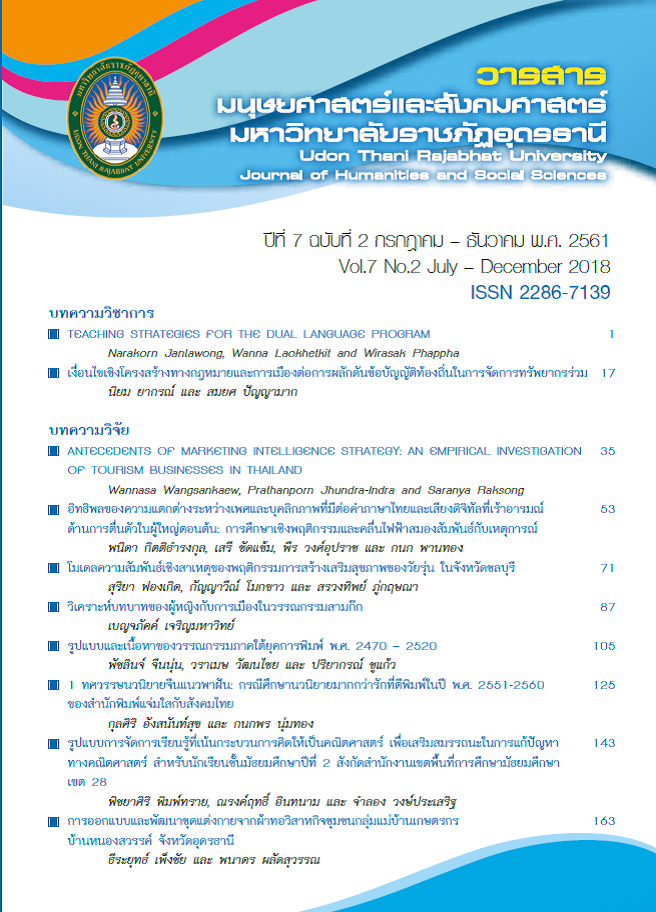
TEACHING STRATEGIES FOR THE DUAL LANGUAGE PROGRAM
Article Sidebar
Main Article Content
บทคัดย่อ
บทความนี้มีวัตถุประสงค์เพื่อเป็นแนวทางและให้กรอบแนวคิดในการจัดการเรียนการสอนแบบสองภาษาเพื่อเป็นการพัฒนาทักษะด้านภาษาของผู้เรียนโดยการนำเสนอกลยุทธ์การจัดการเรียนการสอนที่เกี่ยวข้อง และยังมีการชี้แจงการนำแนวทางและเทคนิคด้านต่างๆมาใช้ให้เกิดความมีประสิทธิภาพที่สอดคล้องกับกลยุทธ์ซึ่งเป็นแนวทางปฏิบัติตามคำแนะนำ ทั้งนี้ยังมีการเน้นย้ำและพิจารณาความสำคัญของความสามารถในการใช้ภาษาได้หลายภาษาซึ่งเป็นองค์ประกอบสำคัญสำหรับแนวทางการจัดการเรียนการสอนดังกล่าว ข้อมูลด้านต่างๆในเนื้อหาได้มีการนำจากเอกสารและงานวิจัยที่เกี่ยวข้องซึ่งสามารถเชื่อมโยงไปยังแนวทางในการจัดการเรียนการสอนและประโยชน์ของการจัดการเรียนการสอนแบบสองภาษาเพื่อพัฒนาความสามารถด้านภาษาของผู้เรียน และเพื่อให้เกิดประโยชน์ต่อครูผู้สอนและผู้ที่สนใจในการนำไปใช้ในการจัดการเรียนการสอนแบบสองภาษาให้มีประสิทธิภาพต่อไป
Article Details
เอกสารอ้างอิง
Bongolan, R. S. (2005). Six Key Strategies for Teachers of. Retrieved November 10, 2018, from https://uteach.utexas.edu/sites/default/files/ files/SixKeyStrategiesELL. pdf?fbclid=IwAR3yRBFpritjG8_0-YbxGGjzTxW3QwTlCxxUwzcFWFdkyTQa- 4WWf0N-dbk
British Council. (2013). The English Effect. Retrieved November 11, 2018, from https://www.britishcouncil.org/organisation/policy-insight-research/research/ the-english-effect
California Association for Bilingual Education. (2017). DUAL LANGUAGE IMMERSION PROGRAM MODELS. Retrieved November 10, 2018, from http://www.di. gocabe.org/get-started/program-and-implementation-models/di-program -models/
Christen, A. (2009). Transforming the classroom for collaborative learning in the 21st century. Techniques: Connecting Education and Careers. Techniques: Connecting Education and Careers (J1), 84(1), 28-31.
Confucius Institute Headquarters (Hanban). (2018). An Analysis of the Certificate Examination Syllabus for Teacher of Chinese to Speakers of Other Languages. Beijing: People’s Education Press.
Fenner, D. S. (2017). Implementing CCSS in Dual Language Programs: Challenges and Resources (Part II). Retrieved November 10, 2018, from http://www. colorincolorado.org/blog/implementing-ccss-dual-language-programs-challenges-and-resources-part-ii
Fenner, D. S., & Breiseth, L. (2017). Dual Language Instruction: An Overview (Part I). Retrieved November 10, 2018, from http://www.colorincolorado. org/blog/dual-language-instruction-overview-part-I
Freeman, D. (2002). The hidden side of the work: Teacher knowledge and learning to teach. A perspective from north. Language Teaching, 35(1), 1-13.
Gustafsson, J. (2003). What do we know about the effects of school resources on educational results? Swedish Economic Policy Review, 10(13), 77-110.
Johnston, B., & Janus, L. (2003). Teacher Professional Development of the Less Commonly Taught Languages. Minneapolis, MN: Center for Advanced Research on Language Acquisition.
Kárpáti, A. (2009). Teacher training and professional development. Retrieved November 14, 2018, from http://econ.core.hu/file/download/greenbook /chapter8.pdf
Kennedy, B., & Medina, J. (2017). Dual Language Education: Answers to Questions From the Field. Retrieved November 14, 2018, from https://www.massmabe.org/resources/Documents/CAL%20Practitioner%20Brief%20Dual%20Language%20Education%20Sept2017.pdf
Manning, R. (2015). Study: Portland Immersion Students Become Better Readers, English Speakers. Retrieved November 11, 2018, from https://www. opb.org/news/article/study-portland-immersion-students-become-better- readers-english-speakers/
Modern Language Association. (2007). Foreign Languages and Higher Education: New Structures for a Changed World. Retrieved November 14, 2018, from https://www.mla.org/Resources/Research/Surveys-Reports-and-Other-Documents/Teaching-Enrollments-and-Programs/Foreign-Languages-and- Higher-Education-New-Structures-for-a-Changed-World
Mourshed, M., Chijioke, C., & Michael, B. (2010). How the world’s most improved school systems keep getting better. Retrieved from https://www. mckinsey.com/~/media/mckinsey/industries/social%20sector/our%20insights/how%20the%20worlds%20most%20improved%20school%20systems%20keep%20getting%20better/how_the_worlds_most_improved_school_systems_keep_getting_better.ashx
OECD. (2005). Teachers matter. Attracting, Developing and Retaining Effective Teachers. Retrieved November 10, 2018, from http://www. oecd.org/ document/9/0,3343,en_2649_39263231_11969545_1_1_1_1,00.html
OECD. (2016). Global Competency for an Inclusive World. Retrieved November 10, 2018, from https://www.oecd.org/pisa/aboutpisa/Global-competency- for-an-inclusive-world.pdf
Richards, C. J. (2006). Communicative Teaching Today. New York: Cambridge University Press.
Solanki, D., & Phil, M. (2012). Use of Technology in English Language Teaching and Learning. Mumbai: Sardar Patel University.
Stein-Smith, K. (2017). The Multilingual Advantage: Foreign Language as a Social Skill in a Globalized. International Journal of Humanities and Social Science, 7(3), 48-56.
Thomas, W. P., & Collier, V. P. (2012). Dual language education for a transformed world. Albuquerque, NM: Fuente Press.
Valentino, R. A., & Reardon, S. F. (2014). Effectiveness of four instructional programs designed to serve English learners: Variation by ethnicity and initial English proficiency. Retrieved November 10, 2018 from https://cepa.stanford.edu/sites/default/fles/Valentino_Reardon_EL%20Programs_12_15_14.pdf
