
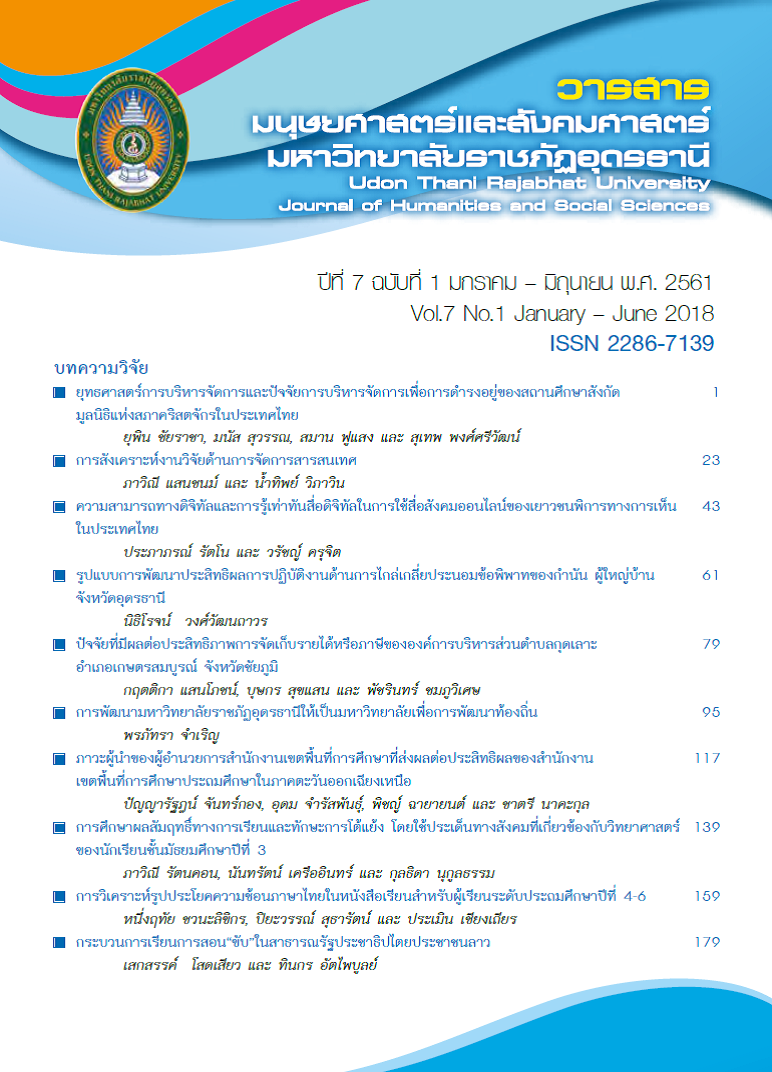
LEADERSHIP OF DIRECTORS OF EDUCATIONAL SERVICE AREA INFLUENCING ON EFFECTIVENESS OF PRIMARY EDUCATIONAL SERVICE AREA OFFICES IN THE NORTHEASTERN REGION
Article Sidebar
Main Article Content
Abstract
The purposes of this research were to 1) study leadership, 2) the principles of leadership and 3) to study the influence on effectiveness of leadership in the primary educational service area office. The research consisted of two phases.
Phase 1: to study leadership of the directors of educational service area which influenced an effectiveness of the primary educational service area offices. The informants were19 experts and the instruments were an open-ended questionnaire. The data was collected by mail and analyzed for content analysis, median, interquartile and category. The results revealed that a leadership of the directors of educational service area consisted of 55 indicators.
Phase 2: to study the principles of leadership and its influence of the directors of Educational Service Area Office towards effectiveness of primary educational service office. The sample consisted of 550 selected directors of the primary educational service area offices by proportional stratified sampling. The data was collected by mail and statistically analyzed for the frequency, percentage, mean, standard deviation, exploratory factor analysis. The results revealed that leadership of the directors of educational service area consisted of 7 factors as follows: being a leader in educational change consisting 22 indicators, being cognitive of the relevant situations featuring 6 indicators, being cognitive of the political, economic and social aspects including 5 indicators, self-development and job development with 5 indicators, learning from the working experiences with 5 indicators, management capabilities of 5 indicators and the network management of 6 indicators.
The leadership influencing on effectiveness of Educational Service Area consisted of 5 aspects: learning from the working experience (X5), management capabilities (X6), being cognitive of the political, economic and social aspects (X3), being cognitive of the relevant situations (X2) and leading educational change (X1). The predictive power of the educational quality was 60.00 percent as follows:
Predicting formula in terms of unstandardized scores (Y)
Ŷ = 1.908 + 0.307(X5) + 0.560(X6) + 0.181(X3) + 0.031(X2) + 0.039(X1)
and predicting formula in terms of standardized scores (Z)
Ẑ = 0.440(Z5) + 0.219(Z6) + 0.305(Z3) + 0.105(Z2) + 0.104(Z1)
Article Details
References
Bass, B. M. (1981). Stodgill’s handbook of leadership: A survey of theory and Research. New York: Free Press.
Bass, B. M., & Riggio, R. E. (2006). Transformational leadership. 2nd ed. Mahwah, New Jersey: Lawrence Erlbaum Associates Inc/Psychology Press.
Board of education management system reform. (1999). Education management system reform in the Ministry of education. Bangkok: Teacher's council publishing. (in Thai).
คณะกรรมการปฎิรูประบบบริหารการศึกษา. (2542). การปฎิรูประบบบริหารการศึกษาในกระทรวงศึกษาธิการ. กรุงเทพฯ: โรงพิมพ์คุรุสภา.
Chareanwongsuk, K. (2013). Civilized unity: The power of unity on a base of good beauty the truth. Journal of Prajadhipok’s Institute, 11(3), 5-18. (in Thai).
เกรียงศักดิ์ เจริญวงศักดิ์. (2556). อารยสามัคคี: พลังสามัคคีบนฐานความดี ความงามความจริง. วารสารสถาบันพระปกเกล้า, 11(3), 5-18.
Chirichello, M. (2003). Reinventing the principalship: from centrist to collective leadership. In Lunenburg, F. C. & Carr, C. S. (Eds.), Shaping the future: Policy, partnerships, and emerging perspectives, pp. 92. Landham, Moldova: Scarecrow Education.
Dessler, G. (1998). Management. New Jersey: Prentice-Hall.
Fiedler, F. E. (1967). A Theory of leadership effectiveness. New York: McGraw-Hill.
________. (1976). Improving leadership effectiveness: The leader Match concept. New York: Wiley.
Fullan, M. (1991). The new meaning of educational change. London: Cassell.
________. (2006). Turnaround leadership. San Francisco: Jossey-Bass.
Gardner, J. W. (1990). On Leadership. New York: Macmillan Publishing.
Hoy, W. K., & Miskel, C. G. (2001). Educational administration: Theory, research, and practice. 6th ed. New York: McGraw-Hill.
________. (2008). Educational administration: Theory, research, and Practice. 8th ed. New York: McGraw-Hill.
Jongsatityu, J. (2002). Educational area: expectation the event included the writings of Thailand OER. and picks on education reform 2543-2545 volume 1. In News and perspective OER. p. 302. Bangkok: Office for Educational Reform. (in Thai).
เจือจันทร์ จงสถิตอยู่. (2545). เขตพื้นที่การศึกษา: สิ่งที่สังคมคาดหวัง หมายเหตุการณ์ศึกษาไทยรวมข้อเขียน สปศ.และบทความคัดสรรว่าด้วย การปฎิรูปการศึกษา 2543-2545 เล่ม 1. ใน ข่าวสารและทัศนะของ สปศ., หน้า 302. กรุงเทพฯ: สำนักงานปฏิรูปการศึกษา.
Karsten, M. F. (2006). Management, gender and race in the 21st century. New York: University Press of America.
Leithwood, K. (2003). Teacher leadership: Its nature, development and Impact on school and students. In M. Brundrett, N. Burton, & R. Smith (eds), Leadership in education, London: Sage. pp.103-117.
Lakomski, G., (2000). Doing educational administration: A theory of administrative practice. Amstredam: Pergamon.
Lucas, N. J. (2000). Lives of integrity: Factors that influence moral transforming leaders. Ph.D. Thesis, The University of Maryland, College Park.
Lunenburg, F. C., & Ornstein, A. C. (2004). Educational administration concepts and practices. New York: Thomson Learning, Inc.
Lussier, R., & Achua, C. (2007). Effective leadership. 3rd ed. Mason, State of Ohio: Thomson Higher Education.
Ministry of Education. (2003). Act Ministry of Education 2546. Bangkok: Bangkok Ministry of Education. (in Thai).
กระทรวงศึกษาธิการ. (2546). พระราชบัญญัติระเบียบบริหารราชการ กระทรวงศึกษาธิการ พุทธศักราช 2546. กรุงเทพฯ: กระทรวงศึกษาธิการ.
Office for educational reform. (2002). The development of indicators for the evaluation of quality management education area. Bangkok: Tarnahcson. (in Thai).
สำนักงานปฏิรูปการศึกษา. (2545). การพัฒนาตัวบ่งชี้สำหรับประเมินคุณภาพการบริหารจัดการ เขตพื้นที่การศึกษา. กรุงเทพฯ: ธารอักษร.
Office of the education council. (2007). The impact of globalization on education Thailand in the next 5 years. Bangkok: A comparative study of the center Research and Education Development Office. (in Thai).
สำนักงานเลขาธิการสภาการศึกษา. (2550). ผลกระทบโลกาภิวัตน์ต่อการจัดการศึกษาไทยในอีก 5 ปีข้างหน้า. กรุงเทพฯ: ศูนย์การศึกษาเปรียบเทียบ สำนักวิจัยและพัฒนาการศึกษา.
Office of the education council. (2010). Decentralization of education to educational service area and schools. Bangkok: Office of the education council. (in Thai).
สำนักงานเลขาธิการสภาการศึกษา. (2553). การกระจายอำนาจการจัดการศึกษาสู่เขตพื้นที่การศึกษาและสถานศึกษา. กรุงเทพฯ: สำนักงานเลขาธิการสภาการศึกษา.
Office of the National Economics and Social Development Board. (2011). Strategic development of the competitiveness of the country Thailand in long term. Bangkok: Office of the National Economics and Social Development Board. (in Thai).
สำนักงานคณะกรรมการพัฒนาการเศรษฐกิจและสังคมแห่งชาติ. (2554). ยุทธศาสตร์การพัฒนาขีดความสามารถในการแข่งขันของประเทศไทยในระยะยาว. กรุงเทพฯ: สำนักงานคณะกรรมการพัฒนาการเศรษฐกิจและสังคมแห่งชาติ.
Phanit, W. (2014). Creating learning to Century 21. 2nd ed. Bangkok: Chulalongkorn University. (in Thai).
วิจารณ์ พานิช. (2557). การสร้างการเรียนรู้สู่ศตวรรษที่ 21. พิมพ์ครั้งที่ 2. กรุงเทพฯ: จุฬาลงกรณ์มหาวิทยาลัย.
Raelin, J. A. (2004). Don’t bother putting leadership into people. Academy of Management Executive, 18(3), 7.
Samkoset, W. (2017). Global Change 3. Bangkok: Openworlds publishing. (in Thai).
วรากรณ์ สามโกเศศ. (2560). Global Change 3. กรุงเทพฯ: โอเพ่น เวิลด์ส พับลิชชิ่ง.
Schrader, S. (1995). Gaining advantage by leaking information: Informal Information trading. European Management Journal, 13(2), 156-163.
Schrader, S. M. (1995). Discourage opportunistic behavior in collaborative R&D: A new role for government. Research Policy, 24, 367-389.
Speanchai, P. (2003). School administrators with research to create a learning organization. Bangkok: Prikwarn. (in Thai).
พจน์ สะเพียรชัย. (2546). ผู้บริหารสถานศึกษากับการวิจัยเพื่อสร้างองค์กร แห่งการเรียนรู้. กรุงเทพฯ: พริกหวาน.
Wasee, P. (2005). Knowledge management: The process of liberating human potential milions Freedom and happiness. Bangkok: Institute for Social Knowledge Management. (in Thai).
ประเวศ วะสี. (2548). การจัดการความรู้ : กระบวนการปลดปล่อยมนุษย์สู่ศักยภาพ เสรีภาพและความสุข. กรุงเทพฯ: สถาบันส่งเสริมการจัดการความรู้เพื่อสังคม.
Yukl, G. A. (1989). leadership in organizations. 2nd ed. New Jersey: Prentice Hall.
