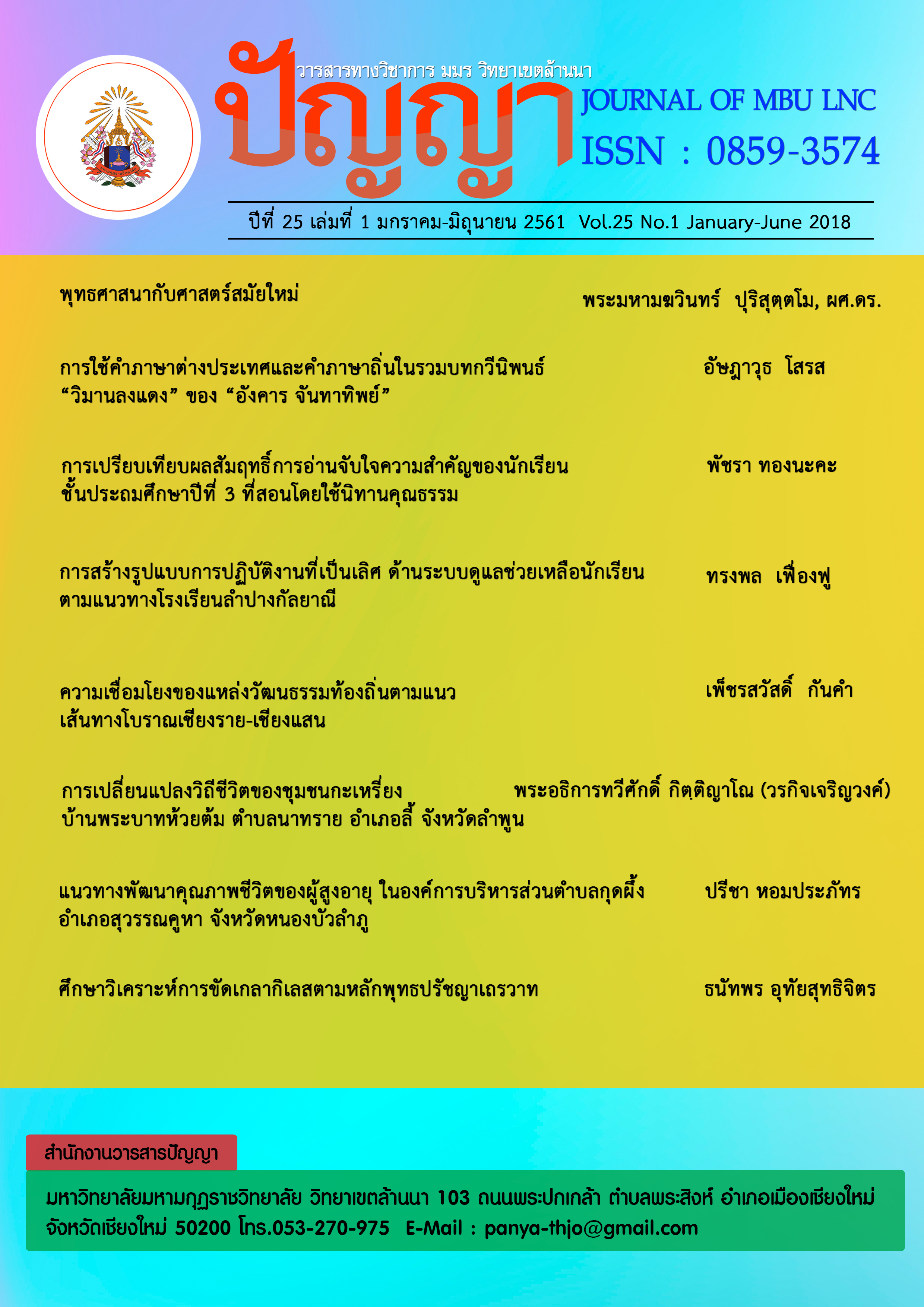
THE USE OF FOREIGN LANGUAGE WORDS AND DIALECTS IN THE COMBINATION OF THE POEM “WIMAN LONG DANG” OF “ANGKARN CHANTHATHIP
Keywords:
foreign language, Angkarn Chanthathip, dialects words, Wiman Long DangAbstract
The use of foreign language and dialects words in the combination of the poem “Wiman Long Dang” of “Angkarn Chanthathip” purpose to study foreign language and dialects words that appearing the poem "Wiman Long Dang" of "Angkarn Chanthathip", by studying and analyzing from the total of 50 poems.The classification of foreign language words by criteria of Suwilai Premsrirat, the classification of dialects words according to the criteria of the Thai language institution.The research found that:
In the classification of foreign languages that appearing in the poem, classified according to the language family, the most common are the Indo-European languages family, found 415 words as follows: 1) found 276 words of Pali-Sanskrit, 2) found 68 words of Pali, 3) found 57 words of Sanskrit, 4) found 10 words of English and 5) found 4 words of Persian, Followed by the Austro-Asiatic language family, found 101 words as follows: 1) found 95 words of Khmer, 2) found 4 words of Khmer-Mon, 3) found 1 word of Mon, and 4) found 1 word of Malaya. The Chinese-Tibetan family found 15 words as follows: 1) 1) found 14 words of Chinese and 2) found 1 word of Myanmar. Tai-Kadai language family found 14 words of Lao. Semitic language family found 3 words of Arabic. Dravidian language family found 2 words of Tamil. The least common is the Altai language family found 1 word of Japanese. On "The use of foreign language and dialectswords that appear in the poem "Viman Long Dang" of "Angkarn Chanthathip", which uses a variety of languages, both foreign languages and dialects words. Therefore making it more diverse and interesting and this poem still has the beauty of prosody of the language according to thai poetry.
References
ธีระ รุ่งธีระ. (2555). ประเด็นศึกษาเกี่ยวกับงานวิจัยด้านวรรณกรรมไทยร่วมสมัยระหว่าง พ.ศ. 2533-2552 : การสำรวจภาพรวม. วารสารมนุษยศาสตร์. คณะมนุษยศาสตร์ มหาวิทยาลัยเกษตรศาสตร์.
นัทภณิตา วารีปาน. (2558). วัจนลีลาในกวีนิพนธ์ไร้ฉันทลักษณ์:หนังสือเรื่องไม่มีหญิงสาวในบทกวี ของ ซาการีย์ยา อมตยา. สุพรรรบุรี: มหาวิทยาลัยเทคโนโลยีราชมงคลสุวรรณภูมิ.
นูรีดา เจ๊ะสามอเจ๊ะ และคณะ (2561). การทับศัพท์ภาษาอังกฤษในวรรณกรรมสำหรับเยาวชนรางวัลซีไรต์. รายงานสืบเนื่องการประชุมหาดใหญ่วิชาการระดับชาติและนานาชาติครั้งที่ 9 The 9 the Hatyai National and International Conference. น.953-961.
บุญเหลือ เทพยสุวรรณ. (2539). แว่นวรรณกรรม. พิมพ์ครั้งที่2. พิมพลักษณ์, กรุงเทพฯ: อมรินทร์พริ้นติ้งแอนด์พับลิชชิ่ง.
พระยาอุปกิตศิลปสาร. (2548). หลักภาษาไทย. กรุงเทพฯ: แม่โพสพ.
พิชญา สุวรรณโน. (2557). ความสามารถด้านการใช้ภาษาในการเขียนกวีนิพนธ์ของนักเรียนระดับมัธยมศึกษา. รายงานสืบเนื่องการประชุมหาดใหญ่วิชาการระดับชาติ ครั้งที่ 6 วันที่ 26 มิถุนายน 2558 มหาวิทยาลัยหาดใหญ่. น.639-648.
วิไลศักดิ์ กิ่งคํา. (2550). ภาษาต่างประเทศในภาษาไทย. กรุงเทพฯ: มหาวิทยาลัยเกษตรศาสตร์.
สถาบันภาษาไทย. (2555). บรรทัดฐานภาษาไทย เล่ม 4 : วัฒนธรรมการใช้ภาษาไทย. กรุงเทพฯ: สกสค.
สุภัทร แก้วพัตร. (2560). ภาษากับสังคม. อุดรธานี: มหาวิทยาลัยราชภัฏอุดรธานี.
สุวิไล เปรมศรีรัตน์. (2549). สถานการณ์ทางภาษาในสังคมกับความหลากหลายทางชาติพันธุ์. วารสารภาษาและวัฒนธรรม. นครปฐม: มหาวิทยาลัยมหิดล.
อมรา ประสิทธิ์รัฐสินธุ์. (2548). ภาษาในสังคมไทย : ความหลากหลาย การเปลี่ยนแปลงการพัฒนา. กรุงเทพฯ: จุฬาลงกรณ์มหาวิทยาลัย.
อังคาร จันทาทิพย์. (2544). วิมานลงแดง. กรุงเทพฯ: สำนักพิมพ์ดับเบิ้ลนายน์.
Downloads
Published
How to Cite
Issue
Section
License
ผลการวิจัยและความคิดเห็นที่ปรากฏในบทความ ถือเป็นความคิดเห็นและอยู่ในความรับผิดชอบของผู้เขียนบทความ มิใช่ความเห็นหรือความรับผิดชอบของกองบรรณาธิการ หรือมหาวิทยาลัยมหามกุฏราชวิทยาลัย วิทยาเขตล้านนา ทั้งนี้ไม่รวมความผิดพลาดอันเกิดจากการพิมพ์ บทความที่ได้รับการเผยแพร่โดยวารสารปัญญา ถือเป็นสิทธิ์ของวารสารฯ