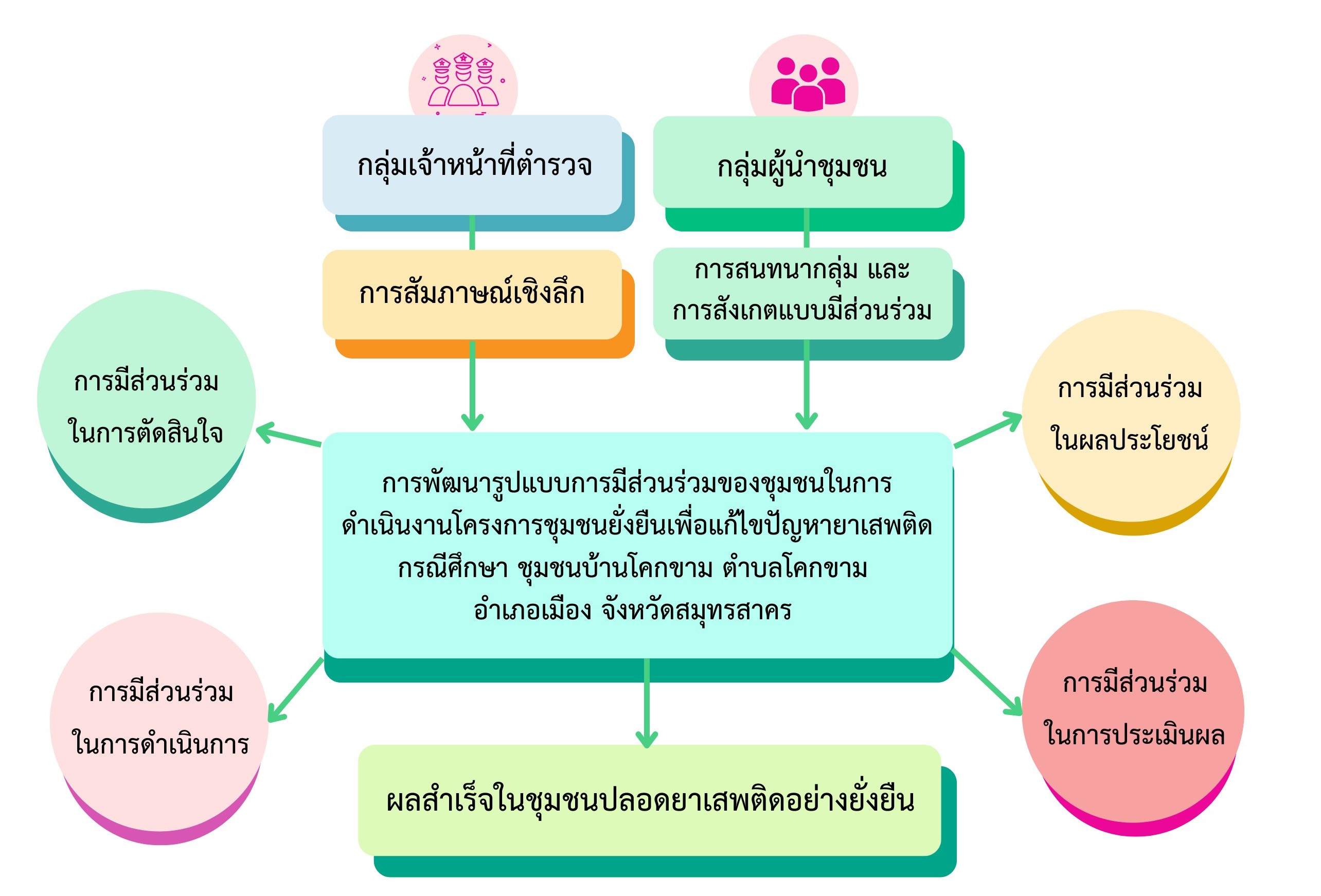
The Development of a Community Participation Model in the Implementation of the Sustainable Community Project to Address Drug Problems: A Case Study of Ban Khok Kham Community, Khok Kham Subdistrict, Mueang District, Samut Sakhon Province
Keywords:
Participation Model, Community, Community LeadersAbstract
The purposes of this research were 1) study the development of a participatory model in the implementation of the Sustainable Community Project to address drug problems in Ban Khok Kham Community, Khok Kham Subdistrict, Mueang District, Samut Sakhon Province, and 2) propose guidelines for developing the participatory model in the implementation of the Sustainable Community Project to address drug problems in Ban Khok Kham Community, Khok Kham Subdistrict, Mueang District, Samut Sakhon Province. This study is qualitative research. The key informants include 15 community leaders in the Ban Khok Kham area and police officers involved in the Sustainable Community Project to address drug problems. The data collection tools are in-depth interviews and focus group discussions. Data analysis was conducted using content analysis, followed by descriptive analysis. The research findings are as follows: 1. The development of a participatory model in the implementation of the Sustainable Community Project to address drug problems in Ban Khok Kham Community, Khok Kham Subdistrict, Mueang District, Samut Sakhon Province, includes publicizing to help citizens understand and see the benefits of the project implementation, as well as adjusting the participation activities to fit the community. The process of addressing drug problems should be systematic and tangible, including legal penalties and rehabilitation. 2. The guidelines for developing the participatory model in the implementation of the Sustainable Community Project to address drug problems in Ban Khok Kham Community, Khok Kham Subdistrict, Mueang District, Samut Sakhon Province, include adjusting community activities to be conducive to the community context, proactive visits to meet residents, and serious attention to solving community problems, which are important for encouraging the community to participate more in the project and benefit more from it.References
จักรพงษ์ พวงงามชื่น และคณะ. (2556). การพัฒนารูปแบบการมีส่วนร่วมของประชาชนในการจัดการป่าชุมชน: กรณีศึกษา บ้านทาป่าเปา ตำบลทาปลาดุก อำเภอแม่ทา จังหวัดลำพูน. วารสารวิจัยและพัฒนา มจธ., 36(2), 215-233.
นราศักดิ์ ปานบุตร. (2554). การสร้างรั้วชุมชนในการป้องกันปัญหายาเสพติดโดยความร่วมมือของแกนนำในชุมชนบ้านบ่อแปดร้อย เทศบาลตำบลในเมือง อำเภอสวรรคโลก จังหวัดสุโขทัย. สุโขทัย: สำนักงานป้องกันและปราบปรามยาเสพติดภาค 6.
พระธวัชชัย สนฺติธมฺโม (วรรณนาวิน). (2561). การมีส่วนร่วมของประชาชนในการพัฒนาชุมชนในเขตเทศบาลเมืองสระแก้ว จังหวัดสระแก้ว. (การค้นคว้าอิสระรัฐประศาสนศาสตรมหาบัณฑิต). พระนครศรีอยุธยา: มหาวิทยาลัยมหาจุฬาลงกรณราชวิทยาลัย.
สำนักงานว่าด้วยยาเสพติดและอาชญากรรมแห่งสหประชาชาติ. (2565). ข้อมูลจากรายงาน World Drug Report 2022. (n.d.-b). United Nations: Office on Drugs and Crime. เข้าถึงได้จาก https://www.unodc.org/unodc/data-and-analysis/world-drug-report-2022.html
อรทัย ก๊กผล. (2556). การบริหารปกครองสาธารณะ: การบริหารรัฐกิจในศตวรรษที่ 21. (พิมพ์ครั้งที่ 2). ปทุมธานี: มหาวิทยาลัยธรรมศาสตร์ ศูนย์รังสิต.