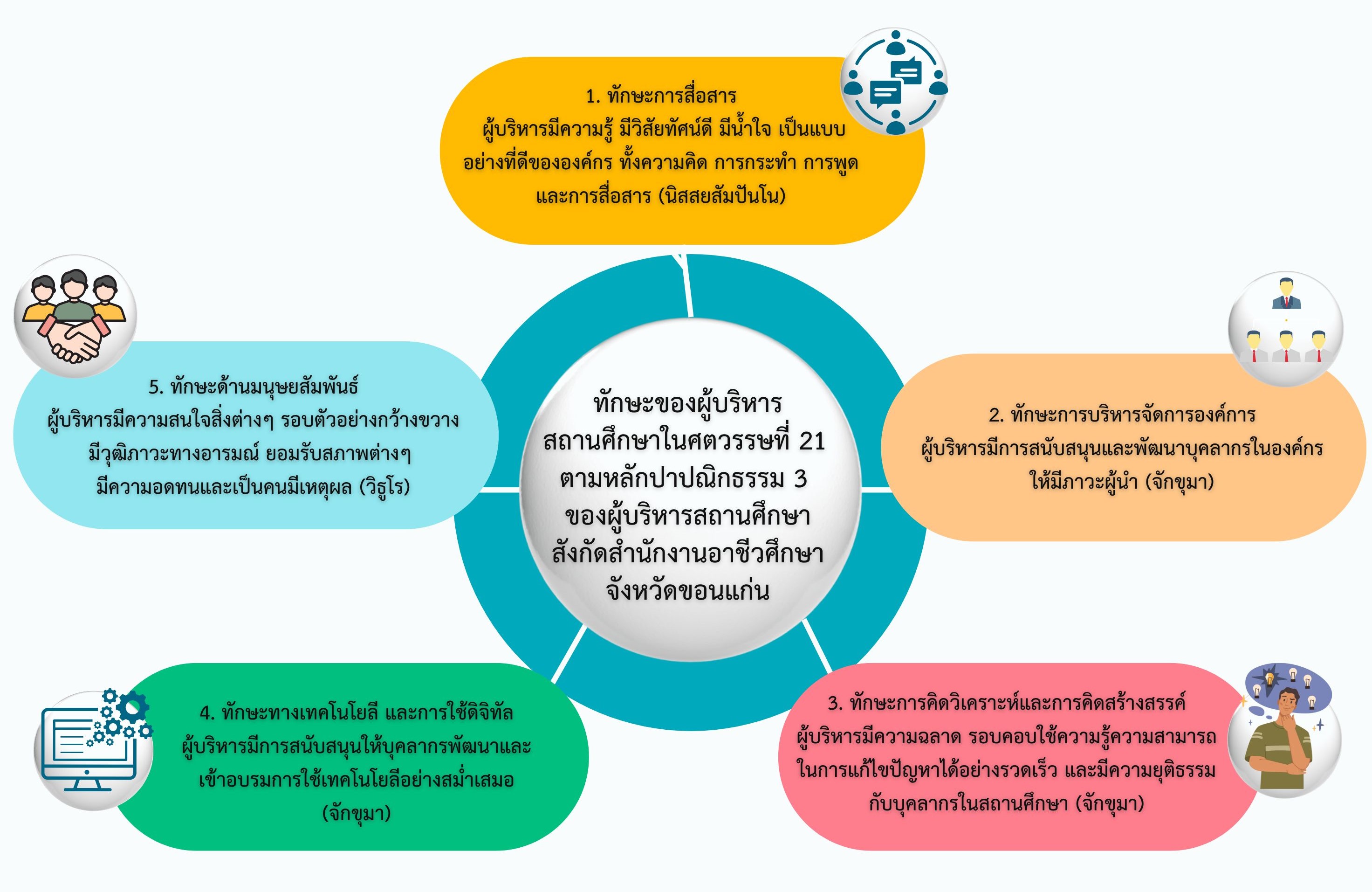
The Skills of Educational Institution Administrators in the 21st Century According to the Three Pāpaṇika Dhamma Principles by Educational Institution Administrators under the Office of Vocational Education, Khon Kaen Province
Keywords:
Skills, Educational Institution Administrators, Papanika DhammaAbstract
The purposes of this research were 1) study the issues related to the skills of educational institution administrators in the 21st century according to the Three Pāpaṇika Dhamma Principles by educational institution administrators under the Office of Vocational Education, Khon Kaen Province; 2)propose guidelines to enhance the skills of educational institution administrators in the 21st century according to the same principles in this context. The study used a mixed-methods approach. The sample group included 289 school administrators and teachers, with an additional 12 key informants for qualitative insights. The research instruments included a questionnaire and an interview. Data analysis for the quantitative aspect used percentage, mean, and standard deviation, while qualitative analysis employed descriptive methods. The research results were as follows: 1. The state of the skills of educational institution administrators in the 21st century according to the Three Pāpaṇika Dhamma Principles by educational institution administrators under the Office of Vocational Education, Khon Kaen Province, was generally at the highest level overall and across all individual aspects. The aspects, ranked by descending means, were: analytical and creative thinking skills, organizational management skills, technology and digital skills, communication skills, and interpersonal skills. 2. The guidelines to enhance the skills of educational institution administrators in the 21st century according to the Three Pāpaṇika Dhamma Principles are Communication Skills: encourage communication in vision setting and develop specialized knowledge; Organizational Management Skills: promote good decision-making, effective interpersonal relationships, and problem-solving in personnel management, assets, and budgets; Analytical and Creative Thinking Skills: foster problem-solving to lead schools toward excellence; Technology and Digital Skills: Encourage sharing of modern technology knowledge and Interpersonal Skills: encourage administrators to transfer teamwork skills to others.References
กณิษฐา ทองสมุทร. (2561). ทักษะการบริหารงานในศตวรรษที่ 21 ของผู้บริหารสถานศึกษา ตามการรับรู้ของครูสังกัดสำนักงานเขตพื้นที่การศึกษาประถมศึกษาสุราษฎร์ธานี เขต 2. (วิทยานิพนธ์ครุศาสตรมหาบัณฑิต). สุราษฎร์ธานี: มหาวิทยาลัยราชภัฏสุราษฎร์ธานี.
กระทรวงศึกษาธิการ. (2553). พระราชบัญญัติการศึกษาแห่งชาติ พ.ศ. 2542 (และแก้ไขเพิ่มเติม 2545, 2553). กรุงเทพฯ: องค์การค้าของคุรุสภา.
บุญชม ศรีสะอาด และคณะ. (2554). การวิจัยเกี่ยวกับการบริหารการศึกษา. กรุงเทพฯ: สุวีริยาสาส์น.
บุญชม ศรีสะอาด. (2553). การวิจัยเบื้องต้น. (พิมพ์ครั้งที่ 8). กรุงเทพฯ: สุวีริยาสาสน์.
พรทิพย์ สุขเอียด. (2562). คุณลักษณะที่พึงประสงค์ของผู้บริหารตามทัศนะของครู สังกัดสำนักงานเขตพื้นที่การศึกษาประถมศึกษาสงขลา เขต 3. (สารนิพนธ์ศึกษาศาสตรมหาบัณฑิต). สงขลา: มหาวิทยาลัยหาดใหญ่.
พิมพันธ์ เดชะคุปต์. (2558). การจัดการเรียนรู้ในศตวรรษที่ 21. (พิมพ์ครั้งที่ 2). กรุงเทพฯ: มูลนิธิพุทธธรรม.
มหาจุฬาลงกรณราชวิทยาลัย. (2539). พระไตรปิฏกภาษาไทยฉบับมหาจุฬาลงกรณราชวิทยาลัย. กรุงเทพฯ: มหาจุฬาลงกรณราชวิทยาลัย
สำนักงานคณะกรรมการพัฒนาการเศรษฐกิจและสังคมแห่งชาติ. (2560). แผนพัฒนาเศรษฐกิจและสังคมแห่งชาติ ฉบับที่ 12 (พ.ศ. 2560-2564). กรุงเทพฯ: สำนักนายกรัฐมนตรี.
สุวัฒน์ กู้เกียรติกาญจน์ และวิชิต แสงสว่าง. (2564). ทักษะการบริหารในศตวรรษที่ 21 ของผู้บริหารสถานศึกษาสังกัดอาชีวศึกษาจังหวัดฉะเชิงเทรา. วารสาร มจร สังคมศาสตร์ปริทรรศน์, 10(3), 68-80.
Krejcie, R. V. & Morgan, D. W. (1970). Determining sample size for research activity. Educational and Psychological Measurement, 30(3), 607-610.