Guidelines for Sangka Organisation Management in Thailand Under the Sufficiency Economy Philosophy
Keywords:
Sangha management, Effectiveness, Sufficiency Economy PhilosophyAbstract
This research the objectives ware to 1) Study and compare the effectiveness of the Sangha missions under the philosophy of Sufficiency Economy classified by factors and characteristics of the Sangha organization. 2) to Study the factors of management of the Sangha organization under the philosophy of Sufficiency Economy that is sent. Effects on the effectiveness of monastic missions under the philosophy of sufficiency economy and 3) to analyze and present guidelines for managing monastic organizations in Thailand under the philosophy of sufficiency economy. It is survey research. The sample group consisted of 400 temple organizations in Thailand. The research instrument was a questionnaire. The reliability value was .89. Statistics used in data analysis included frequency, percentage, mean, standard deviation, t-test, one-way analysis of variance (F-test, One way ANOVA). and Multiple regression analysis. The analysis of the guidelines uses the principles of SWOT Analysis.
The research result finds that:
1. Comparison of the effectiveness of Sangha missions under the philosophy of Sufficiency Economy Classified according to the characteristics of the Sangha organization, it was found that the number of monks and novices within the temple The difference was statistically significant at the .01 level.
2. Factors in the management of the Sangha organization were found to be in the area of command. Coordination and control affected the effectiveness of the mission of the Sangha under the philosophy of Sufficiency Economy. Overall, the effect was statistically significant at the .01 level.
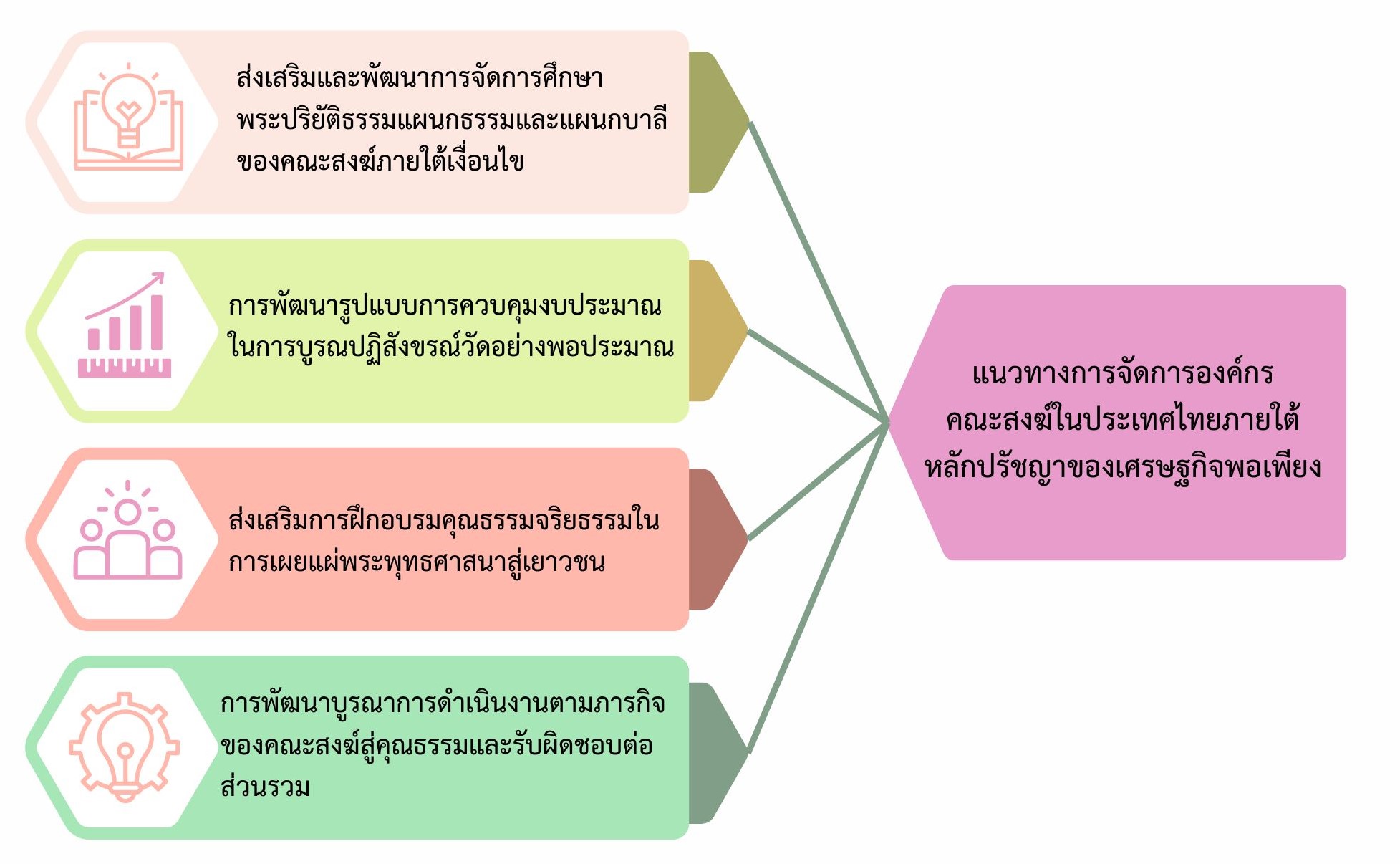
3. Guidelines for organizing the organization of the Sangha in Thailand under the philosophy of Sufficiency Economy. There are 4 approaches, namely, promotion and development of the study of the Pariyatitham, Dhamma section and Pali section. Developing a budget control model for temple restoration in a modest manner. Promote moral and ethical training in propagating Buddhism and development and integration of operations according to the mission of the Sangha.
References
กรมการศาสนา. (2560). แผนยุทธศาสตร์ระยะ 5 ปี (พ.ศ. 2560-2565). กรุงเทพฯ: กรมการศาสนา.
ปริญญา สิริอัตตะกุล. (2555). การวิเคราะห์ความแปรปรวนแบบทางเดียว:การวิจัยทางสังคมศาสตร์. วารสารสหวิทยาการวิจัย: ฉบับบัณฑิตศึกษา, 1(1), 13-23.
พระครูปลัดอภิชาติ สุวณฺณโชโต (ทรงกิจ วิศวการ). (2558). รูปแบบการบริหารกิจการคณะสงฆ์ที่ดีในจังหวัดพระนครศรีอยุธยา. (วิทยานิพนธ์พุทธศาสตรดุษฎีบัณฑิต). พระนครศรีอยุธยา: มหาวิทยาลัยมหาจุฬาลงกรณราชวิทยาลัย.
พระครูสันติธรรมาภิรัต (บุญชัย สนฺติกโร). (2557). การพัฒนารูปแบบการปกครองคณะสงฆ์ในเขตปกครองคณะสงฆ์ภาค 15. (วิทยานิพนธ์พุทธศาสตรดุษฎีบัณฑิต). พระนครศรีอยุธยา: มหาวิทยาลัยมหาจุฬาลงกรณราชวิทยาลัย.
พระมหาจรัญ ภูริโกวิโท (พรมเลิศ). (2562). แนวทางการบริหารกิจการคณะสงฆ์ของพระสังฆาธิการ จังหวัดนนทบุรีเชิงพุทธบูรณาการ. (วิทยานิพนธ์พุทธศาสตรดุษฎีบัณฑิต). พระนครศรีอยุธยา: มหาวิทยาลัยมหาจุฬาลงกรณราชวิทยาลัย.
พระมหาปรีชา เขมนนฺโท (เหล่าทวีคุณ). (2561). การประยุกต์หลักอิทธิบาทธรรมเพื่อการบริหารจัดการสำนักปฏิบัติธรรม ในจังหวัดพระนครศรีอยุธยา. (วิทยานิพนธ์พุทธศาสตรดุษฎีบัณฑิต). พระนครศรีอยุธยา: มหาวิทยาลัยมหาจุฬาลงกรณราชวิทยาลัย.
พระมหาศรณชัย มหาปุญฺโญ. (2556). การพัฒนาการบริหารกิจการคณะสงฆ์ของพระสังฆาธิการในยุคโลกาภิวัตน์. (วิทยานิพนธ์พุทธศาสตรดุษฎีบัณฑิต). พระนครศรีอยุธยา: มหาวิทยาลัยมหาจุฬาลงกรณราชวิทยาลัย.
พระมหาอัครพงษ์ พูลผล. (2561). แนวทางการพัฒนาการบริหารกิจการคณะสงฆ์สังกัดมหานิกาย: กรณีศึกษาการบริหารของเจ้าอาวาสของวัดในจังหวัดชุมพร. (วิทยานิพนธ์รัฐประศาสนศาสตรมหาบัณฑิต). สุราษฎร์ธานี: มหาวิทยาลัยราชภัฏสุราษฎร์ธานี.
สำนักงานพระพุทธศาสนาแห่งชาติ. (2566). การพัฒนาองค์การไปสู่การเป็นองค์การแห่งการเรียนรู้. เข้าถึงได้จาก https://www.onab.go.th/th/content/category/detail/id/1049/iid/45486
Cronbach, L. J. (1970). Essentials of Educational Administration. (8th ed.). Boston: Allyn and Bacon.
Fayol, H. (1916). General and industrial management. London: Sir Isaac Pitman and Son.
Krejcie, R. V., & Morgan, D. W. (1970). Determining Sample Size for Research Activities. Educational and Psychological Measurement, 30(3), 607-610.
Rovinelli, R. J., & Hambleton, R. K. (1997). On the use of content specialists in the assessment of criterion-referenced test item validity. Dutch Journal of Educational Research, 2, 49-60.