Developing the Potential of Community Knowledge Management to Become a Sustainable Grassroots Economic Community Learning Center, Khlong Khwai Subdistrict, Sam Khok District, Pathum Thani Province
Keywords:
Community Innovators, Grassroots Economy, Transmission, Knowledge ManagementAbstract
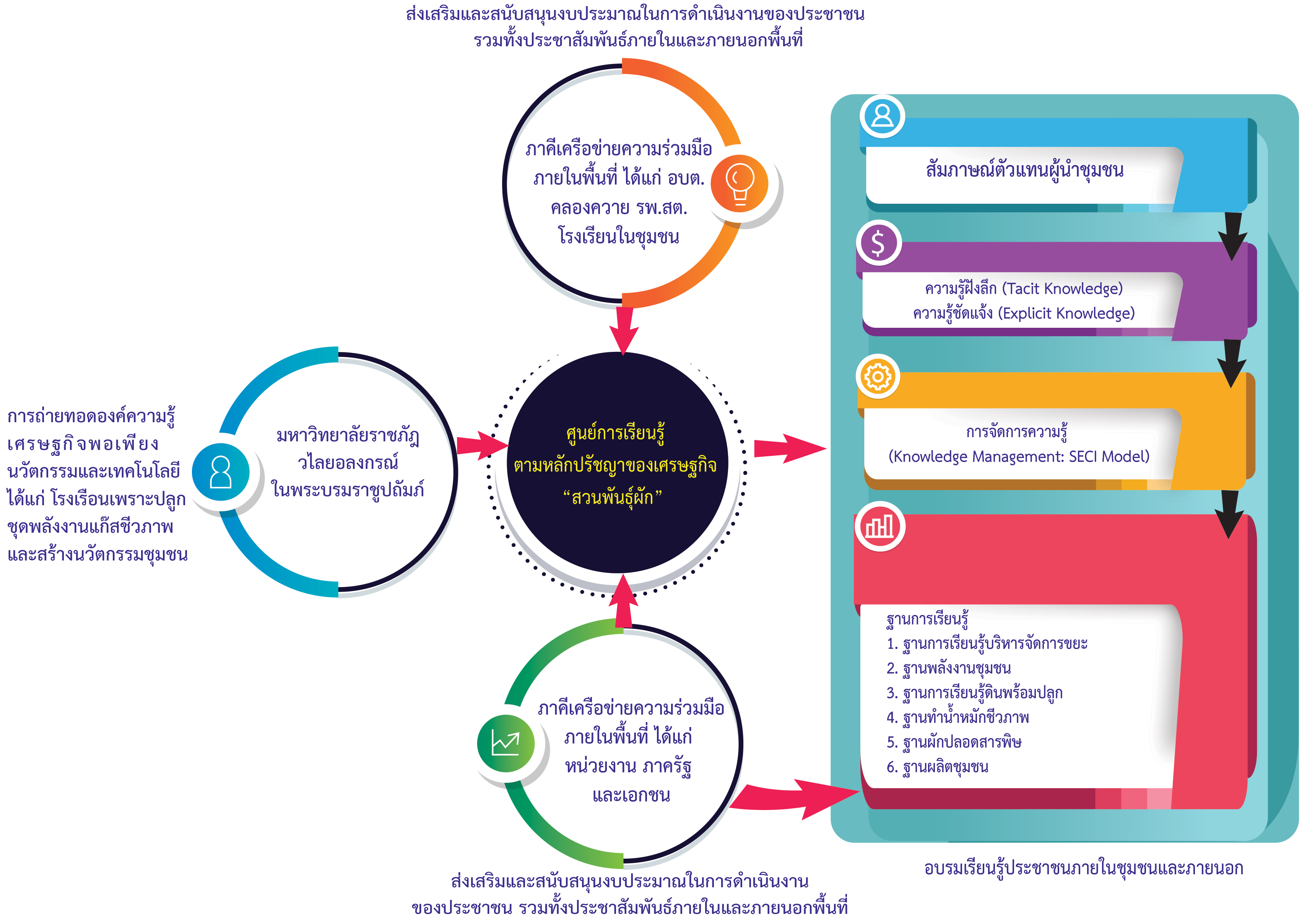
This research aims to explore the development of community knowledge management potential towards establishing a sustainable grassroots economy learning center in Khlong Khwai Subdistrict, Sam Khok District, Pathum Thani Province. This study employs participatory action research (PAR) involving key informants from government and community representatives. A purposive sampling method was used to select a group of 25 individuals. Knowledge management tools were applied to address community issues through collaboration with network partners in implementing research activities and fostering cooperation. The research tool used was an interview, employing the SECI Model to create a prototype for a community learning center.
The research results found that: appropriate knowledge management in the context of the area for establishing a sustainable community learning center for grassroots economic development can be divided into four key activities: 1) Knowledge Exchange (Socialization) - This involves sharing knowledge on how to create a prototype for becoming a community learning center, fostering community innovators to collaboratively develop strategies to enhance the learning center's recognition among external individuals and to serve as a learning space for local residents. 2) Knowledge Extraction (Externalization) - This focuses on developing processes to convey new knowledge through learning bases. 3) Knowledge Collection (Combination) - This involves gathering knowledge for interested parties, such as waste management knowledge, community energy production processes, knowledge on producing ready-to-plant soil, online sales, etc. and 4) Knowledge Integration (Internalization) - This leads to the emergence of community innovators, who are the core drivers of the learning center's activities.
References
สำนักงานคณะกรรมการพัฒนาการเศรษฐกิจและสังคมแห่งชาติ. (2560). ยุทธศาสตร์ชาติ ระยะ 20 ปี (พ.ศ. 2560-2579). กรุงเทพฯ: สำนักงานเลขานุการของคณะกรรมการ ยุทธศาสตร์ชาติ สำนักงานคณะกรรมการพัฒนาการเศรษฐกิจและสังคมแห่งชาติ.
อารีย์ เชื้อเมืองพาน. (2551). วิถีชีวิตแบบเศรษฐกิจพอเพียง: ทางรอดพ้นกับดักทาง เศรษฐกิจและสังคม. วารสารแม่โจ้ปริทัศน์, 9(6), 9-11.
Andersen, A. (2005). Knowledge management news. Retrieved from http://www.kmnews.com/index.php?page=themopportunity
Mangkhang, C., et al. (2016). A study project of the royal project’s knowledge transfer and capacity building for highland communities. Chiang Mai: Highland Research and Development Institute (Public Organization).
Nonaka, I. and Takeuchi, H. (1995). โมเดลเซกิ (SECI Model). เข้าถึงได้จาก http://aminaghazadeh.edublogs.org/2010/08/30/nonakas-seci-model/
Nonaka, I. and Takeuchi, H. (1995). The knowledge creating company: How Japanese companies create the dynamics of innovation. New York: Oxford University.
Sornphaisan. (2017). Pracharat for the people and for the state. Retrieved form https://mgronline.com/mualfund/detail/9580000106890
United Nations Office for South-South Cooperation. (2018). Good Practices in South-South and Triangular Cooperation for Sustainable Development-Volume 2. New York: UNOSSC.