Modifying Human Behavior According to the Guidelines of Western Psychology and Buddhism
Keywords:
Modifying Human Behavior, Overt Behavior, Covert BehaviorAbstract
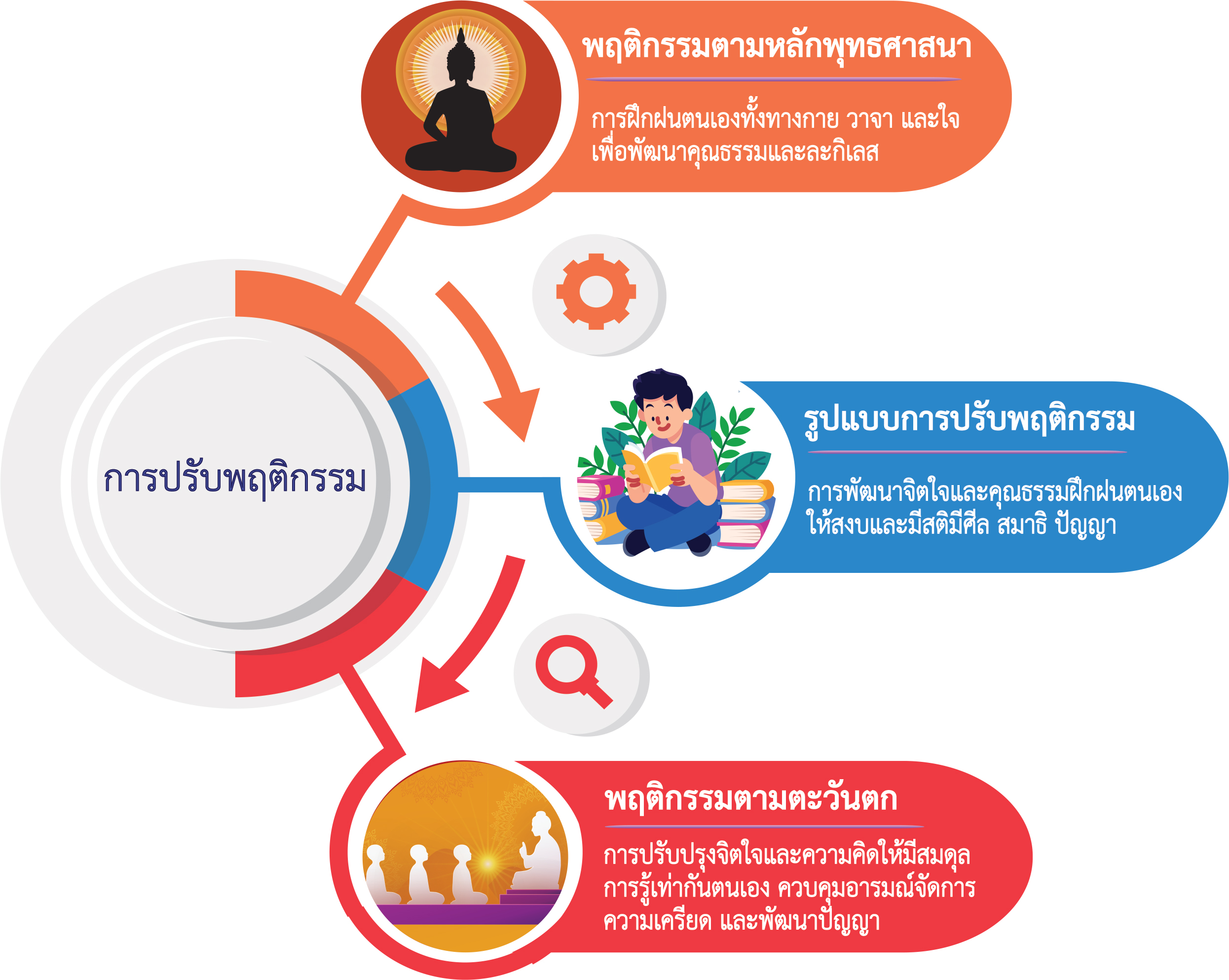
This article aims to study Modifying Human Behavior According to the guidelines of Western psychology and Buddhism. The studies have shown that behavior refers to actions or reactions in response to external or internal stimuli. Western psychologists divide behavior into two main categories: External behavior which are actions that can be directly observed, such as crying or speaking and internal behavior, which is an action that cannot be directly observed such as feelings of hunger or sadness. Western behavior modification emphasizes observation and measurement of obvious results. The behavioral modification model in this article is studied within the framework of John B. Watson and B. F. Skinner. Watson emphasize classical learning that aims to connect Associating stimuli and automatic response. Skinner, on the other hand, emphasized practical learning that uses reinforcement and punishment to modify behavior.
In Buddhism, “behavior” refers to actions that are intentional and intent. It is divided into physical, verbal and mental behavior. Behavior according to Buddhist principles is divided into two main types: Behavior according to body or behavior based on conditioning (saṅkhāra) and behavior according to ethics or behavior based on temperament (jarita). which has various levels of behavior that arises from passion including detailed behavior neutral behavior and rough behavior. There are three levels of behavioral adjustment: The precepts level or sīla, (basic) is used to roughly adjust one’s behavior, namely physical and verbal behavior, to have a behavior that expresses itself physically. Preferred verbal by making an effort to maintain precepts and conduct according to the permitted guidelines. Refrain from prohibited items Concentration level or samādhi, (medium) used to adjust mental behavior to be stable and not shaken, by practicing meditation according to the principles of Samatha meditation. And the (high) intelligence level or wisdom (paññā) is used to adjust behavior in detail makes the mind intelligent to consider reason and correctness, by practicing Vipassana meditation. Behavior modification according to Buddhist guidelines aims to provide two benefits: 1) Self-benefit (attābhāva) and 2) Benefit to others (parattābhāva).
References
พระพรหมคุณาภรณ์ (ป.อ.ปยุตฺโต). (2549). พุทธธรรม ฉบับขยายความ. (พิมพ์ครั้งที่ 11). กรุงเทพฯ: สหธรรมิก.
มหาจุฬาลงกรณราชวิทยาลัย. (2539). พระไตรปิฎกภาษาไทยฉบับมหาจุฬาลงกรณราชวิทยาลัย. กรุงเทพฯ: มหาจุฬาลงกรณราชวิทยาลัย.
มหาวิทยาลัยราชภัฏนครปฐม. (2567). ทฤษฎีการเรียนรู้กลุ่มพฤติกรรมนิยม. เข้าถึงได้จาก http://pws.npru.ac.th/wiratn/system/20151230163521_2528d5f5f549e33fa4551c1141e90d7e.pdf
สมเด็จพระพุฒาจารย์ (อาจ อาสภมหาเถร). (2546). วิสุทธิมรรค ฉบับ แปลและเรียบเรียง คัมภีร์วิสุทธิมรรค. (พิมพ์ครั้งที่ 4). กรุงเทพฯ: วัดมหาธาตุยุวราชรังสฤษฎิ์.
สมเด็จพระพุทธโฆษาจารย์ (ประยุทธ์ ปยุตฺโต). (2529). พุทธธรรม ฉบับปรับปรุงและขยายความพระราชวรมุนี (ประยุทธ์ ปยุคโต). (พิมพ์ครั้งที่ 3). กรุงเทพฯ: มหาจุฬาลงกรณราชวิทยาลัย.
สมโภชน์ เอี่ยมสุภาษิต. (2550). ทฤษฎีและเทคนิคการปรับพฤติกรรม. (พิมพ์ครั้งที่ 6). กรุงเทพฯ: จุฬาลงกรณ์มหาวิทยาลัย.
สิทธิโชค วรานุสันติกุล. (2546). จิตวิทยาสังคม: ทฤษฎีและการประยุกต์. กรุงเทพฯ: ซีเอ็ดยูเคชั่น.
Corsini, R. J. (2002). The Dictionary of Psychology. New York: Brunner-Routledge.
John B. Watson. (2024). ทฤษฎีการวางเงื่อนไขแบบคลาสสิคของวัตสัน. เข้าถึงได้จาก https://eclassnet kku.ac.th.
Warren, H. C. (1934). Dictionary of Psychology. Cambridge: The Riberide Press.