Social Immunity Strategies From Covid-19 and Embracing Buddhist Integration in The Mekong River Basin Border Area, Loei Province.
Keywords:
Building Immunity, COVID-19, Buddhist Integration, Border Areas of the Mekong River BasinAbstract
This research the objectives are to 1) study recovery measures and drive policies to monitor the spread of COVID-19. Buddhist integration and 2) propose guidelines for building social immunity from COVID-19. Buddhist Integration It is qualitative research. The tools used in the research include: In-depth interview Group discussion 60 key informants using purposive methods Data were analyzed using descriptive inductive principles.
The research results found that:
1. Problems in driving policy to monitor the spread of COVID-19 Along the border seam in Loei Province People in Loei Province are alert about self-protection against COVID-19, but lack the knowledge and understanding of self-protection, causing them to not participate in receiving information about surveillance.
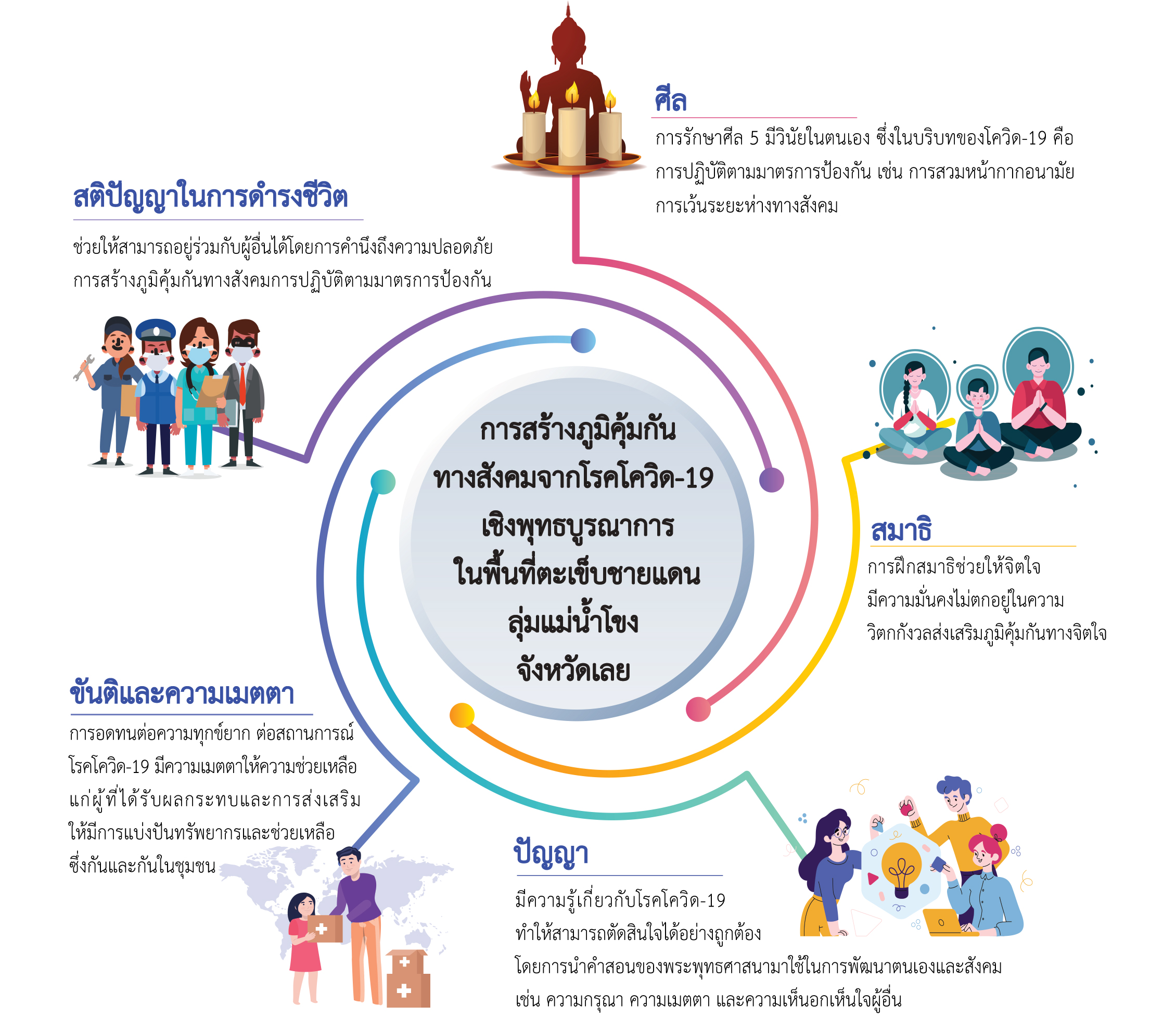
2. The Buddhist Integrative Approach to Building Social Immunity Against COVID-19 focuses on applying Buddhist principles to promote holistic well-being across four dimensions: physical, mental, social, and intellectual. Effective health promotion must involve an integrated approach, addressing the body, mind, and society. Neglecting any one of these dimensions can lead to imbalance. Mental health, as a core foundation, empowers individuals to face life's challenges. Strong mental resilience contributes to physical well-being, with social and environmental factors playing a key role. If any of these components are absent, life can become dysfunctional, negatively impacting the others, potentially leading to illness. Hence, achieving balance with the surrounding environment is essential for overall health. This aligns with the Buddhist doctrine of the Four Foundations of Mindfulness (Bhāvanā), which emphasizes development and training in body, morality, mind, and wisdom, all of which are integral to well-being.
References
ธนัชชา รอดกันภัย. (2560). การสร้างภูมิคุ้มกันทางสังคมของเยาวชนกลุ่มเสี่ยง: กรณีศึกษา นักศึกษา กศน. ตำบลควนทอง อำเภอขนอม จังหวัดนครศรีธรรมราช. (วิทยานิพนธ์ครุศาสตรมหาบัณฑิต). สุราษฎร์ธานี: มหาวิทยาลัยราชภัฏสุราษฎร์ธานี
บุญวรา สุมะโน และณัฏฐณิชา อเนกสมบูรณ์ผล. (2564). ความสำคัญของข้อมูลในช่วงโรคระบาด. เข้าถึงได้จาก https://tdri.or.th/2021/08/the-importance-of-data-in-the-fight-against-covid/
ระนอง เกตุดาว, อัมพร เที่ยงตรงดี และภาสินี โทอินทร์. (2564). การพัฒนารูปแบบการเฝ้าระวัง ป้องกันและควบคุมโรคติดเชื้อไวรัสโคโรนา 2019 โรงพยาบาลส่งเสริมสุขภาพตำบล จังหวัดอุดรธานี (Udon Model COVID-19). วารสารสารธารณสุข, 30(1), 53-61.
วสิษฐ์พล กูลพรม. (2560). การพัฒนากระบวนการเสริมสร้างชุมชนเข้มแข็งตามหลักพุทธธรรมของเทศบาลตำบลต้นธง อำเภอเมือง จังหวัดลำพูน. (รายงานการวิจัย). พระนครศรีอยุธยา: สถาบันวิจัยพุทธศาสตร์ มหาวิทยาลัยมหาจุฬาลงกรณราชวิทยาลัย.
สำนักงานจังหวัดเลย. (2560). รายงานประจำปี 2560. เลย: สำนักงานจังหวัดเลย.