The Social Engagement Mission of Local Universities in the Era of Artificial Intelligence: Promoting Lifelong Learning Through Sustainable Context-Based Approaches
Keywords:
Social Engagement;, Local Universities; , Era of Artificial Intelligence;, Lifelong Learning;, Context-Based ApproachesAbstract
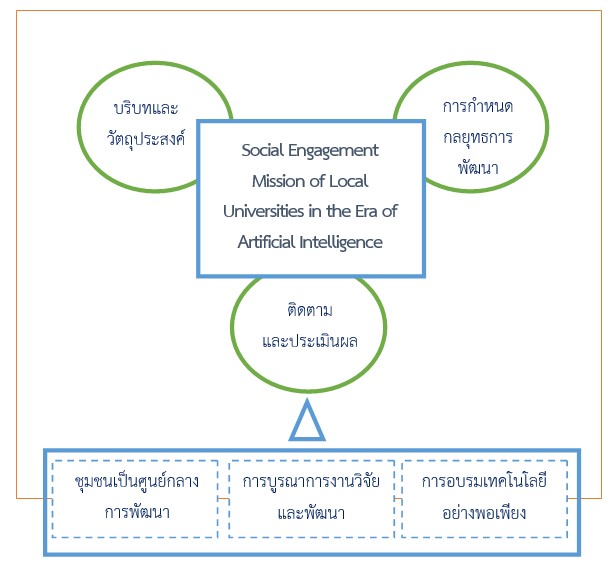
The social engagement mission of local universities in the era of artificial intelligence played a pivotal role in driving community development. It emphasized the integration of knowledge and technology with local contexts to address community needs and enhance human resource development. The application of social engagement principles created opportunities for students and staff to actively participate, beginning with the analysis of community issues and progressing toward the development of sustainable solutions. This article aimed to examine the current state of integrating social engagement missions in local universities, focusing on context-based sustainable community development. It also proposed recommendations to enhance these missions through the development of sustainable living learning centers rooted in local contexts. The study employed document analysis, field-based case studies, and interviews with key informants, synthesizing content and validating findings using triangulation techniques. The results revealed: 1. The integration of social engagement missions by local universities involved three key components: 1.1 Context and Objectives: Integration was based on the local context to ensure that lifelong learning development addressed the specific needs and resources of the community. 1.2 Development Strategies: This included applying context-based approaches, fostering collaboration, and leveraging technology effectively. 1.3 Monitoring and Evaluation: This prioritized participatory processes and evaluations that led to measurable improvements in the quality of life within communities. 2. Recommendations included: 2.1 Prioritizing community-centered development. 2.2 Integrating research and development to enhance capacity-building for improved quality of life. 2.3 Promoting appropriate training and the development of technology that aligned with local needs.
References
คณะกรรมการบริหารงานจังหวัดแบบบูรณาการ จังหวัดราชบุรี. (2564). แผนพัฒนาจังหวัดราชบุรี พ.ศ. 2566-2570. ราชบุรี: คณะกรรมการบริหารงานจังหวัดแบบบูรณาการ จังหวัดราชบุรี.
ธีระพงศ์ บุศรากูล. (2566). การจัดการเรียนรู้ตลอดชีวิตของชุมชนเพื่อสร้างชุมชนแห่งการเรียนรู้. วารสารการบริหารจัดการและนวัตกรรมท้องถิ่น, 5(7), 448-463.
นิภาวรรณ เจริญลักษณ์. (2566). การศึกษากิจกรรมเพื่อเรียนรู้ท้องถิ่น: ประสบการณ์ศูนย์เรียนรู้ปรัชญาเศรษฐกิจพอเพียงของชุมชนบ้านถ้ำเสือ ตำบลแก่งกระจาน อำเภอแก่งกระจาน จังหวัดเพชรบุรี. วารสารสังคมศาสตร์และวัฒนธรรม, 7(7), 43-54. https://so06.tci-thaijo.org/index.php/JSC/article/view/265198/178492
วิจารณ์ พานิช. (2561). มหาวิทยาลัยหุ้นส่วนสังคมที่สหราชอาณาจักร. กรุงเทพฯ: สถาบันคลังสมองของชาติ.
สำนักงานเกษตรจังหวัดราชบุรี. (2563). รายชื่อเกษตรกรจังหวัดราชบุรี 2563. ราชบุรี: กลุ่มส่งเสริมและพัฒนาเกษตรกร สำนักงานเกษตรจังหวัดราชบุรี.
Altbach, P., & Knight, J. (2007). The internationalization of higher education: Motivations and realities. Journal of Studies in International Education, 11(3), 290-305.
Baker, S., & Willoughby, K. (2021). Community engagement in sustainable development: The role of living learning centers. Journal of Community Development, 56(2), 145-162.
Benneworth, P., & Jongbloed, B. (2010). Who matters to universities? A stakeholder perspective on humanities, arts and social sciences valorization. Higher Education, 59(5), 567-588.
Bhagwan, R. (2019). Community engagement in social work education: Building pedagogical pathways. Southern African Journal of Social Work and Social Development, 6(1), 1-14.
Bhattacharyya, J., et al. (2010). Community development: A critical approach. Sage Publications.
Brown, J. S., Collins, A., & Duguid, P. (1989). Situated cognition and the culture of learning. Educational Researcher, 18(1), 32-42.
Gaventa, J. (2004). Finding the spaces for change: A power analysis. Institute of Development Studies.
Gaventa, J. (2004). Participatory development and community empowerment. Community Development Journal, 39(2), 123-134.
Goodfellow, I., Bengio, Y., & Courville, A. (2016). Deep learning. MIT Press.
Herrington, J., & Oliver, R. (2000). An instructional design framework for authentic learning environments. Educational Technology Research and Development, 48(3), 23-48.
Holland, J., & Burdett, M. (2018). Creating sustainable learning communities: The impact of living learning centers on community resilience. International Journal of Sustainability in Higher Education, 19(4), 668-682.
Lave, J., & Wenger, E. (1991). Situated learning: Legitimate peripheral participation. Cambridge University Press.
Marcus, G. (2018). Deep learning: A critical appraisal. arXiv preprint arXiv:1801.00631. https://arxiv.org/abs/1801.00631
McCarthy, J. (2007). What is artificial intelligence? Stanford University. Retrieved from https://stanford.edu/~jmc/whatisai.html
McIlrath, L., & Mac Labhrainn, I. (2007). Higher education and civic engagement: International perspectives. Ashgate.
Morrow, E., & Smith, J. (2019). Participatory learning in practice: Living learning centers as a model for community engagement. Journal of Adult and Continuing Education, 25(1), 39-54.
Pretty, J. (2003). Social capital and the collective management of resources. Science, 302(5652), 1912-1914.
Putnam, R. D. (2000). Bowling alone: The collapse and revival of American community. Simon & Schuster.
Rennie, L. J. (2017). Learning in community: The role of living learning centers in adult education. International Review of Education, 63(2), 243-261.
Russell, S., & Norvig, P. (2020). Artificial intelligence: A modern approach. (4th ed.). Pearson.
Srivastava, A. (2020). Socially responsible higher education in the age of AI. International Journal of Community Engagement, 9(1), 22-35.
Watson, D., Hollister, R., Stroud, S. E., & Babcock, E. (2011). The engaged university: International perspectives on civic engagement. Routledge.