“Chong” Identity Space in the Development Trend
Keywords:
Chong; , Space; , Identity; , DevelopmentAbstract
This research aimed to 1) study the loss of cultural identity of the Chong ethnic group in the Eastern region of Thailand, 2) maintain the cultural traditions that affect the existence of the Chong ethnic group, and 3) propose policy guidelines for spatial development through the Chong cultural traditions. This research was qualitative with 19 key informants. The research instruments were in-depth interviews, participant observation, focus group discussions, and document analysis. The research focused on case studies of Chong ethnic communities in the Eastern region of Thailand. Data triangulation was used in terms of data collection methods, content analysis, and description.
The research results found that:
1. Loss of Cultural Identity of the Chong Ethnic Group in Eastern Community It was found that the social structure and kinship system of the Chong people were weakened by the development of capitalist economy. Policies that encourage people to enter the modern labor market have separated the youth from the community. As a result, traditional rituals such as “Phīpračhamtrakoon” and “Praphēnīkānrǣknā” have become less intense. This change is consistent with Marx's idea about the state and capital dominating the social structure.
2. Methods of preserving cultural traditions that affect the existence of the Chong ethnic group in the Eastern community found that communities that still preserve culture, such as Ban Takhian Thong and Ban Chang Thun, use methods of combining traditional culture with the new economic system, such as promoting cultural tourism and using technology to transfer knowledge, which is consistent with structuralism that views culture as being able to adapt under a new structure.
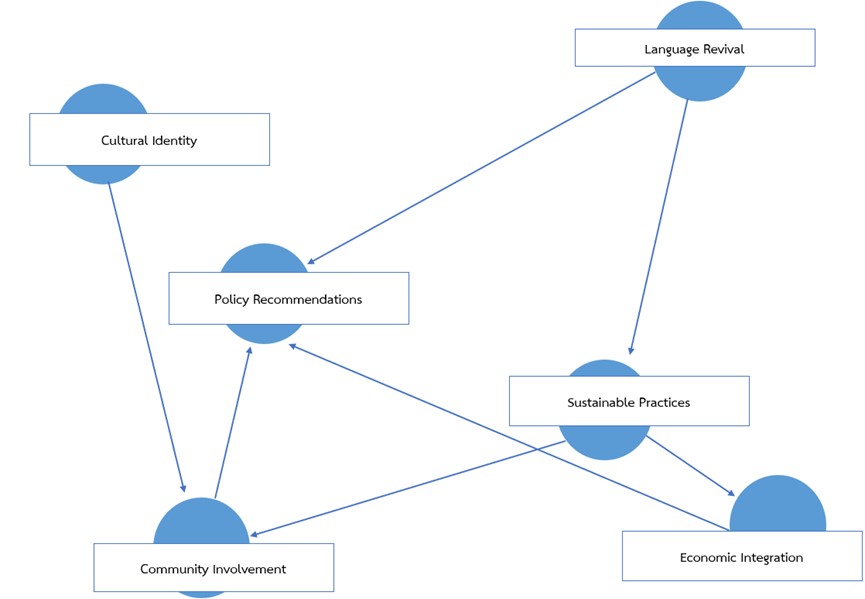
3. Suggesting policy guidelines for spatial development through the “Chong” cultural path to preserve Chong identity, there should be (1) the establishment of cultural conservation zones, (2) the integration of Chong language curriculum in schools, (3) government support in organizing cultural activities, and (4) the development of community economy linked to cultural capital. This approach supports Bourdieu's view that “cultural capital can create bargaining power and preserve identity”.
References
คารร์ เอ. (2509). ชาติวงศ์วิทยา ว่าด้วยชนชาติเผ่าต่างๆ ในประเทศไทย. กรุงเทพฯ: อักษรเจริญทัศน์.
จังหวัดระยอง. (2525). ประวัติมหาดไทยส่วนภูมิภาคจังหวัดระยอง. ระยอง: ธนชาติการพิมพ์.
ชิน อยู่ดี. (2529). สมเด็จพระเทพรัตนราชสุดาฯ สยามบรมราชกุมารีทรงพระกรุณาโปรดเกล้าฯ เสด็จพระราชดำเนินพระราชทานเพลิงศพ ศาสตราจารย์ชิน อยู่ดี ต.ม., จ.ช. ณ เมรุวัดตรีทศเทพ กรุงเทพมหานคร วันจันทร์ที่ 13 ตุลาคม พุทธศักราช 2529 เวลา 17.00 นาฬิกา. พิฆเณศ.
ปรีชา เปี่ยมพงศ์สานต์. (2556). เศรษฐศาสตร์การเมือง นิเวศวิทยาการเมืองและนิเวศสังคมนิยม. วารสารเศรษฐศาสตร์การเมือง, 1(1), 217-233.
ปรีชา เปี่ยมพงศ์สานต์. (2557). เศรษฐศาสตร์การเมือง และทฤษฎีสังคมวิพากษ์. ขอนแก่น: คณะมนุษยศาสตร์และสังคมศาสตร์ มหาวิทยาลัยขอนแก่น.
สุนทรภู่. (2498). นิราศเมืองแกลง และประวัติสุนทรภู่. ม.ป.พ.
สุวิไล เปรมศรีรัตน์. (2559). ภาษาชอง. ใน ภาษา: มรดกภูมิปัญญาทางวัฒนธรรมของชาติ (หน้า 18-21). กรุงเทพฯ: องค์การสงเคราะห์ทหารผ่านศึกในพระบรมราชูปถัมภ์.
อัลธูแชร์ หลุยส์. (2557). Ideology and Ideological State Apparatuses [อุดมการณ์และกลไกทางอุดมการณ์ของรัฐ] (กาญจนา แก้วเทพ, ผู้แปล). (พิมพ์ครั้งที่ 2). กรุงเทพฯ: สยามปริทัศน์.
เออร์เนสต์ แมนเดล. (2559). From class society to Communism: An introduction to Marxism [เศรษฐศาสตร์การเมืองเบื้องต้น] (กนกศักดิ์ แก้วเทพ, ผู้แปล). กรุงเทพฯ: Text.
โอฬาร ถิ่นบางเตียว. (2557). จังหวัดระยอง: จากเศรษฐกิจชุมชนถึงทุนนิยมโลกาภิวัตน์. วารสารเศรษฐศาสตร์การเมืองบูรพา, 2(1), 41-71.
Ameen, R. M., & Magirovskaya, O. V. (2020). Ethnic language use as a symbol of keeping the nation’s culture and traditions (the case of the displaced peoples’ languages in the Kurdistan region). Journal of Siberian Federal University, Humanities & Social Sciences, 13(4), 480-487. https://doi.org/10.17516/1997-1370-0555
Barthes, R. (1977). Rhetoric of the image. In Image, music, text (pp. 32-51). Fontana Press.
Barthes, R. (1977). The third meaning. In Image, music, text (pp. 52-68). Hill and Wang.
Bertrand, J., & Xu, C. (2023). Indigenous groups and ethnic minorities. Routledge. https://doi.org/10.4324/9780367422080-18
Borisova, N., & Borodina, L. S. (2016). "Struggle for language" and language preferential policy as factors of ethnic conflicts in modern India. Ars Administrandi, 4, 95-113. https://doi.org/10.17072/2218-9173-2016-4-95-113
Borkowska, M., Nazroo, J., Finney, N., & Harrison, J. (2023). Ethnic identities. https://doi.org/10.51952/9781447368861.ch003
Bourdieu, P. (1994). Distinction: A Social Critique of the Judgement of Taste. London: Routledge.
Bourdieu, R. (1977). Out of a Theory of Practice. Cambridge: Cambridge University Press.
Brass, P. R. (1985). Ethnic Groups and the State. Routledge. https://doi.org/10.4324/9781 003372059
Chirlesan, G., & Chirleşan, D. (2017). Working with multicultural groups: A culture and ethnicity case study in Romania. European Proceedings of Social & Behavioural Sciences, 17, 106-112. https://doi.org/10.15405/EPSBS.2017.05.02.245
Dou, J., Han, Y., & Duan, G. (2022). A case study on economic development and traditional culture protection: Taking the Oroqen as an example. Journal of Education,
Humanities and Social Sciences, 4(1), 1-8. https://doi.org/10.54097/ehss.v4i.2731
Hamer, K., McFarland, S., Czarnecka, B., Golińska, A., Cadena, L. M., Łużniak-Piecha, M., & Jułkowski, T. (2020). What is an “ethnic group” in ordinary people’s eyes? Different ways of understanding it among American, British, Mexican, and Polish respondents: Cross-cultural research. Journal of Cross-Cultural Psychology, 51(4), 427-441. https://doi.org/10.1177/1069397118816939
Kotenok, E. G., & Frolova, V. S. (2022). The manifestation of ethnicity in the modern world (on the example of the analysis of wedding ceremonies). Society and Security Insights, 2, 13-22. https://doi.org/10.14258/ssi(2022)2-13
Koutrelakos, J. (2013). Ethnic identity: Similarities and differences in white groups based on cultural practices. Psychological Reports, 112(3), 745-762. https://doi.org/ 10.2466/17.10.PR0.112.3.745-762
Leach, E. (1970). The legitimacy of Solomon. In M. Lane (Ed.), Structuralism: A reader (pp. 248-292). Jonathan Cape.
Li, M., Li, M., Li, L. M. W., Zhao, K., & Gao, D. (2019). Cultural group perception enhances sense of agency in a multicultural society. Scandinavian Journal of Psychology, 60(5), 457-463. https://doi.org/10.1111/SJOP.12552
Modell, M., Mughal, Z., & Boyd, R. (1996). Ethnic groups. In Paediatric problems in general practice (3rd ed.). https://doi.org/10.1093/oso/9780192625120.003.0009
Ricoeur, P. (1974). Structure and hermeneutics. In Conflict of interpretations (pp. 27-61). Northwestern University Press.
Sidoryakin, R. V. (2022). Scientific and theoretical substantiation of the “ethnic identity” concept in the world psychological paradigm. Psychology of Education in a Multicultural Space, 58(2), 22-34. https://doi.org/10.24888/2073-8439-2022-58-2-22-34
Smooha, S. (2022). Ethnic groups. Routledge.
Smooha, S. (2022). Ethnic relations. Routledge.