Characteristics of Administrators Based on the Principles of Good Governance under the Office of Khon Kaen Primary Educational Service Area 4
Keywords:
Administrator Characteristics;, Good Governance;, Khon Kaen Primary Education Area 4Abstract
The objectives of this research were: (1) to study the characteristics of school administrators based on the principles of good governance, and (2) to propose guidelines for enhancing such characteristics. A mixed-methods approach, combining quantitative and qualitative research, was employed. The quantitative sample consisted of 264 school administrators and teachers selected through simple random sampling, while the qualitative data were obtained from 12 key informants. Research instruments included a questionnaire with a reliability coefficient of .85 and interviews. Quantitative data were analyzed using descriptive statistics-percentage, mean, and standard deviation-while qualitative data were analyzed through inductive content analysis.
The research results were as follows:
1. The overall characteristics of administrators based on the principles of good governance, under Khon Kaen Primary Educational Service Area Office 4, were rated at a high level. The highest-rated aspect was morality, followed by value for money, rule of law, accountability, and transparency, with the lowest being participation.
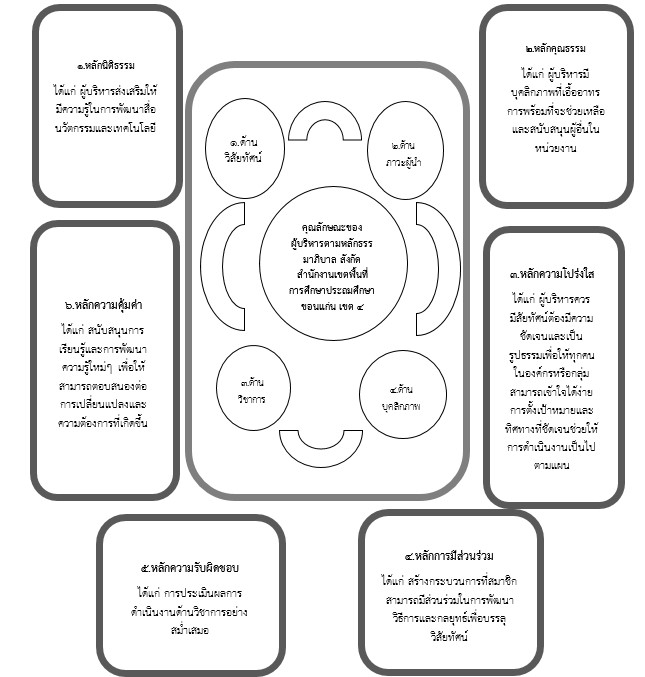
2. The proposed guidelines for administrators’ characteristics based on good governance included: (1) promoting knowledge in innovation and technology; (2) demonstrating a caring personality and willingness to support others; (3) having a clear and concrete vision to set organizational goals and directions; (4) creating participatory processes for developing strategies; (5) regularly evaluating academic performance; and (6) encouraging continuous learning and development to meet emerging changes and organizational needs.
References
กมลพรรณ พึ่งด้วง. (2560). การบริหารตามหลักธรรมาภิบาลกับประสิทธิผลของสถานศึกษาสังกัดสำนักงานเขตพื้นที่การศึกษาประถมศึกษาสมุทรสาคร. (วิทยานิพนธ์การบริการการศึกษามหาบัณฑิต). กรุงเทพฯ: มหาวิทยาลัยศิลปากร.
เจ้าอธิการบุญช่วย โชติวํโส (อุ้ยวงค์) และพระมหาสำรอง สญฺญโต (แสงทอง). (2562). ภาวะผู้นำตามหลัก ธรรมาภิบาลของผู้บริหารสถานศึกษาขั้นพื้นฐาน อำเภอเมืองขอนแก่น จังหวัดขอนแก่น. วารสารบัณฑิตศึกษามหาจุฬาขอนแก่น, 6(1), 156-168.
บุญชม ศรีสะอาด. (2545). การวิจัยเบื้องต้น. (พิมพ์ครั้งที่ 7). กรุงเทพฯ: สุวีริยสาส์น.
พงษ์ธร สิงห์พันธ์. (2564). การบริหารสถานศึกษาตามหลักธรรมาภิบาลของผู้บริหารสถานศึกษา สังกัดสำนักงานเขตพื้นที่การศึกษาประถมศึกษาอำนาจเจริญ. วารสารบริหารการศึกษาบัวบัณฑิต, 21(2), 12-21. https://so06.tci-thaijo.org/index.php/BUAJEAD/article/view/260101/ 174592
พระพรหมบัณฑิต (ประยูร ธมฺมจิตฺโต). (2551). ทิศทางการศึกษาไทย. กรุงเทพฯ: มหาจุฬาลงกรณราชวิทยาลัย.
สำนักงานเขตพื้นที่การศึกษาประถมศึกษาขอนแก่น เขต 4. (2566-2570). แผนพัฒนาคุณภาพการศึกษาขั้นพื้นฐาน. เข้าถึงได้จาก https://www.khonkaen4.go.th/
สำนักงานคณะกรรมการการศึกษาแห่งชาติ. (2545). พระราชบัญญัติการศึกษาแห่งชาติ (ฉบับที่ 2) พ.ศ. 2545. ราชกิจจานุเบกษา.
Abdullahi, N. J. K. (2020). Good governance issues in education system and management of secondary schools in Kwara State, Nigeria. NAU Journal of Education Research and Practice. http://nau.edu/COE/eJournal/