Local Political Leaders’ Participation in Promoting the Administration of the Sangha in Kalasin Municipality Through the Application of Aparihaniyadhamma
Keywords:
Participation, Local Leadership, Monastic Administration, Aparihaniyadhamma, Kalasin MunicipalityAbstract
This research aimed to: 1) examine the level of participation of local political leaders in promoting Sangha administration in Kalasin Town Municipality; 2) investigate the relationship between the principles of Aparihāniyadhamma and the participation of local political leaders in promoting Sangha administration; and 3) propose guidelines for applying the principles of Aparihāniyadhamma to promote Sangha administration among local political leaders in Kalasin Town Municipality. A mixed-methods research design was employed. The quantitative sample consisted of 197 local political leaders. The sample size was determined using Taro Yamane’s formula, and stratified random sampling was applied. For the qualitative component, 12 key informants, including monks and laypersons, were selected. The research instruments comprised a questionnaire and an in-depth interview form. The questionnaire had a reliability coefficient of .830. Quantitative data were analyzed using frequency, percentage, mean, standard deviation, and Pearson’s correlation coefficient, while qualitative data were analyzed through descriptive content analysis.
The results revealed that:
1. The overall participation of local political leaders in promoting Sangha administration was at a high level (M = 3.52, S.D. = 0.54). The participation dimension had the highest mean score (M = 3.63), followed by participation in evaluation (M = 3.53), while participation in implementation and participation in receiving benefits had equal mean scores (M = 3.47).
2. The principles of Aparihāniyadhamma had a statistically significant positive relationship with the participation of local political leaders in promoting Sangha administration at the .01 level (r = .78).
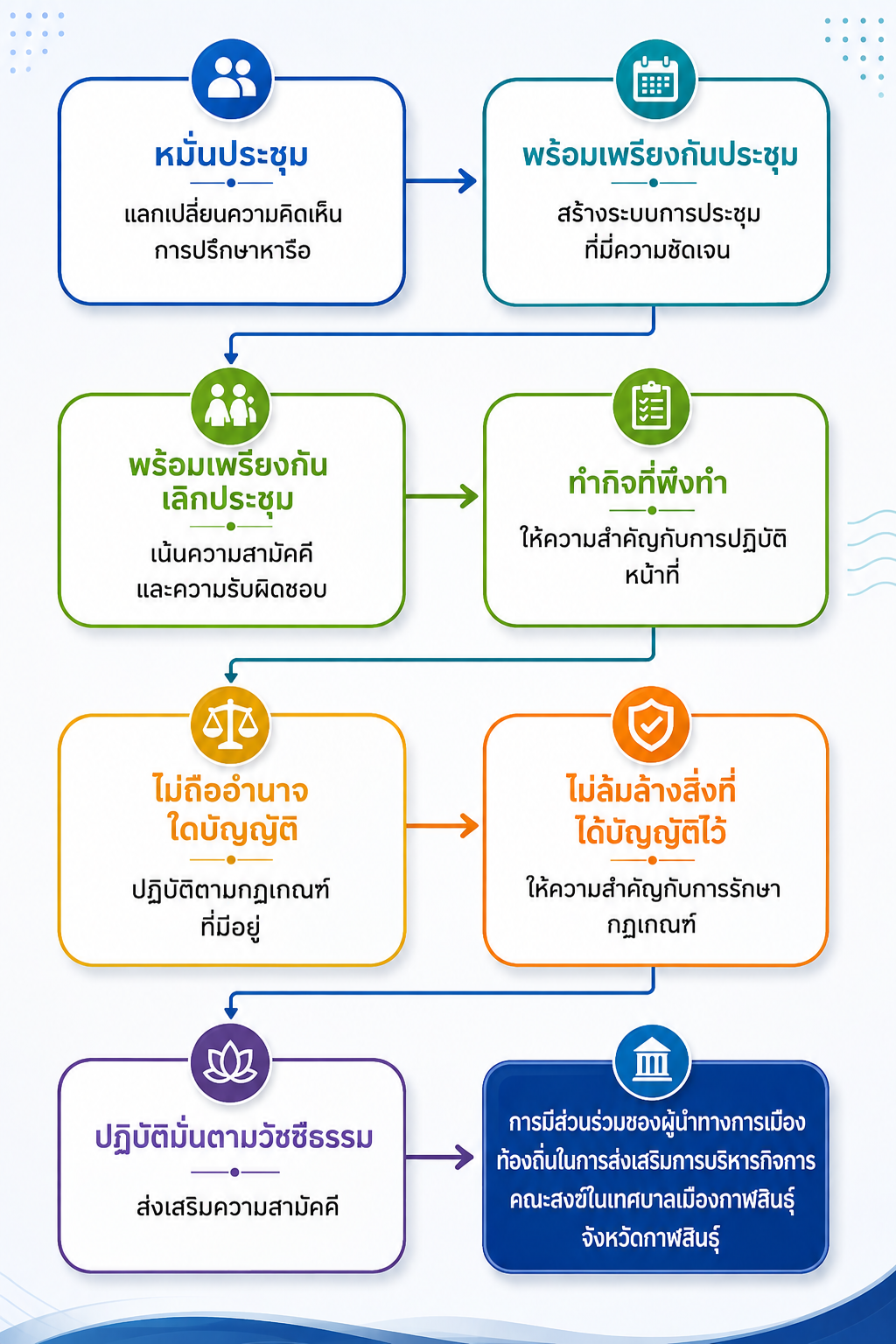
3. The application of Aparihāniyadhamma should emphasize regular and harmonious meetings, a clear meeting system, collective activities for the common good, respect for existing rules and regulations, and the promotion of unity and mutual understanding among local political leaders, the Sangha, and the community.
References
ปรีชา มีชัย. (2562). การเมืองไทยกับพุทธศาสนา. กรุงเทพฯ: มติชน.
พระมหาจิระศักดิ์ สิริภทฺโท (จิระสถิต). (2567). การประยุกต์หลักพุทธธรรมเพื่อส่งเสริมการมีส่วนร่วมของภาคประชาสังคม ในการจัดงานมหกรรมพืชสวนโลก จังหวัดอุดรธานี. (วิทยานิพนธ์รัฐศาสตรมหาบัณฑิต). พระนครศรีอยุธยา: มหาวิทยาลัยมหาจุฬาลงกรณราชวิทยาลัย.
พระมหาวรเมธ เตชธมฺโม (ดีสุรกุล). (2561). การส่งเสริมการบริหารกิจการคณะสงฆ์ด้านสาธารณสงเคราะห์ของอำเภอแก้งคร้อ จังหวัดชัยภูมิ. (สารนิพนธ์พุทธศาสตรมหาบัณฑิต). พระนครศรีอยุธยา: มหาวิทยาลัยมหาจุฬาลงกรณราชวิทยาลัย.
พระมหาภานุวัฒน์ สิทธิเมธาวี (จันทะยา), ชาญชัย ฮวดศรี และสุธิพงษ์ สวัสดิ์ทา. (2566). การมีส่วนร่วมในการบริหารกิจการคณะสงฆ์ด้านสาธารณสงเคราะห์ของผู้นำท้องถิ่นในอำเภอเมืองขอนแก่น จังหวัดขอนแก่น. วารสารบัณฑิตสาเกตปริทรรศน์, 8(2), 214-226. https://so03.tci-thaijo.org/index.php/saketreview/article/view/269300/181784
พระวสันต์ วสนฺตเวที (หงอกชัย) และชาญชัย ฮวดศรี. (2564). การมีส่วนร่วมของผู้นำท้องถิ่นในการส่งเสริมการปกครองคณะสงฆ์อำเภอเมือง จังหวัดขอนแก่น. Journal of Buddhist Education and Research, 7(1), 71-82.
มหาจุฬาลงกรณราชวิทยาลัย. (2539). พระไตรปิฎกภาษาไทย ฉบับมหาจุฬาลงกรณราชวิทยาลัย. กรุงเทพฯ: มหาจุฬาลงกรณราชวิทยาลัย.
เทศบาลเมืองกาฬสินธุ์. (2567). คณะผู้บริหารสำนักงานแรงงานจังหวัดกาฬสินธุ์. เข้าถึงได้จาก https//www.kalasinlocal.go.th/public/person/data/chart/structure_id/17/menu/1180
สมชาย ปรีชา. (2555). บทบาทของคณะสงฆ์ไทยในสังคมไทย. กรุงเทพฯ: มหาวิทยาลัยธรรมศาสตร์.
Yamane, T. (1967). Statistics: An introductory analysis. (2nd ed.). New York: Harper and Row.