Factors Innovative Leadership of Administrators that Affect the Effectiveness of Schools under Khon Kaen Primary Educational Service Area Office 1
Keywords:
Leadership;, Instructional Media Innovation;, Effectiveness;, AdministratorsAbstract
The objectives of this research were: (1) to study the factors of innovative leadership among school administrators, (2) to examine the level of school effectiveness, and (3) to analyze the relationship between innovative leadership of administrators and school effectiveness. This study employed a quantitative research methodology. The sample consisted of 317 school administrators and teachers, selected using Taro Yamane's sampling formula. The research instrument was a questionnaire with a reliability coefficient of 0.92. Data were analyzed using descriptive statistics, correlation analysis, and multiple regression analysis.
The results revealed that:
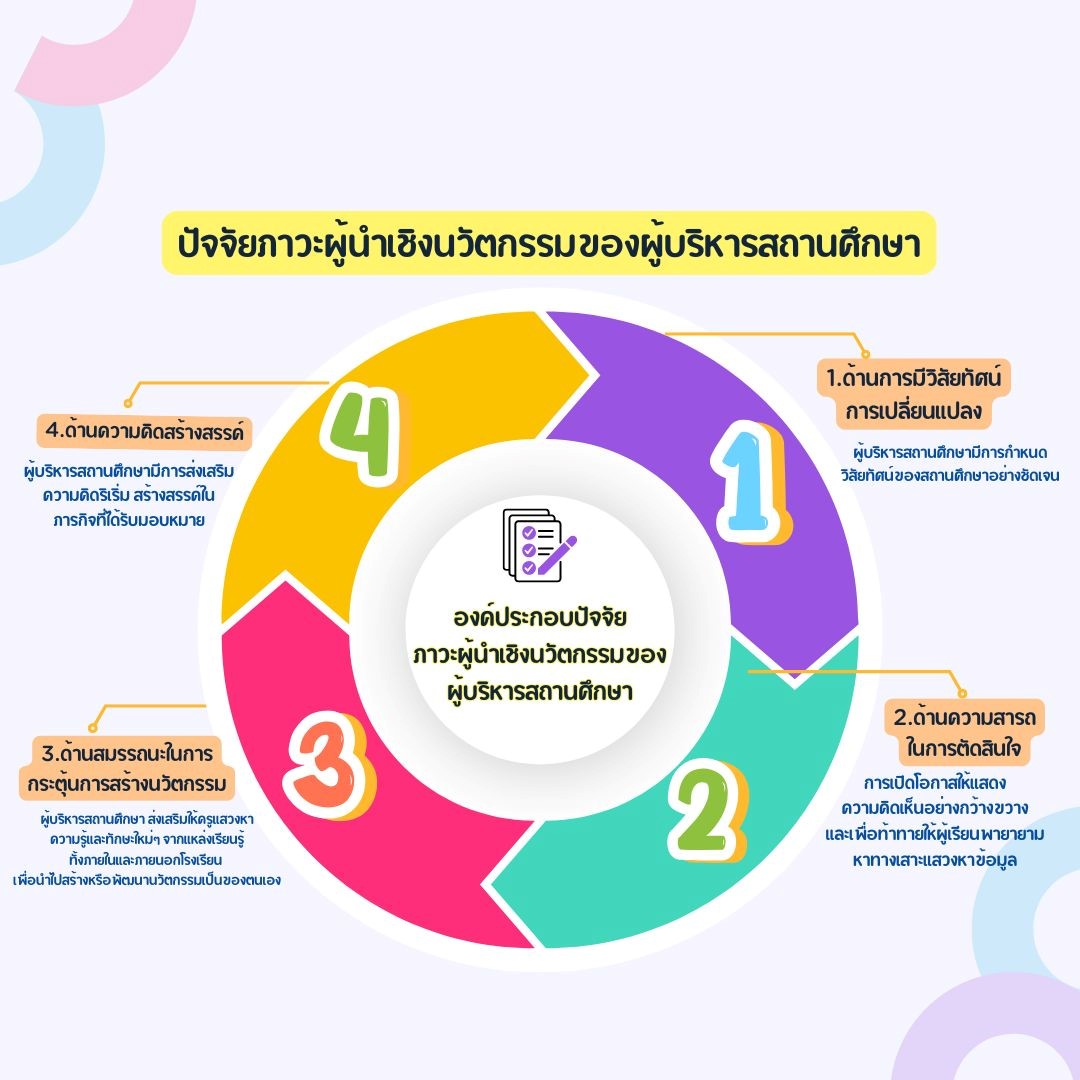
1. The innovative leadership factors of school administrators, both overall and by individual aspects, were at a high level. The aspect with the highest mean score was the competence in stimulating innovation ( = 4.40, S.D. = 0.74), followed by visionary leadership for change. The lowest mean score was found in the decision-making competence aspect (
= 4.30, S.D. = 0.68).
2. The overall school effectiveness was at a high level ( = 4.33, S.D. = 0.58). When considering each aspect individually, all were at high levels. The highest-rated aspect was the ability to promote high academic achievement among students (
= 4.39, S.D. = 0.54), followed by the ability to solve internal school problems (
= 4.34, S.D. = 0.65) and the ability to adapt and develop the school (
= 4.33, S.D. = 0.67). The aspect with the lowest score was the ability to foster students’ positive attitudes (
= 4.26, S.D. = 0.59).
3. The level of innovative leadership among administrators was found to have a statistically significant relationship with school effectiveness at the .01 level. The four predictor variables showed multiple correlation coefficients ranging from 0.922 to 0.954. Notably, the competence in stimulating innovation alone was a strong predictor of school effectiveness.
References
กนกทิพย์ ดอกลัดดา. (2560). ความสัมพันธ์ระหว่างการบริหารสถานศึกษากับประสิทธิผลสถานศึกษาของโรงเรียนราชวินัตบางแก้ว สังกัดสำนักงานเขตพื้นที่การศึกษามัธยมศึกษา เขต 6. (วิทยานิพนธ์การศึกษามหาบัณฑิต). ชลบุรี: มหาวิทยาลัยบูรพา.
ธิดาพร สร้อยสังวาล. (2564). บทบาทภาวะผู้นำเชิงนวัตกรรมของผู้บริหารโรงเรียนในสังกัดเทศบาลเมืองพะเยา จังหวัดพะเยา. (การศึกษาค้นคว้าการศึกษามหาบัณฑิต). พะเยา: มหาวิทยาลัยพะเยา
บริพัฒน์ สารผล. (2565). ภาวะผู้นำเชิงนวัตกรรมของผู้บริหารที่ส่งผลต่อประสิทธิผลการบริหารงานบุคคลของสถานศึกษา สังกัดสำนักงานเขตพื้นที่การศึกษามัธยมศึกษาอุดรธานี. (วิทยานิพนธ์ครุศาสตรมหาบัณฑิต). สกลนคร: มหาวิทยาลัยราชภัฏสกลนคร.
ศิริพร พงษ์เนตร (2564). การศึกษาภาวะผู้นำเชิงนวัตกรรมของผู้บริหารศึกษาสังกัดสำนักงานเขตพื้นที่การศึกษาประถมศึกษาปทุมธานี เขต 2. (วิทยานิพนธ์ศึกษาศาสตรมหาบัณฑิต). ปทุมธานี: มหาวิทยาลัยเทคโนโลยีราชมงคลธัญบุรี.