Guidelines for Developing Dual Vocational Training in Educational Institutions under the Vocational Education Commission, Khon Kaen Province
Keywords:
Development Guidelines;, Vocational Education Management;, Dual SystemAbstract
The objectives of this study were: (1) to investigate the current conditions of dual vocational education management in institutions under the Office of Vocational Education in Khon Kaen Province, and (2) to propose guidelines for its development. A mixed-methods research design was employed, combining quantitative and qualitative approaches. The sample consisted of 271 administrators and teachers, determined by Taro Yamane’s formula, together with three key informants for in-depth data. The research instruments included a questionnaire with a reliability coefficient of 0.94 and a semi-structured interview. Quantitative data were analyzed using percentage, mean, and standard deviation, while qualitative data were analyzed through content analysis.
The research results found that:
1. The overall condition of dual vocational education management in the studied institutions was at a high level ( = 4.25, S.D. = 0.63). The highest mean score was in the area of cooperation with enterprises (
= 4.30, S.D. = 0.59), followed by curriculum management (
= 4.29, S.D. = 0.63), while the lowest was in supervision (
= 4.19, S.D. = 0.71).
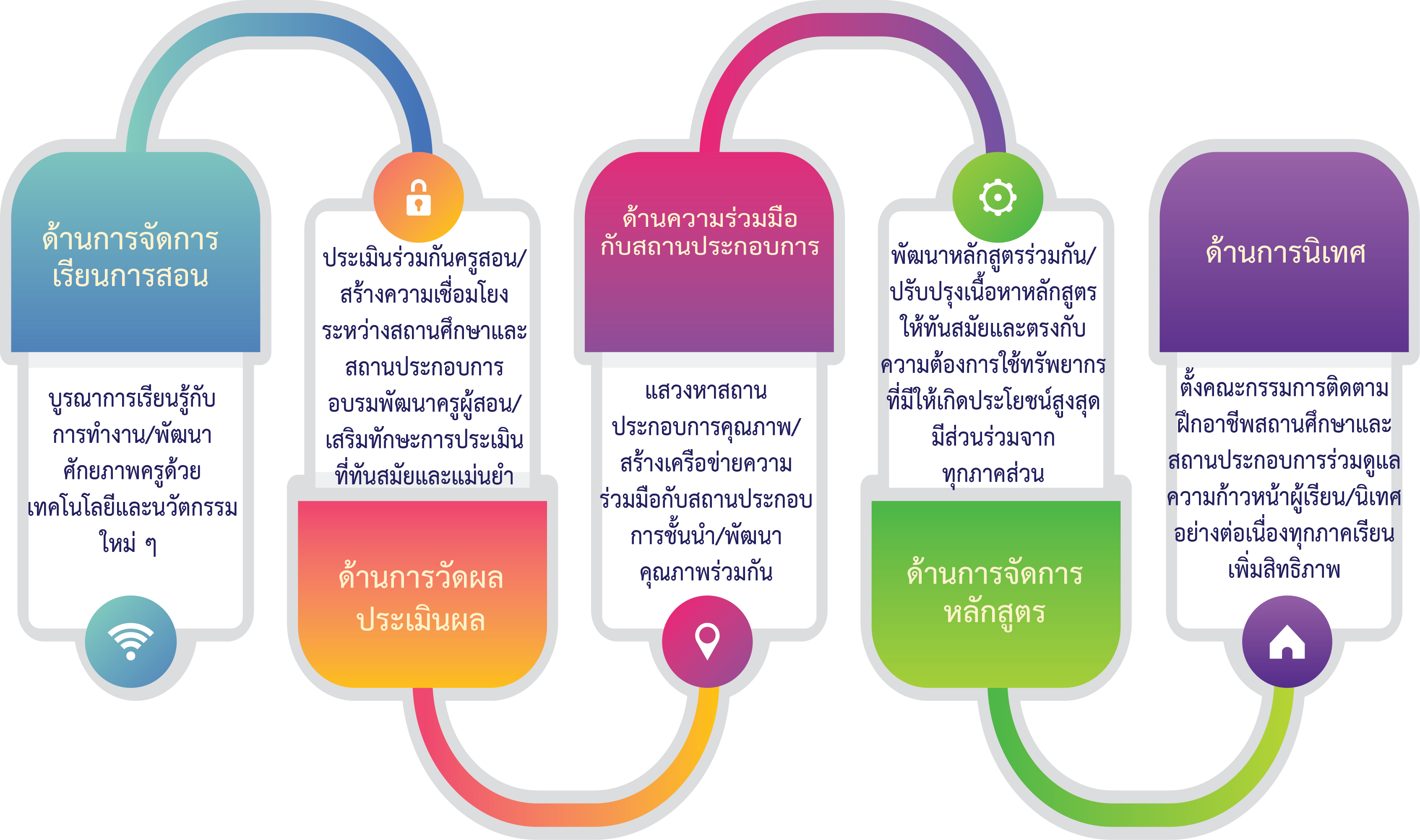
2. The development guidelines consisted of five aspects: (a) teaching and learning-emphasizing work-integrated learning, teacher development through technology, and alignment with enterprise contexts and needs; (b) assessment-promoting collaboration between teachers and trainers using both documents and online systems; (c) cooperation with enterprises-seeking partnerships with leading enterprises and adopting them as role models; (d) curriculum management-jointly developing curricula to align with contexts and training facilities; and (e) supervision-establishing joint committees, monitoring training progress, and developing an information system for more effective supervision.
References
กระทรวงศึกษาธิการ. (2551). พระราชบัญญัติการอาชีวศึกษา พ.ศ. 2551. ราชกิจจานุเบกษา.
______. (2562). พระราชบัญญัติการศึกษาแห่งชาติ (ฉบับที่ 4) พ.ศ. 2562. ราชกิจจานุเบกษา.
กุลริศา ตรีโชติ. (2564). การบริหารเครือข่ายความร่วมมือในการจัดการอาชีวศึกษาระบบทวิภาคีของสถานศึกษา สังกัดอาชีวศึกษาจังหวัดภูเก็ต. (วิทยานิพนธ์ศึกษาศาสตรมหาบัณฑิต). นนทบุรี: มหาวิทยาลัยสุโขทัยธรรมาธิราช.
ทรายทอง สมเป้า. (2561). สภาพและแนวทางการพัฒนาการจัดการอาชีวศึกษาระบบทวิภาคีของสถาบันการอาชีวศึกษาภาคเหนือ 1. (วิทยานิพนธ์ศึกษาศาสตรมหาบัณฑิต). นนทบุรี: มหาวิทยาลัยสุโขทัยธรรมาธิราช.
นิพล แก้วกาหลง. (2564). ปัจจัยทางการบริหารที่ส่งผลต่อประสิทธิผลในการจัดการศึกษา ระบบทวิภาคีของวิทยาลัย ในสังกัดอาชีวศึกษาจังหวัดสกลนคร. (วิทยานิพนธ์ครุศาสตรมหาบัณฑิต). สกลนคร: มหาวิทยาลัยราชภัฏสกลนคร.
บุญชม ศรีสะอาด. (2554). การวิจัยเบื้องต้น. (พิมพ์ครั้งที่ 9). กรุงเทพฯ: สุวีริยาสาส์น จำกัด.
พิมพ์พิศา รัตนธรรมาศ และสุกัญญา สุดารัตน์. (2567). แนวทางการจัดการอาชีวศึกษาระบบทวิภาคีของอาชีวศึกษาจังหวัดราชบุรี สำนักงานคณะกรรมการการอาชีวศึกษา. วารสารวิชาการสถาบันพัฒนาพระวิทยากร, 7(3), 184-192.
ศูนย์อาชีวศึกษาทวิภาคี. (2563). แนวทางปฏิบัติการจัดการอาชีวศึกษาระบบทวิภาคีตามประกาศคณะกรรมการการอาชีวศึกษา. กรุงเทพฯ: ศูนย์อาชีวศึกษาทวิภาคี สำนักความร่วมมือ.
สมบัติ ท้ายเรือคำ. (2552). ระเบียบวิธีวิจัยสำหรับมนุษยศาสตร์และสังคมศาสตร์. (พิมพ์ครั้งที่ 4). มหาสารคาม: มหาวิทยาลัยมหาสารคาม.
สมาพร ม่วงทอง, สาธร ทรัพย์รวงทอง และสุพัฒนา หอมบุปผา. (2567). แนวทางการจัดการอาชีวศึกษาระบบทวิภาคีของสถานศึกษาในสังกัด สำนักงานอาชีวศึกษา จังหวัดเพชรบูรณ์. วารสารครุศาสตร์ มหาวิทยาลัยราชภัฏนครสวรรค์, 7(2), 385-397. https://so02.tci-thaijo.org/index.php/edunsrujo/article/view/267174/181756
สำนักงานคณะกรรมการการอาชีวศึกษา. (2555). ยุทธศาสตร์การผลิตและพัฒนากำลังคนอาชีวศึกษา 15 ปี (พ.ศ. 2555-2569). กรุงเทพฯ: สำนักงานคณะกรรมการการอาชีวศึกษา.
สำนักงานสภาพัฒนาการเศรษฐกิจและสังคมแห่งชาติ. (2565). รายงานภาพรวมเศรษฐกิจและสังคมของประเทศไตรมาสที่ 4 ปี 2565. เข้าถึงได้จาก https://www.nesdc.go.th
Likert, R. (1976). A technique for the measurement of attitudes. In J. T. Tedeschi (Ed.), The psychology of attitude change and social influence (pp. 233-243). McGraw-Hill.
Yamane, T. (1973). Statistics: An introductory analysis. (3rd ed.). Harper and Row.