Guidelines for Being Professional Learning Community in Schools under Nakhon Phanom Primary Educational Service Area Office 1
Keywords:
Professional learning community;, Development guidelines;, Basic education schoolsAbstract
The objectives of this research were: 1) to examine the current situation of Professional Learning Communities (PLCs) in schools, and 2) to study guidelines for being Professional Learning Communities in schools. A mixed-methods research approach was employed. The sample consisted of 39 school administrators and 297 teachers, totaling 336 participants from 249 schools under the Nakhon Phanom Primary Educational Service Area Office 1. The sample size was determined using stratified sampling. The research instruments included a five-point rating scale questionnaire and a semi-structured interview. Quantitative data were analyzed using frequency, percentage, mean, standard deviation, median, and interquartile range, while qualitative data were analyzed through content analysis.
The research findings revealed that:
1. The overall level of being Professional Learning Communities in schools, as well as in each aspect, was at a high level ( = 4.38, S.D. = 0.56). The aspect of professional learning and development recorded the highest mean score (
= 4.40, S.D. = 0.57), followed by shared vision (
= 4.39, S.D. = 0.57), caring community (
= 4.38, S.D. = 0.59), shared leadership (
= 4.38, S.D. = 0.58), supportive community structure (
= 4.37, S.D. = 0.59), and collaborative teamwork (
= 4.36, S.D. = 0.59).
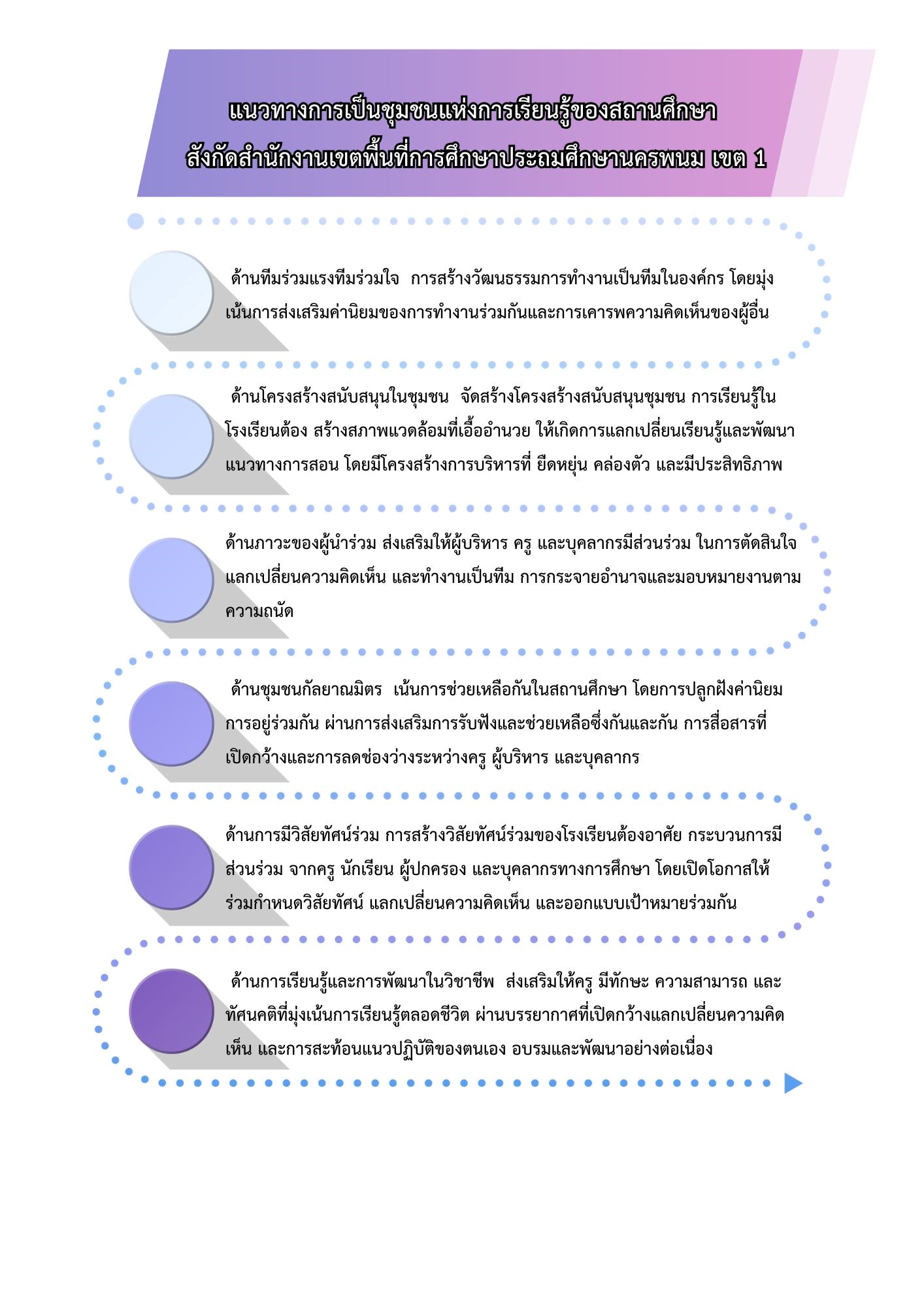
2. The guidelines for being Professional Learning Communities in schools consisted of six key components, ranked from the lowest to the highest mean as follows: 1) shared vision, 2) collaborative teamwork, 3) professional learning and development, 4) caring community, 5) supportive community structure, and 6) shared leadership. These guidelines were found to be appropriate and can be effectively applied to strengthen and enhance Professional Learning Communities in schools.
References
กระทรวงศึกษาธิการ. (2562). พระราชบัญญัติการศึกษาแห่งชาติ พุทธศักราช 2553 (ฉบับที่ 3). กรุงเทพฯ: กระทรวงศึกษาธิการ.
ธนินทร์ ศิลป์จารุ. (2555). การวิจัยและวิเคราะห์ข้อมูลทางสถิติด้วย SPSS. (พิมพ์ครั้งที่ 13). นนทบุรี: เอส.อาร์.พริ้นติ้ง แมสโปรดักส์.
บุญชม ศรีสะอาด. (2560). การวิจัยเบื้องต้น. กรุงเทพฯ: สุวีริยาสาส์น.
ประจักษ์ ยอดเมิน. (2563) แนวทางการดำเนินงานชุมชนแห่งการเรียนรู้ทางวิชาชีพครูในสถานศึกษา สังกัดสำนักงานเขตพื้นที่การศึกษามัธยมศึกษา เขต 19 หนองบัวลำภู. (วิทยานิพนธ์การศึกษามหาบัณฑิต). มหาสารคาม: มหาวิทยาลัยมหาสารคาม.
พิมพ์อร สดเอี่ยม, ชิษณพงศ์ ศรจันทร์, ภัทราพร เกษสังข์, สมยงค์ สีขาว และธีรศักดิ์ อุปไมยอธิชัย. (2561). ข้อเสนอแนวทางการขับเคลื่อนการเป็นชุมชนแห่งการเรียนรู้ทางวิชาชีพในสถานศึกษา สังกัดสำนักงานเขตพื้นที่การศึกษาประถมศึกษา จังหวัดเลย. Journal of Inclusive and Innovative Education, 2(3), 53-60 https://so01.tcithaijo.org/index.php/cmujedu/article/view/167091/120558
วันดี สมมิตร. (2552). ผลกระทบของการสอบระดับชาติขั้นพื้นฐานที่มีต่อพฤติกรรมการสอนของครูในเขตกรุงเทพมหานคร: การวิจัยแบบผสม. (วิทยานิพนธ์ครุศาสตรมหาบัณฑิต). กรุงเทพฯ: จุฬาลงกรณ์มหาวิทยาลัย.
วิชัย วงษ์ใหญ่ และมารุต พัฒผล. (2562). การพัฒนาคุณภาพการจัดการเรียนรู้ ตามแนวคิดชุมชนแห่งการเรียนรู้ทางวิชาชีพ (Professional Learning Community: PLC). กรุงเทพฯ: ศูนย์ผู้นำนวัตกรรมหลักสูตรและการเรียนรู้.
วิเชียร เกตุสิงห์. (2538). ค่าเฉลี่ยกับการแปลความหมาย: เรื่องง่ายๆ ที่บางครั้งก็พลาดได้ ข่าวสารวิจัยการศึกษา. กรุงเทพฯ: สำนักสารสนเทศทางการศึกษาแห่งชาติ สำนักงานคณะกรรมการศึกษาแห่งชาติ.
สมบัติ ท้ายเรือคำ. (2553). สถิติขั้นสูงสำหรับการวิจัยทางการศึกษา. มหาสารคาม: มหาวิทยาลัยมหาสารคาม.
สำนักงานคณะกรรมการการศึกษาขั้นพื้นฐาน. (2560). ชุมชนแห่งการเรียนรู้ทางวิชาชีพ (PLC). กรุงเทพฯ: สำนักงานคณะกรรมการการศึกษาขั้นพื้นฐาน.
สำนักงานเลขาธิการสภาการศึกษา. (2563). แผนการศึกษาแห่งชาติ พ.ศ. 2560-2579. กรุงเทพฯ: พริกหวานกราฟฟิค.
Yamane, T. (1973). Statistics: An introductory analysis. (3rd ed.). New York, NY: Harper & Row.