Work Process Techniques for Enhancing Organizational Effectiveness
Keywords:
Work process;, Organizational effectiveness;, Process optimization;, Instructional Media Innovation;, Strategic managementAbstract
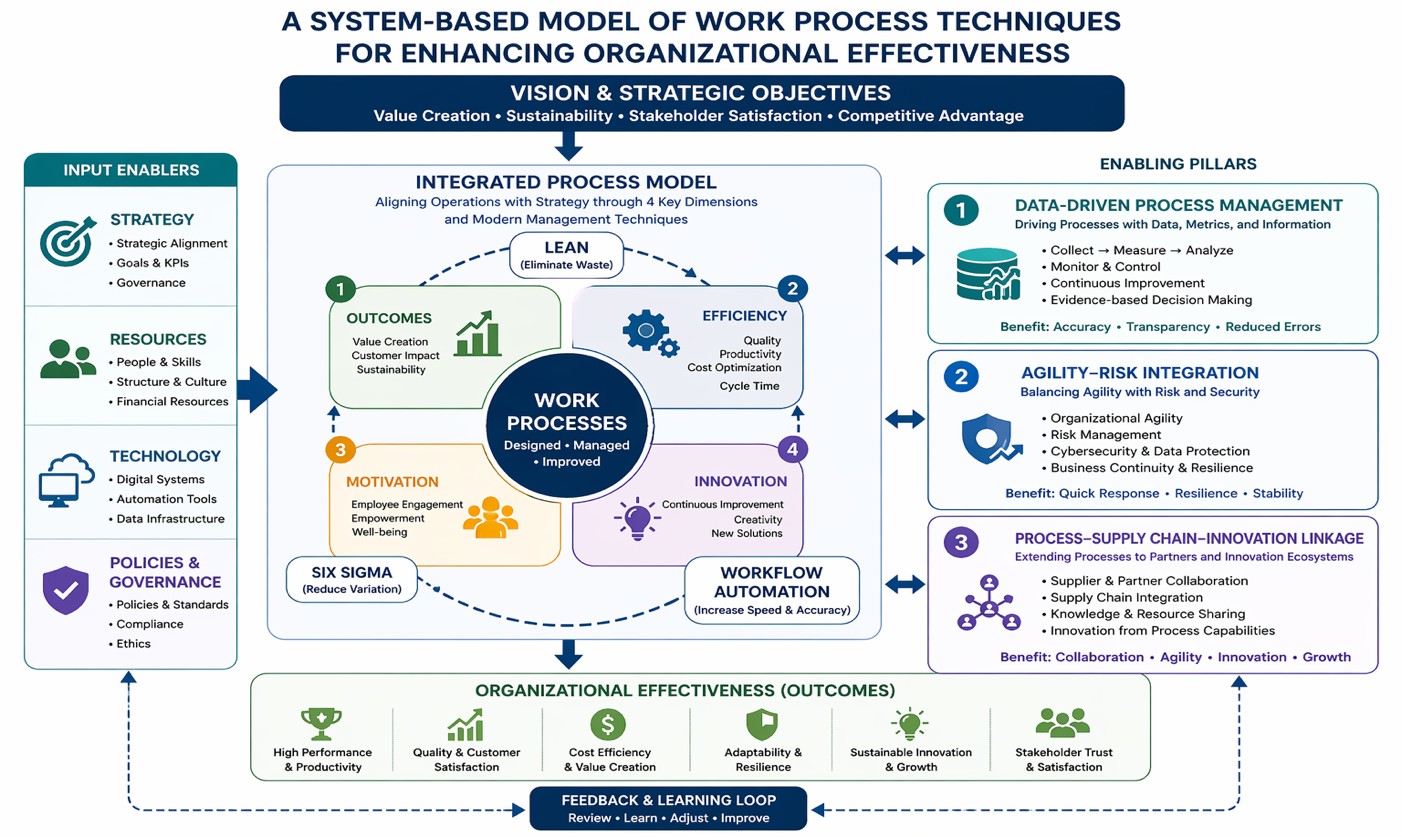
This article aims to analyze and present work process techniques that enhance organizational effectiveness within the context of rapid change, complexity, and increasing competition. It emphasizes the integration of theoretical concepts with practical applications. The study indicates that work processes are fundamental mechanisms that transform inputs into valuable outputs and are closely linked to organizational effectiveness, reflecting the ability to achieve strategic goals efficiently.
The findings reveal four key dimensions contributing to effective work processes: (1) output and outcome orientation, (2) efficiency in resource utilization, (3) employee motivation, and (4) innovation and continuous improvement. Key techniques for improving work processes include process optimization, workflow automation, lean principles, continuous improvement, Six Sigma management, and process mapping. Furthermore, organizational direction setting, process design, supply chain management, and innovation development play critical roles in reducing variability, enhancing efficiency, and strengthening sustainable competitiveness. Emphasis on information security, risk management, and business continuity is also essential in modern organizational operations.
In conclusion, operational effectiveness arises from the systematic integration of processes, technology, resources, and management practices. Such integration enables organizations to create value, reduce costs, and achieve strategic objectives sustainably.
References
Davenport, T. H. (2013). Process innovation: Reengineering work through information technology. Boston, MA: Harvard Business School Press.
Drucker, P. F. (2007). Management challenges for the 21st century. New York, NY: HarperCollins.
Hammer, M. (2015). What is business process management? In J. vom Brocke, & M. Rosemann (Eds.), Handbook on business process management 1: Introduction, methods, and information systems (2nd ed.), 3-16. Berlin: Springer.
Hammer, M., & Champy, J. (1993). Reengineering the corporation: A manifesto for business revolution. New York, NY: Harper Business.
Kaplan, R. S., & Norton, D. P. (2004). Strategy maps: Converting intangible assets into tangible outcomes. Boston, MA: Harvard Business School Press.
Oakland, J. S. (2003). Total quality management: Text with cases. (3rd ed.). Oxford: Butterworth-Heinemann.
Oakland, J. S. (2014). Total quality management and operational excellence: Text with cases. (4th ed.). London: Routledge.
Porter, M. E. (1985). Competitive advantage: Creating and sustaining superior performance. New York, NY: Free Press.
Pyzdek, T., & Keller, P. A. (2014). The Six Sigma handbook. (4th ed.). New York, NY: McGraw-Hill.
Robbins, S. P., & Coulter, M. (2018). Management. (14th ed.). Boston, MA: Pearson.
Womack, J. P., Jones, D. T., & Roos, D. (1990). The machine that changed the world. New York, NY: Free Press.