Administrative Factors Affecting Proactive Learning Management of Teachers in Schools under the Secondary Educational Service Area Office Chaiyaphum
Keywords:
Administrative factors;, Proactive learning management; , Secondary educationAbstract
This research aimed to: 1) examine administrative factors related to teachers’ proactive learning management, 2) investigate the level of teachers’ proactive learning management, 3) analyze the relationship between administrative factors and teachers’ proactive learning management, and 4) identify administrative factors affecting teachers’ proactive learning management in schools under the Secondary Educational Service Area Office Chaiyaphum. This study employed a correlational research design. The population consisted of 1,699 teachers working in schools under the Secondary Educational Service Area Office Chaiyaphum in the 2024 academic year. The sample comprised 313 teachers, selected using the Krejcie and Morgan table and stratified random sampling based on school size. The research instrument was a questionnaire on administrative factors
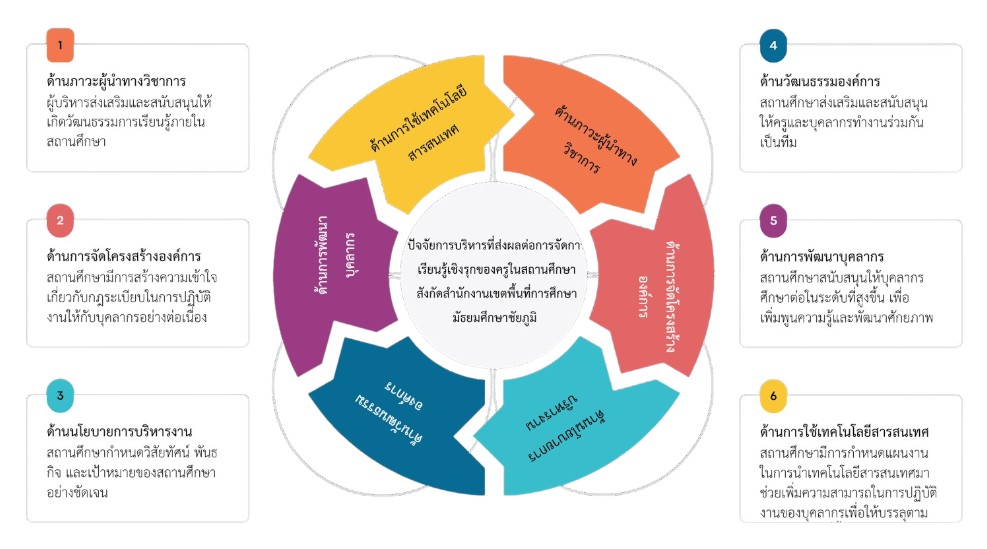
related to teachers’ proactive learning management, including academic leadership, organizational structure, administrative policy, organizational culture, personnel development, and information technology utilization. The reliability coefficients of these factors ranged from .90 to .97. The questionnaire measuring teachers’ proactive learning management had a reliability coefficient of .98. Data were analyzed using mean, standard deviation, Pearson’s product–moment correlation coefficient, and stepwise multiple regression analysis.
The research findings revealed that:
1. The overall level of administrative factors related to teachers’ proactive learning management was at a high level, with administrative policy having the highest mean score.
2. The overall level of teachers’ proactive learning management was at the highest level, with learning activity management showing the highest mean score.
3. Administrative factors were positively correlated with teachers’ proactive learning management at a moderate level, with statistical significance at the .01 level.
4. Information technology utilization, administrative policy, and academic leadership were significant predictors of teachers’ proactive learning management at the .01 level, collectively accounting for 43.4 percent of the variance in teachers’ proactive learning management.
References
จินดารัตน์ บัวพงชน. (2560). ปัจจัยการบริหารที่สัมพันธ์ต่อการดำเนินงานประกันคุณภาพภายในศูนย์การศึกษานอกระบบและการศึกษาตามอัธยาศัยเขต สังกัดสำนักงานส่งเสริมการศึกษานอกระบบและการศึกษาตามอัธยาศัย กรุงเทพมหานคร. (วิทยานิพนธ์ศึกษาศาสตรมหาบัณฑิต). นนทบุรี: มหาวิทยาลัยสุโขทัยธรรมาธิราช.
ทิพวรรณ สำเภาแก้ว (2560). ปัจจัยการบริหารที่ส่งผลต่อประสิทธิผลของสถานศึกษา สังกัดสำนักงานเขตพื้นที่การศึกษาประถมศึกษาสระบุรี เขต 2. (วิทยานิพนธ์ครุศาสตรมหาบัณฑิต). ฉะเชิงเทรา: มหาวิทยาลัยราชภัฏราชนครินทร์.
ธนัฏฐา คุณสุข. (2565). การบริหารงานวิชาการที่ส่งผลต่อการจัดการเรียนรู้เชิงรุกของสถานศึกษาระดับมัธยมศึกษาในจังหวัดจันทบุรี. (วิทยานิพนธ์ครุศาสตรมหาบัณฑิต). จันทบุรี: มหาวิทยาลัยราชภัฏรำไพพรรณี.
นัยนา กวนวงค์. (2558). ปัจจัยการบริหารที่ส่งผลต่อประสิทธิภาพการสอนของครูในโรงเรียนสังกัดสำนักงานเขตพื้นที่การศึกษาประถมศึกษาจังหวัดขอนแก่น. (วิทยานิพนธ์ครุศาสตรมหาบัณฑิต). อุดรธานร: มหาวิทยาลัยราชภัฏอุดรธานี.
พลอยไพลิน นิลกรรณ์. (2562). แนวทางการจัดการเรียนรู้เชิงรุก (Active Learning) โครงการนิเทศการจัดการเรียนรู้เชิงรุกโดยใช้กระบวนการชี้แนะและการเป็นพี่เลี้ยง. กลุ่มนิเทศ ติดตาม และประเมินผลการจัดการศึกษา สำนักงานเขตพื้นที่การศึกษามัธยมศึกษา เขต 35. เข้าถึงได้จาก https://www.sesalpglpn.go.th/wp-content/uploads/2019/12/book10-62.pdf
มนสิช สิทธิสมบูรณ์. (2567). กลยุทธ์การจัดการเรียนรู้เชิงรุก. วารสารสังคมศาสตร์และวัฒนธรรม, 8(1), 164-172.
สำนักงานเขตพื้นที่การศึกษามัธยมศึกษาชัยภูมิ. (2566). รายงานผลการดำเนินงานตามแผนปฏิบัติการ ประจำปีงบประมาณ พ.ศ. 2566. ชัยภูมิ: สำนักงานเขตพื้นที่การศึกษามัธยมศึกษาชัยภูมิ.
สำนักงานคณะกรรมการการพัฒนาการเศรษฐกิจและสังคมแห่งชาติ. (2561). ยุทธศาสตร์ชาติ พ.ศ. 2561-2580. ราชกิจจานุเบกษา, 135(82), 1-61.
สำนักงานคณะกรรมการการศึกษาขั้นพื้นฐาน. (2562). แนวทางการนิเทศเพื่อพัฒนาและส่งเสริมการจัดการเรียนรู้เชิงรุก (Active Learning) ตามนโยบายลดเวลาเรียน เพิ่มเวลารู้. กรุงเทพฯ: ชุมนุมสหกรณ์การเกษตรแห่งประเทศไทย จำกัด.
_______. (2567). ข้อมูลครูสำนักงานเขตพื้นที่การศึกษามัธยมศึกษาชัยภูมิ. ชัยภูมิ: กลุ่มนิเทศ ติดตาม และประเมินผลการจัดการศึกษา สำนักงานเขตพื้นที่การศึกษามัธยมศึกษาชัยภูมิ.
สิริภา สงคราม. (2568). การบริหารสถานศึกษาเพื่อส่งเสริมการใช้ปัญญาประดิษฐ์ (AI) ในการจัดการเรียนรู้เชิงรุก. วารสารสมาคมพัฒนาวิชาชีพการบริหารการศึกษาแห่งประเทศไทย (สพบท.), 7(2), 583-597. https://so04.tci-thaijo.org/index.php/JAPDEAT/article/view/279968/188260
สุวัชชัย อาจวิเชียร. (2567). ปัจจัยการบริหารที่ส่งผลต่อสมรรถนะการจัดการเรียนรู้ของครูในสถานศึกษา สังกัดสำนักการศึกษา กรุงเทพมหานคร. วารสารศึกษาศาสตร์ มหาวิทยาลัยศิลปากร, 22(1), 249-264.
อรุณี ทองนพคุณ. (2558). การศึกษาบทบาทการบริหารงานของผู้บริหารสถานศึกษา สังกัดสำนักงานเขตพื้นที่การศึกษาประถมศึกษาฉะเชิงเทรา. (วิทยานิพนธ์ครุศาสตรมหาบัณฑิต). จันทบุรี: มหาวิทยาลัยราชภัฏรำไพพรรณี.
อิทธิเดช น้อยไม้ และณัฐวรรณ เฉลิมสุข. (2566). เสริมสมรรถนะผู้เรียนด้วยแนวคิดการจัดการเรียนรู้เชิงรุก. วารสารครุศาสตร์ มหาวิทยาลัยราชภัฏบ้านสมเด็จเจ้าพระยา, 17(1), 13-23. https://so17.tci-thaijo.org/index.php/EduBSRU/article/view/250
Ayeni, O. O., Hamad, N. M. A., Chisom, O. N., Osawaru, B., & Adewusi, O. E. (2024). AI in education: A review of personalized learning and educational technology. GSC Advanced Research and Reviews, 18(02), 261-271. https://doi.org/10.30574/gscarr.2024.18.2.0062
Jamaludin, R., & Osman, S. Z. M. (2014). The use of a flipped classroom to enhance engagement and promote active learning. Journal of Education and Practice, 5(2), 124-131.
Khosravi, H., Sadiq, S., & Amer-Yahia, S. (2023). Data management of AI-powered education technologies: Challenges and opportunities. Journal of Learning Letters, 1, 2-2. https://doi.org/10.59453/xlud7002
Krejcie, R. V., & Morgan, D. W. (1970). Determining sample size for research activities. Educational and Psychological Measurement, 30(3), 607-610.
Liu, M., Ren, Y., Nyagoga, L. M., Stonier, F., Wu, Z., & Yu, L. (2023). Future of education in the era of generative artificial intelligence: Consensus among Chinese scholars on applications of ChatGPT in schools. Future in Educational Research, 1(1), 72-101. https://doi.org/10.1002/fer3.10
Patino, A., Ramírez-Montoya, M. S., & Buenestado-Fernández, M. (2023). Active learning and education 4.0 for complex thinking training: analysis of two case studies in open education. Smart Learning Environments, 10(1), 8.
Yılmaz, O. (2024). Personalised learning and artificial intelligence in science education: current state and future perspectives. Educational Technology Quarterly, 2024(3), 255-274. https://doi.org/10.55056/etq.744