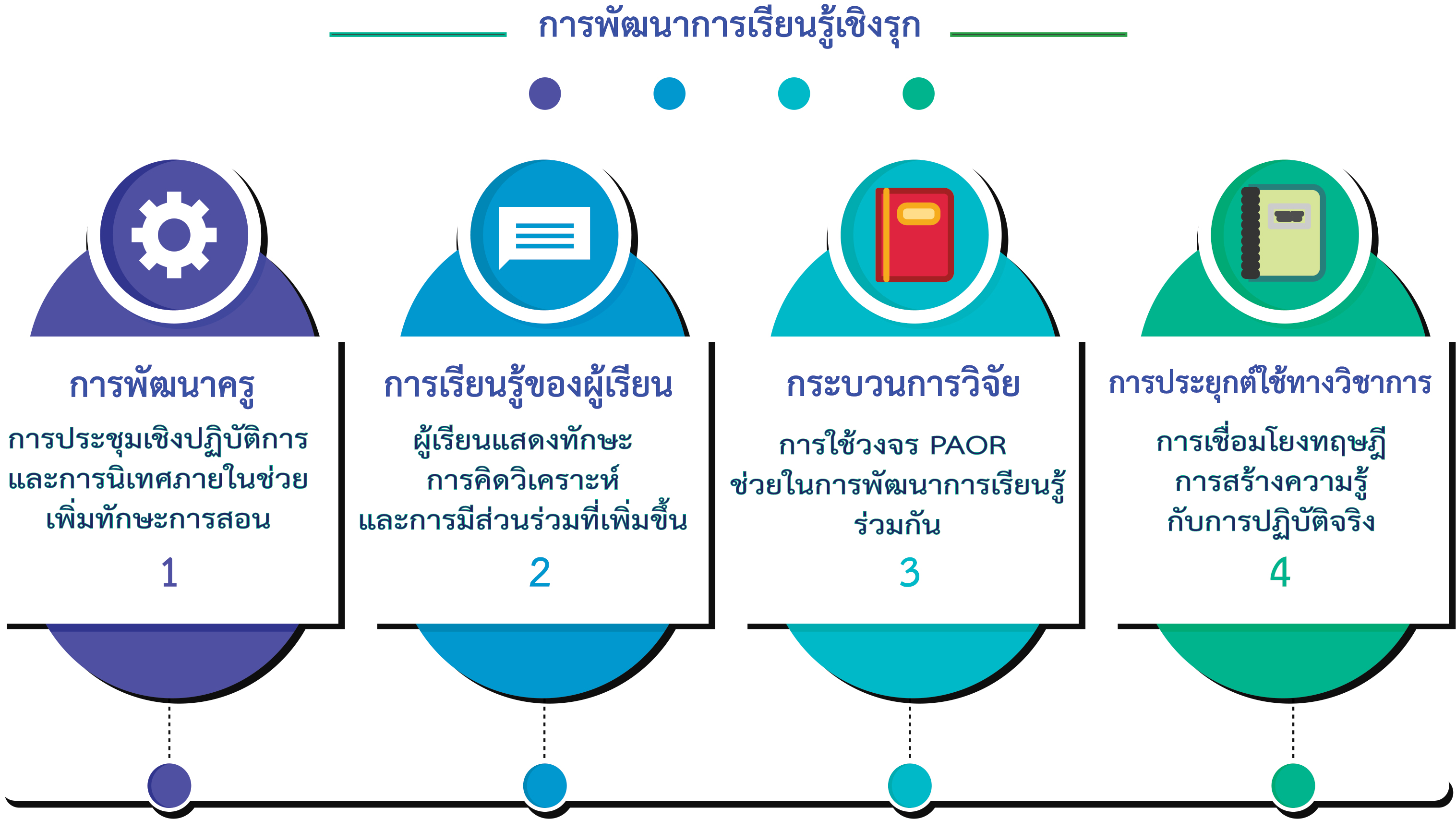
The Development of Active Learning Management Skills Using the Inquiry-Based Approach for Teachers at Ban Kud Lao School Under the Khon Kaen Primary Educational Service Area 5
Keywords:
Teacher Skill Development;, Proactive Learning Management;, Inquiry-Based Learning;, Ban Kudlao School;Abstract
This study aimed to: 1) develop teachers’ knowledge and understanding of active learning management using an inquiry-based approach; 2) enhance teachers’ skills in implementing active learning activities; 3) examine teachers’ satisfaction with the development; and 4) investigate students’ satisfaction with the learning activities. The research employed an action research methodology based on the concept of Stephen Kemmis and Robin McTaggart, conducted in two cycles. Each cycle consisted of four stages: planning, action, observation, and reflection. The sample group comprised nine teachers from Ban Kud Lao School who voluntarily participated in the study. The research instruments included a knowledge test, interviews, observation forms, meeting records, skill assessment forms, and satisfaction questionnaires. Data were analyzed using descriptive statistics.
The findings revealed that:
1. Teachers’ knowledge and understanding of active learning using the inquiry-based approach significantly improved. In Cycle 1, teachers demonstrated a good level of understanding, while in Cycle 2, all teachers were able to accurately explain the concepts and procedures.
2. Teachers’ instructional skills improved progressively. In Cycle 1, teachers were able to design lesson plans and conduct activities at an overall satisfactory level, although limitations were found in the explaining, concluding, and elaborating stages. In Cycle 2, all teachers were able to implement all five stages of inquiry-based learning correctly and appropriately.
3. Teachers reported a high level of satisfaction with the development process.
4. Students also reported a high level of satisfaction with the active learning activities using the inquiry-based approach. In conclusion, the integration of workshops and internal supervision effectively enhanced teachers’ knowledge, understanding, and instructional skills, and positively influenced students’ learning outcomes.
References
ชาตรี ฝ่ายคำตา. (2557). การจัดการเรียนรู้วิทยาศาสตร์เชิงรุก. กรุงเทพฯ: จุฬาลงกรณ์มหาวิทยาลัย.
ทิศนา แขมมณี. (2551). ศิลปะการสอน: แนวทางการจัดการเรียนรู้เพื่อความเป็นเลิศของผู้เรียน. (พิมพ์ครั้งที่ 5). กรุงเทพฯ: แห่งจุฬาลงกรณ์มหาวิทยาลัย.
วิจารณ์ พานิช. (2563). การเรียนรู้เชิงรุกและการจัดการเรียนรู้สำหรับศตวรรษที่ 21. กรุงเทพฯ: มูลนิธิสดศรี-สฤษดิ์วงศ์.
_______. (2563). การเรียนรู้เชิงรุกและการเรียนรู้เชิงรุกโดยใช้การสืบเสาะ. กรุงเทพฯ: มูลนิธิสยามกัมมาจล.
สถาบันทดสอบทางการศึกษาแห่งชาติ. (2564). รายงานผลการทดสอบทางการศึกษาระดับชาติขั้นพื้นฐาน (O-NET) ปีการศึกษา 2563. กรุงเทพฯ: สถาบันทดสอบทางการศึกษาแห่งชาติ.
สำนักงานสภาพัฒนาการเศรษฐกิจและสังคมแห่งชาติ. (2565). แผนพัฒนาเศรษฐกิจและสังคมแห่งชาติ ฉบับที่ 13 (พ.ศ. 2566-2570). กรุงเทพฯ: สำนักงานสภาพัฒนาการเศรษฐกิจและสังคมแห่งชาติ.
สิริพร ทิพย์คง. (2557). การจัดการเรียนการสอนคณิตศาสตร์. (พิมพ์ครั้งที่ 2). กรุงเทพฯ: พัฒนาคุณภาพวิชาการ (พว.).
สุวิทย์ มูลคำ. (2554). กลยุทธ์การสอนคิดวิเคราะห์. กรุงเทพฯ: ภาพพิมพ์.
_______. (2554). การจัดการเรียนรู้เชิงรุก: แนวคิด ทฤษฎี และการปฏิบัติ. กรุงเทพฯ: จุฬาลงกรณ์มหาวิทยาลัย.
สุวิมล ว่องวาณิช. (2558). การวิจัยเชิงปฏิบัติการเพื่อพัฒนานวัตกรรมการเรียนรู้. กรุงเทพฯ: มหาวิทยาลัยศรีนครินทรวิโรฒ.
Bonwell, C. C., & Eison, J. A. (1991). Active learning: Creating excitement in the classroom. Washington, DC: The George Washington University.
Johnson, M. R. (2019). Developing science teachers' inquiry-based teaching skills through professional development program. (Doctoral dissertation, Stanford University). Stanford, CA: ProQuest Dissertations & Theses Global.
Kemmis, S., & McTaggart, R. (1988). The action research planner. Geelong: Deakin University Press.
Piaget, J. (1970). Science of education and the psychology of the child. New York, NY: Orion Press.
Vygotsky, L. S. (1978). Mind in society: The development of higher psychological processes. Cambridge, MA: Harvard University Press.