Administrative Factors Affecting Data-Driven Organization of Schools under the Office of Lopburi Primary Educational Service Area 1
Keywords:
Administrative factors; , Data-Driven Organization;, Primary educationAbstract
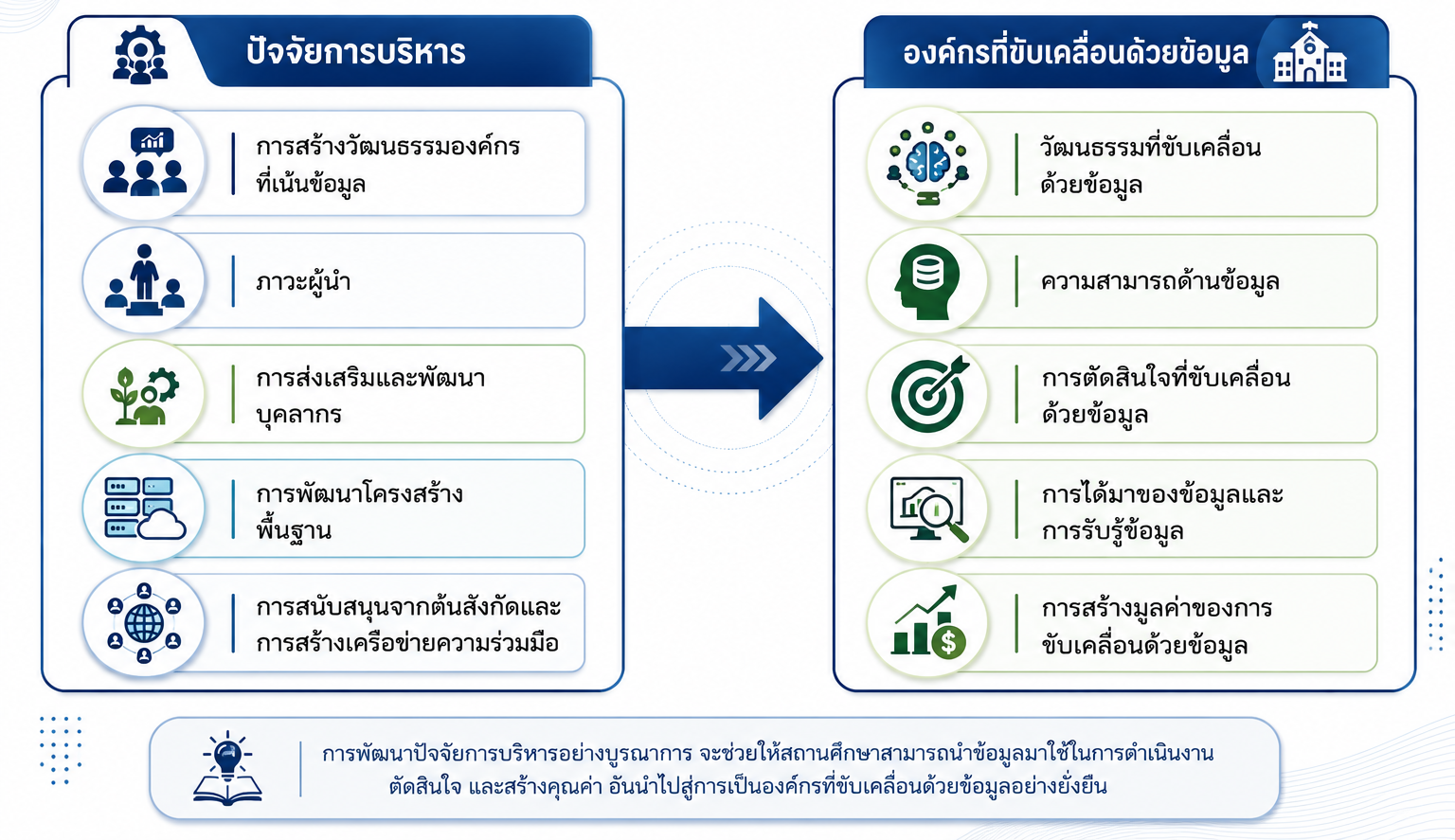
The objectives of this research were to: 1) study the level of administrative factors related to data-driven organization of schools; 2) study the level of schools as data-driven organizations; 3) examine the relationship between administrative factors and data-driven organization of schools; and 4) identify administrative factors predicting data-driven organization of schools under the Office of Lopburi Primary Educational Service Area 1. This study employed a correlational research design. The sample consisted of 306 school administrators and teachers in the academic year 2025, selected through proportional stratified random sampling. The research instrument was a questionnaire covering five administrative factors: data-oriented organizational culture, leadership, personnel promotion and development, organizational infrastructure development, and support from the parent organization and collaborative networking. The reliability coefficients were .945, .975, .947, .959, and .968, respectively, while the reliability coefficient for the data-driven organization variable was .978. Data were analyzed using mean, standard deviation, Pearson's product-moment correlation coefficient, and stepwise multiple regression analysis.
The findings revealed that:
1. The overall level of administrative factors related to data-driven organization was high.
2. The overall level of schools as data-driven organizations was high.
3. All administrative factors were positively correlated with data-driven organization at the .01 level of statistical significance.
4. Three administrative factors significantly predicted data-driven organization, namely data-oriented organizational culture, personnel promotion and development, and organizational infrastructure development. Together, these factors accounted for 71.2% of the variance (Adjusted R² = .712). The standardized prediction equation was Z = 0.405(X₁) + 0.359(X₃) + 0.136(X₄).
References
อารีย์ น้ำใจดี และพิชญาภา ยืนยาว. (2562). ผู้นำกับการบริหารสถานศึกษายุคดิจิทัล. ใน การประชุมวิชาการระดับชาติ มหาวิทยาลัยราชภัฏนครปฐม ครั้งที่ 11, 11-12 กรกฎาคม 2562 (หน้า 1647-1648). นครปฐม: มหาวิทยาลัยราชภัฏนครปฐม.
Anderson, C. (2015). Creating a data-driven organization: Practical advice from the trenches. Sebastopol, CA: O’Reilly Media.
Bernhardt, V. L. (2004). Continuous improvement: It takes more than test scores. Leadership, 34, 16-19.
Datnow, A., Park, V., & Wohlstetter, P. (2007). Achieving with data: How high-performing school systems use data to improve instruction for elementary students. Los Angeles, CA: University of Southern California.
Davenport, T. H., & Harris, J. G. (2017). Competing on analytics: Updated, with a new introduction: The new science of winning. Boston, MA: Harvard Business Review Press.
Fischer, H., Wiener, M., Strahringer, S., Kotlarsky, J., & Bley, K. (2023). Data-driven organizations: Review, conceptual framework, and empirical illustration. Australasian Journal of Information Systems, 27, 1-26.
Gartner. (2021). Gartner survey finds 72% of data & analytics leaders are leading or heavily involved in digital transformation initiatives. Receive from https://www.gartner.com/en/newsroom/press-releases/2021-05-05-gartner-data-and-analytics-summit-americas-day-2-highlights
Gummer, E. S., & Mandinach, E. B. (2015). Building a conceptual framework for data literacy. Teachers College Record, 117(4), 1-22.
Krejcie, R. V., & Morgan, D. W. (1970). Determining sample size for research activities. Educational and Psychological Measurement, 30(3), 607-610.
Levin, J. A., & Datnow, A. (2012). The principal role in data-driven decision making: Using case-study data to develop multi-mediator models of educational reform. School Effectiveness and School Improvement, 23(2), 179-201.
Lukić, J. (2015). Leadership challenges for the big data era. In M. Radović-Marković & S. Ilieva (Eds.), Challenges to promoting entrepreneurship, leadership and competitiveness (pp. 293-309). Belgrade, Serbia: Faculty of Business Economics and Entrepreneurship.
Mandinach, E. B. (2012). A perfect time for data use: Using data-driven decision making to inform practice. Educational Psychologist, 47(2), 71-85.
Marsh, J. A., McCombs, J. S., & Martorell, F. (2010). How instructional coaches support data-driven decision making: Policy implementation and effects in Florida middle schools. Educational Policy, 24(6), 872-907.
McKinsey Global Institute. (2013). Game changers: Five opportunities for US growth and renewal. New York, NY: McKinsey & Company.
Mintzberg, H., Ahlstrand, B., & Lampel, J. (2003). Strategy safari: A guided tour through the wilds of strategic management. New York, NY: Free Press.
Schildkamp, K., & Kuiper, W. (2010). Data informed curriculum reform: Which data, what purposes, and promoting and hindering factors. Teaching and Teacher Education, 26, 482-496.
Storm, M., & Borgman, H. (2020). Understanding challenges and success factors in creating a data-driven culture. In Proceedings of the 53rd Hawaii International Conference on System Sciences (pp. 5399-5408). Honolulu, HI: University of Hawai‘i at Mānoa.
Tabachnick, B. G., & Fidell, L. S. (2019). Using multivariate statistics. (7th ed.). Boston, MA: Pearson.
World Economic Forum. (2021). Data-driven economies: Foundations for our common future. Geneva, Switzerland: World Economic Forum.