The Creation of a Learning Network for Temples and Communities on Public Spaces Around Kaen Nakhon Lake, Khon Kaen
Abstract
This research aimed to: 1) examine the principles of establishing community learning networks focused on local history, arts, and culture; 2) establish a learning network between temples and communities in the public areas surrounding Bueng Kaen Nakhon, Khon Kaen Province; and 3) evaluate the establishment of the temple–community learning network. The study employed a participatory action research (PAR) approach. Eighteen key informants, including monks and laypersons, were selected through purposive sampling. The study also identified a population of 100 individuals. The research instruments consisted of an interview guide and a network establishment evaluation form. Data were analyzed using descriptive analysis, the Modified Priority Needs Index (PNI_modified), means, and standard deviations.
The research findings were as follows:
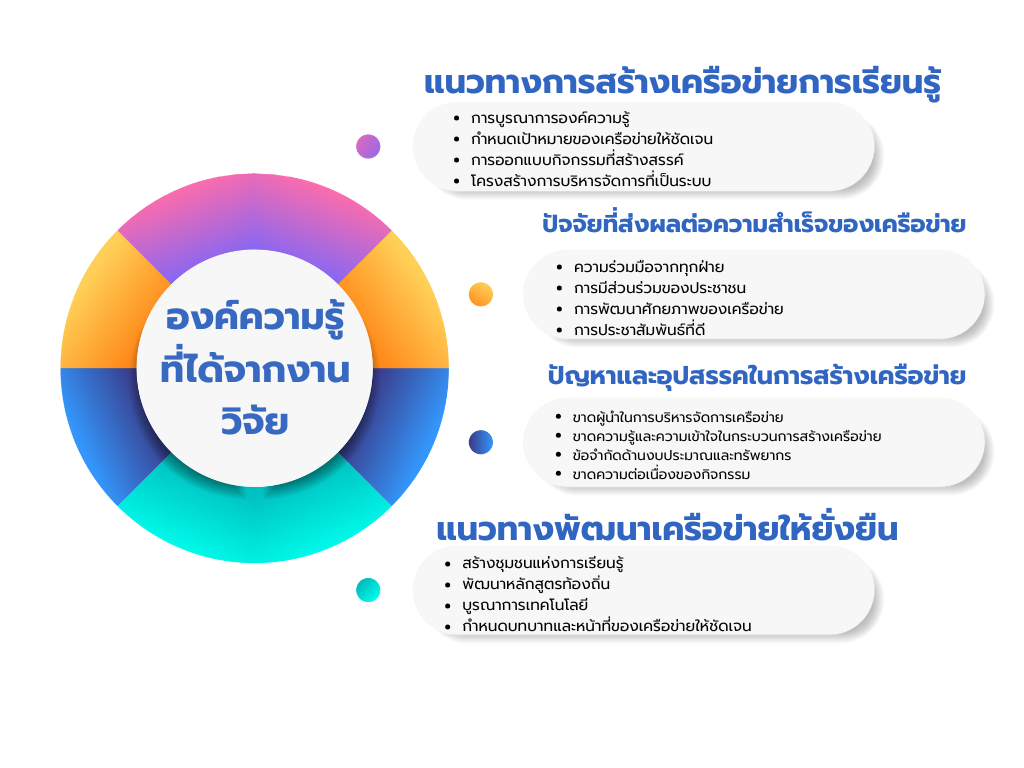
1. The establishment of the temple–community learning network was constrained by inadequate leadership, a lack of coordination mechanisms, and limited knowledge and understanding of network management. The overall Modified Priority Needs Index (PNI_modified) was 1.06, while the dimension of network management development had the highest priority needs index of 1.18.
2. The participatory action research process resulted in the establishment of a learning network comprising five temples and five communities. Four stages of network management were identified: planning, implementation, evaluation, and dissemination. These stages were designed to support learning activities related to local history, arts, and culture.
3. Overall satisfaction with the establishment of the learning network was at the highest level. The personnel and service provision dimension received the highest mean rating, whereas the network performance dimension received the lowest. These findings represent participants' satisfaction with network operations during the study period and do not establish the network's long-term sustainability.
References
เทศบาลนครขอนแก่น. (2566). แผนพัฒนาท้องถิ่น (พ.ศ. 2566-2570) เทศบาลนครขอนแก่น. ขอนแก่น: เทศบาลนครขอนแก่น. เข้าถึงได้จาก https://kkmuni.go.th/downloads?id=19
ธนา ประมุขกูล. (2547). บทความปริทัศน์. ขอนแก่น: ศูนย์ส่งเสริมสุขภาพ เขต 6.
พระปลัดโฆษิต คงแทน, ธีระ รุญเจริญ, จําเริญรัตน์ จิตต์จิรจรรย์ และกรองทิพย์ นาควิเชตร. (2557). รูปแบบการจัดการศึกษาของวัดให้เป็นแหล่งเรียนรู้ของชุมชน. วารสารบริหารการศึกษา มศว, 11(20), เข้าถึงได้จาก https://ejournals.swu.ac.th/index.php/EAJ/article/view/5406
สุจิตรา ยางนอก. (2562). เอกสารประกอบการเรียนการสอนวิชาเครือข่ายการเรียนรู้กับการพัฒนาสังคม (รหัสวิชา 2534503). บุรีรัมย์: คณะมนุษยศาสตร์และสังคมศาสตร์ มหาวิทยาลัยราชภัฏบุรีรัมย์. เข้าถึงได้จาก https://blog.bru.ac.th/wp-content/uploads/bp-attachments/11339/บทที่-3เครือข่ายการเรียนรู้.pdf
OpenAI. (2026). ChatGPT [Generative AI tool]. https://chatgpt.com/