The Problem of Water Management for Agricultural Participation of Community in Som Poi Sub- District, Chatturat District, Chaiyaphum Province
Keywords:
water management; community participation; agricultural water useAbstract
This study aimed to: 1) examine the problems associated with participatory agricultural water management in Som Poi Subdistrict, Chatturat District, Chaiyaphum Province; and 2) develop recommendations for participatory agricultural water management in the community. The study employed a qualitative research design. The key informants consisted of 26 participants selected through purposive sampling from four groups: village leaders or village committee members, local wisdom holders, heads of water user groups, and members of water user networks. Data were collected through in-depth interviews and small-group discussions using an interview form and focus group discussion guidelines. The data were analyzed through content analysis. Credibility was examined through data triangulation and member checking with the informants.
The findings were as follows:
1. The problems related to participatory agricultural water management were identified in 10 areas: insufficient water storage capacity, an imbalance in water availability between the rainy and dry seasons, generally acceptable water quality for agricultural use with contamination risks in some areas, inconsistent regulation of water use, unclear procedures for requesting water and setting priorities, water allocation that does not cover all cropping seasons, high water use without a clear measurement and monitoring system, dependence on government budgets for maintaining water distribution systems, the absence of a systematic database for water-use planning, and discontinuity in coordination with government agencies.
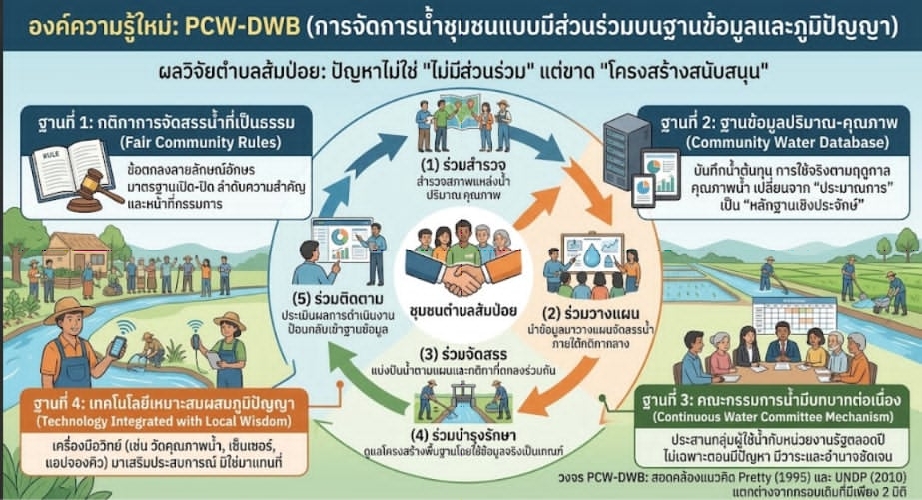
2. The recommendations for participatory agricultural water management comprised four components: establishing fair community rules, developing a community water database, strengthening a continuous community water committee mechanism, and integrating technology with local wisdom. These components are intended to improve the efficiency of water allocation, reduce conflicts, and support long-term community water management.
References
บุผาชาติ จันทร์หอม. (2564). แนวทางการพัฒนาการมีส่วนร่วมของประชาชนในการจัดการน้ำสู่ความยั่งยืน. Journal of Roi Kaensarn Academi, 6(6), 340-356.
ประสูตร แก้วนิ่ม. (2568). การจัดการน้ำท้องถิ่นแบบมีส่วนร่วมขององค์กรผู้ใช้น้ำรอบบึงบอระเพ็ด จังหวัดนครสวรรค์ ตามหลักอปริหานิยธรรม. วารสารรัฐประศาสนศาสตร์และสหวิทยาเพื่อสังคม, 1(1), 1-19.
พระครูโสภณธรรมโชติ (สัมพันธ์ สิริโรจน์บริรักษ์). (2568). นวัตกรรมการจัดการทรัพยากรน้ำและสิ่งแวดล้อมพื้นที่ลุ่มน้ำสวยโดยการบูรณาการภูมิปัญญาท้องถิ่นเพื่อหนุนเสริมการเกษตรแบบยั่งยืนสู่ระบบเศรษฐกิจฐานรากจังหวัดหนองคาย. วารสารมณีเชษฐาราม, 8(1), 340-353.
พัชรินทร์ ทะริยะ. (2560). การบริหารจัดการน้ำเพื่อการเกษตรของสมาชิกฝายร่องหินบ้านดอนเงิน ตำบลออย อำเภอปง จังหวัดพะเยา. (วิทยานิพนธ์เกษตรศาสตรมหาบัณฑิต). นนทบุรี: มหาวิทยาลัยสุโขทัยธรรมาธิราช.
พันธุ์ทิพย์ นวานุช, บุศรินทร์ ใหม่รุ่งโรจน์, พัทธนันท์ สิรโชครตามณี และพงศพล มหาวัจน์. (2565). การบริหารจัดการน้ำเพื่อการเกษตรโดยชุมชน. วารสารวิชาการวิทยาลัยสันตพล, 8(2), 182-190.
ยุภาพร อำนาจ, ธนัสนี สมบูรณ์ และวัฒนาชัย มาลัย. (2566). การมีส่วนร่วมของเกษตรกรในการจัดการน้ำเพื่อการเกษตรในพื้นที่จังหวัดอุบลราชธานี. วารสารจันทรเกษมสาร, 29(1), 1-16.
สำนักงานทรัพยากรน้ำแห่งชาติ. (2565). รายงานประจำปี 2565. กรุงเทพฯ: สำนักงานทรัพยากรน้ำแห่งชาติ.
อภิชาติ ทรัพย์สุข. (2563). การศึกษาคุณภาพน้ำในแม่น้ำชีและความเหมาะสมต่อการเกษตรกรรม. วารสารสิ่งแวดล้อมภาคอีสาน, 15(1), 89-102.
อภิชาต อนุกูลอำไพ. (2546). การบริหารจัดการทรัพยากรน้ำแบบผสมผสาน (Integrated Water Resources Management: IWRM). กรุงเทพฯ: บีวีออฟเซ็ต.
Olankidjaroen, S. (2016). Strategic plan of water resource management of Nongbualumpoo Province. Walailak Abode of Culture Journal, 16(2), 139-174.
Pretty, J. (1995). Participatory learning for sustainable agriculture. World Development, 23(8), 1247-1263.
United Nations Development Programme. (2010). Water governance in developing countries: A framework for action. New York, NY: United Nations Development Programme.