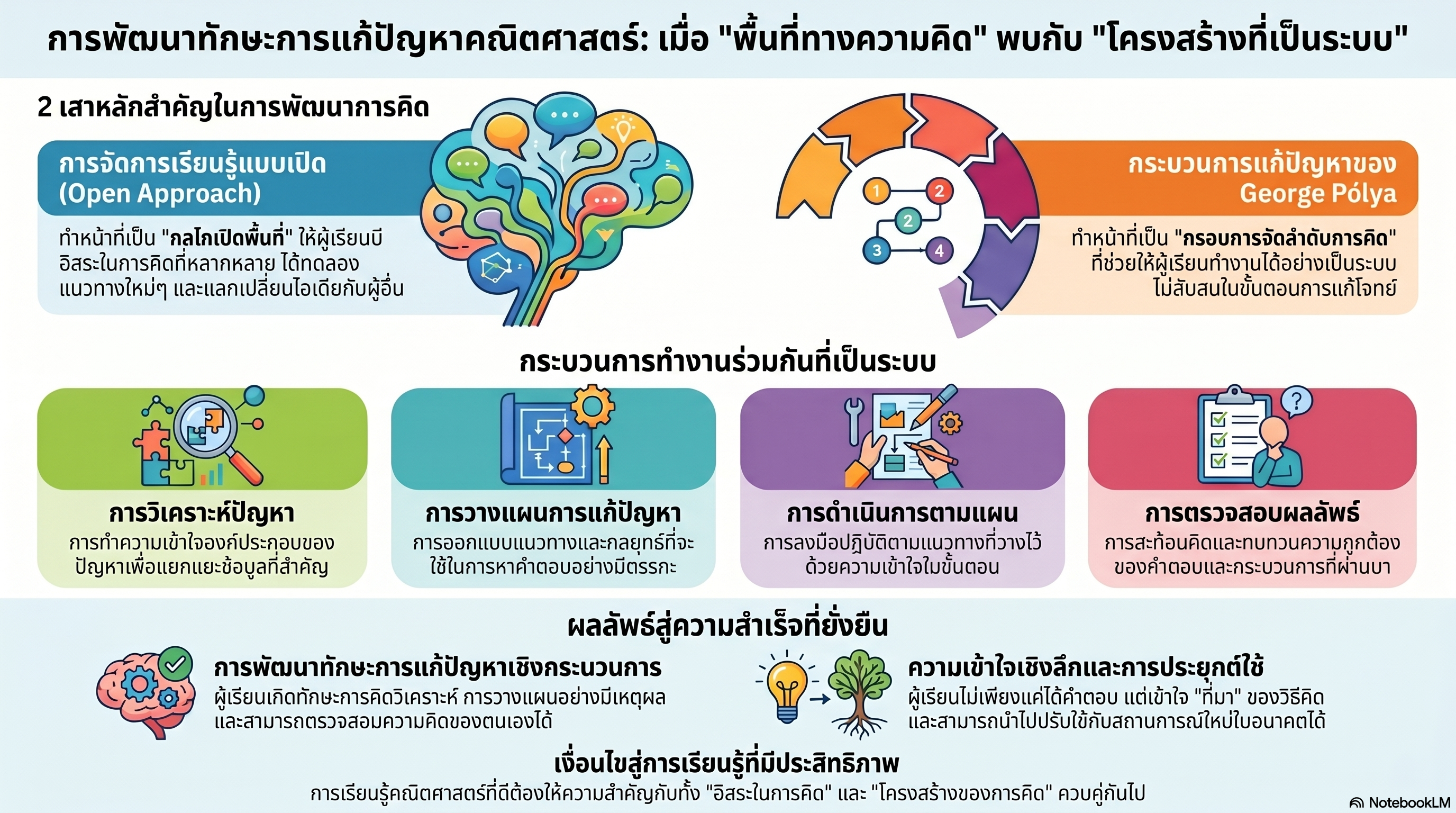
The Effects of Open Approach Instruction Integrated with Polya’s Problem-Solving Process on the Mathematical Problem-Solving Ability of Grade 10 Students
Keywords:
Open Approach Instruction;, Polya’s Problem-Solving Process;, Mathematical Problem-Solving Ability;, Secondary School StudentsAbstract
This study aimed to: (1) develop learning activities based on the Open Approach integrated with Polya’s problem-solving process for Grade 10 students to achieve an efficiency criterion of 70 percent, and (2) compare students’ learning achievement and mathematical problem-solving ability before and after the implementation of the instructional approach. The research employed a pre-experimental design using a one-group pretest–posttest design. The sample consisted of 45 Grade 10/2 students selected through cluster random sampling. The research instruments included: (1) seven lesson plans totaling 23 instructional hours; (2) a mathematical problem-solving ability test (difficulty index ranging from 0.65 to 0.75, discrimination index of 0.30, and reliability coefficient of 0.71); and (3) a learning achievement test (difficulty index ranging from 0.30 to 0.77, discrimination index ranging from 0.27 to 0.97, and reliability coefficient of 0.87). Data were analyzed using percentage, mean, standard deviation, one-sample t-test, and dependent t-test.
The findings revealed that:
1. The developed learning activities achieved an efficiency of 78.70 percent, which exceeded the specified criterion.
2. The students’ post-learning achievement averaged 81.22 percent, which was higher than the 70 percent criterion. In addition, the students’ mathematical problem-solving ability after the intervention (mean = 16.22, or 81.11%) was significantly higher than before the intervention (mean = 9.78, or 48.89%) at the .05 level. These results indicate that the Open Approach integrated with Polya’s problem-solving process effectively enhances students’ mathematical problem-solving skills and improves their learning achievement.
References
กระทรวงศึกษาธิการ. (2551). หลักสูตรแกนกลางการศึกษาขั้นพื้นฐาน พุทธศักราช 2551. กรุงเทพฯ: คุรุสภา ลาดพร้าว
กุลิสรา จิตรชญาวณิช. (2562). การจัดการเรียนรู้แบบเปิด (Open Approach). กรุงเทพฯ: จุฬาลงกรณ์มหาวิทยาลัย.
ทิศนา แขมมณี. (2557). ศาสตร์การสอน: องค์ความรู้เพื่อการจัดกระบวนการเรียนรู้ที่มีประสิทธิภาพ. กรุงเทพฯ: จุฬาลงกรณ์มหาวิทยาลัย.
สำนักงานเลขาธิการสภาการศึกษา. (2560). แผนการศึกษาแห่งชาติ พ.ศ. 2560-2579. กรุงเทพฯ: พริกหวานกราฟฟิค.
อาภรณ์ ใจเที่ยง. (2553). หลักการสอน. (พิมพ์ครั้งที่ 5). กรุงเทพฯ: โอเดียนสโตร์.
Hiebert, J., Carpenter, T. P., Fennema, E., Fuson, K. C., Human, P., Murray, H., Olivier, A., & Wearne, D. (1996). Problem solving as a basis for reform in curriculum and instruction: The case of mathematics. Educational Researcher, 25(4), 12-21.
Piaget, J. (1970). Science of education and the psychology of the child. New York, NY: Orion Press.
Polya, G. (1945). How to solve it: A new aspect of mathematical method. Princeton, NJ: Princeton University Press.
Polya, G. (1957). How to solve it: A new aspect of mathematical method. (2nd ed.). Princeton, NJ: Princeton University Press.
Vygotsky, L. S. (1978). Mind in society: The development of higher psychological processes. Cambridge, MA: Harvard University Press.