The Integration of Theravada Buddhist Philosophy into the Administration of Phrapariyattidhamma Schools (General Education Department) in Roi Et Province
Keywords:
Educational Administration;, Theravada Buddhist Philosophy;, Phrapariyattidhamma Schools;, IntegrationAbstract
The objectives of this research were to: 1) examine the administration of Phrapariyattidhamma Schools (General Education Department) in Roi Et Province; 2) identify appropriate Theravada Buddhist philosophical principles for school administration; 3) integrate these principles into the administrative framework; and 4) synthesize the knowledge derived from this integration. This study employed a qualitative research design, utilizing documentary analysis and in-depth interviews with 20 key informants selected through purposive sampling. Data were gathered using semi-structured interview guides and analyzed through content analysis and phenomenological interpretation, with credibility ensured by triangulation.
The findings revealed that:
1. The administration of these schools is characterized by a strong emphasis on Buddhist moral values; however, there is a clear need for enhancement in strategic planning, data-driven decision-making, and effective resource management.
2. The foundational principles identified as most suitable for administration include the Four Brahmavihāras, the Seven Kalyāṇamitta Qualities, and the Four Iddhipāda, which serve as moral pillars for personnel and student development.
3. Systematic integration of these principles balances organizational efficiency with moral cultivation among administrators, teachers, and students.
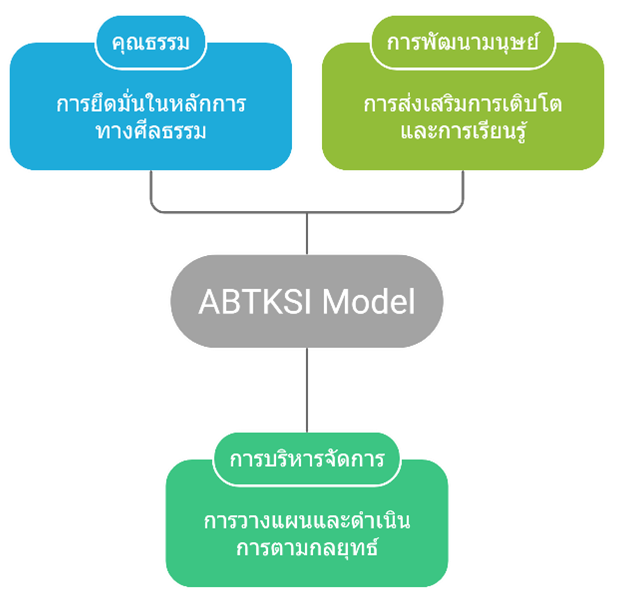
4. The synthesized knowledge culminated in the "ABTKSI Model," a holistic administrative framework comprising three dimensions: self-management, people management, and task management. This model provides a sustainable approach to elevating educational quality by harmonizing modern management techniques with Buddhist ethical standards.
References
กระทรวงศึกษาธิการ. (2559). แผนพัฒนาการศึกษาของกระทรวงศึกษาธิการ ฉบับที่ 12 (พ.ศ. 2560-2564). กรุงเทพฯ: พริกหวานกราฟฟิค.
ฝ่ายการศึกษาพระปริยัติธรรม กองพุทธศาสนศึกษา. (2553). แผนยุทธศาสตร์และแผนปฏิบัติการ การพัฒนาการศึกษา โรงเรียนพระปริยัติธรรม แผนกสามัญศึกษา (พ.ศ. 2553-พ.ศ.2562). กรุงเทพฯ: สำนักงานพระพุทธศาสนาแห่งชาติ.
พระครูใบฎีกาสุวินท์ สุวิชาโน. (2561). การพัฒนาการบริหารจัดการโรงเรียนวิถีพุทธในจังหวัดสมุทรปราการ. (ดุษฎีนิพนธ์ปรัชญาดุษฎีบัณฑิต). พระนครศรีอยุธยา: มหาวิทยาลัยมหาจุฬาลงกรณราชวิทยาลัย.
พระมหาอธิวัฒน์ วรจกฺโก (ทองขาว), พระครูจิรธรรมธัช, พระมหาไพฑูรย์ สิริธมฺโม และอริย์ธัช เลิศรวมโชค. (2568). การประยุกต์ใช้หลักอปริหานิยธรรม 7 กับการบริหารงานบุคคลของผู้บริหารโรงเรียนพระปริยัติธรรม แผนกสามัญศึกษา จังหวัดหนองคาย. วารสารสหศาสตร์การพัฒนาสังคม, 3(1), 397-380.
วรภาส ประสมสุข และนิพนธ์ กินาวงศ์. (2550). หลักการบริหารการศึกษาตามแนวพุทธธรรม. วารสารศึกษาศาสตร์, 18(2), 63-84.