Development of Learning Environment Management Model of Phanthainorasing Wittaya School under the Secondary Educational Service Area Office Samut Sakhon Samut Songkhram
Keywords:
Learning environment;, Learning environment model;, SPIE ModelAbstract
This study aimed to 1) examine the problems in organizing the learning environment at Phanthainorasing Wittaya School, 2) design and develop a learning environment management model, 3) evaluate the model, 4) compare the results before and after the implementation of the model, and 5) investigate the effectiveness, efficiency, and value of the model. The study employed a research and development (R&D) approach. The experimental group consisted of 12 administrators and teachers, selected by purposive sampling. The research instruments included a problem assessment questionnaire, the SPIE Model, a model evaluation form, an experimental action plan, pre- and post-test evaluation forms, and evaluation forms for effectiveness, efficiency, and value. The quality of the instruments was examined using the Index of Item-Objective Congruence (IOC). Data were analyzed using percentage, mean, standard deviation, paired-sample t-test, and content analysis.
The findings revealed that:
1. The overall problems in organizing the learning environment were at a high level.
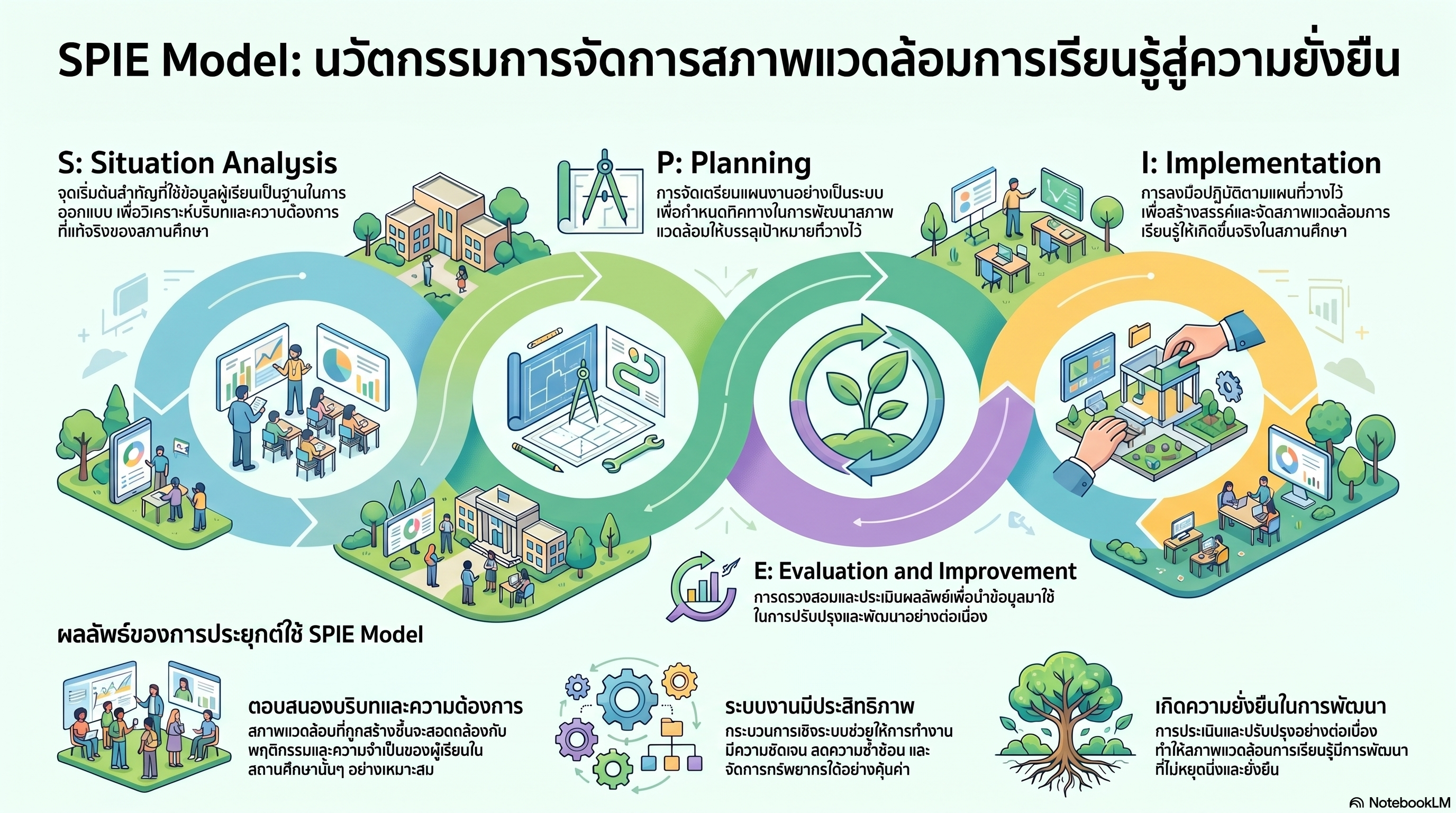
2. The developed model, named the SPIE Model, consisted of four stages: learner and environment analysis, planning, implementation, and evaluation and improvement.
3. The model evaluation showed an average IOC value of 1.00.
4. The post-test scores were significantly higher than the pre-test scores at the .01 level.
5. The effectiveness, efficiency, and value of the model were at a high level.
References
กรรณิกา ศิลาเรียม และสุริยะ รูปหมอก. (2568). แนวทางการบริหารสภาพแวดล้อมการเรียนรู้เชิงสร้างสรรค์สำหรับสถานศึกษา สหวิทยาเขตราชบุรีที่ 1 สังกัดสำนักงานเขตพื้นที่การศึกษามัธยมศึกษาราชบุรี. วารสารสหวิทยาการและการจัดการร่วมสมัย, 4(1), 19-35.
กิ่งกนก กิณเรศ, อภิสิทธิ์ สมศรีสุข และพรเทพ เสถียรนพเก้า. (2565). การพัฒนารูปแบบการบริหารจัดการสภาพแวดล้อมในสถานศึกษา สังกัดสำนักงานเขตพื้นที่การศึกษามัธยมศึกษาสกลนคร. วารสารวิจยวิชาการ, 5(6), 165-178. https://doi.org/10.14456/jra.2022.143
กิตติยา โพธิสาเกตุ. (2561). การพัฒนาแนวทางการจัดสภาพแวดล้อมการเรียนรู้ภายในสถานศึกษาเอกชนสังกัดอัครสังฆมณฑลท่าแร่-หนองแสง. (วิทยานิพนธ์การศึกษามหาบัณฑิต). มหาสารคาม: มหาวิทยาลัยมหาสารคาม.
พระราชบัญญัติการศึกษาแห่งชาติ พ.ศ. 2542. (19 สิงหาคม 2542). ราชกิจจานุเบกษา, เล่ม 116 ตอนที่ 74 ก, หน้า 1-19.
โรงเรียนพันท้ายนรสิงห์วิทยา. (2568). รายงานการจัดสภาพการเรียนรู้ของสถานศึกษา. สมุทรสงคราม: โรงเรียนพันท้ายนรสิงห์วิทยา [เอกสารภายใน].
วารุณี ยะวะหาบ. (2564). แนวทางการพัฒนาการบริหารสภาพแวดล้อมเพื่อการจัดการเรียนรู้ของโรงเรียนเอกชนสอนศาสนาอิสลาม จังหวัดพัทลุง. (การศึกษาค้นคว้าอิสระศึกษาศาสตรมหาบัณฑิต). นนทบุรี: มหาวิทยาลัยสุโขทัยธรรมาธิราช.
ศศิวิมล จันทสุข. (2567). แนวทางพัฒนาการจัดสภาพแวดล้อมการเรียนรู้ของโรงเรียนในสังกัดสำนักงานเขตพื้นที่การศึกษาประถมศึกษานครราชสีมา เขต 4. วารสารนวัตกรรมการจัดการศึกษาและการวิจัย, 6(4), 760-770.
สำนักงานคณะกรรมการการศึกษาขั้นพื้นฐาน. (2566). นโยบายและจุดเน้นของสำนักงานคณะกรรมการการศึกษาขั้นพื้นฐาน ปีงบประมาณ พ.ศ. 2566. เข้าถึงได้จาก https://www.obec.go.th
สำนักงานสภาพัฒนาการเศรษฐกิจและสังคมแห่งชาติ. (2561). แผนแม่บทภายใต้ยุทธศาสตร์ชาติ (พ.ศ. 2561-2580). เข้าถึงได้จาก https://www.nesdc.go.th
Astin, A. W. (1968). The college environment. Washington, DC: American Council on Education.
Astin, A. W. (1971). Two approaches to measuring students' perceptions of their college environment. Journal of College Student Personnel, 12(3), 169-172.
Best, J. W. (1977). Research in Education. Englewood Cliffs, NJ: Prentice Hall.
Deming, W. E. (1982). Quality, productivity and competitive position. Cambridge, MA: MIT Center for Advanced Engineering Study.
Fraser, B. J. (2012). Classroom learning environments: Retrospect, context and prospect. In B. J. Fraser, K. Tobin, & C. McRobbie (Eds.), Second international handbook of science education, 1191-1239. Dordrecht: Springer.
Lund, D. A. (Ed.). (1989). Older bereaved spouses: Research with practical applications. New York, NY: Hemisphere Publishing Corp.
McVey, G. F. (1989). Learning environment. In T. Husen & T. N. Postlethwaite (Eds.), The international encyclopedia of education. Oxford: Pergamon Press.
OECD. (2015). Students, computers and learning: Making the connection. Paris: OECD Publishing
Rovinelli, R. J. (1976). On the use of content specialists in the assessment of criterion-referenced test item validity. International Journal of Solids and Structures, 184, 153-166.
Savage, G. T., Nix, T. W., Whitehead, C. J., & Blair, J. D. (1991). Strategies for assessing and managing organizational stakeholders. Academy of Management Perspectives, 5, 61-75.