Competencies of School Administrators in the Digital Age in the Muang Song Khlong Secondary School Cluster Under the Secondary Educational Service Area Office Kamphaeng Phet
Keywords:
School Administrator Competencies;, Digital Competency;, Digital Age Leadership;, Competency DevelopmentAbstract
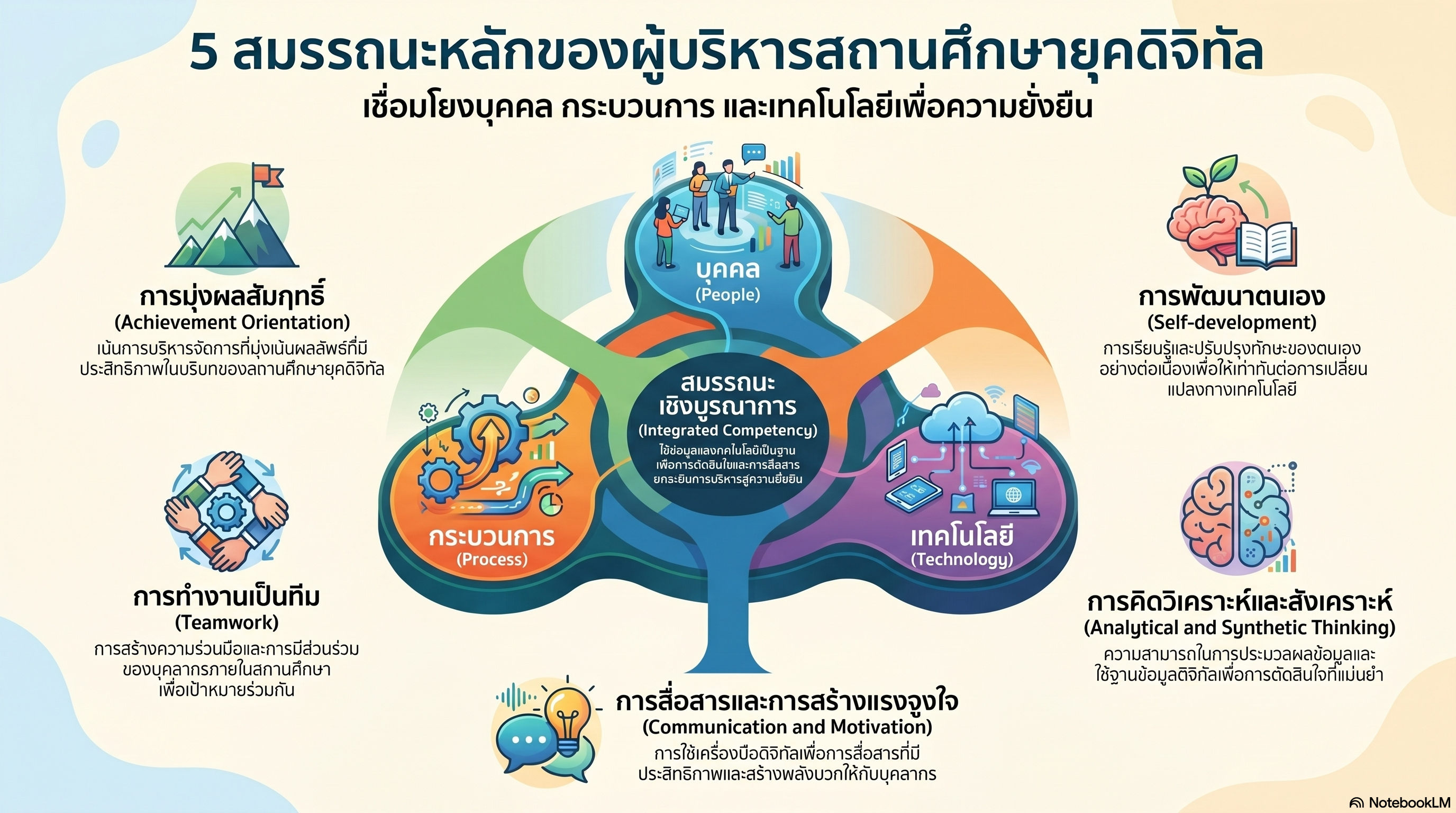
This research aimed to (1) examine the competencies of school administrators in the digital age and (2) explore guidelines for developing such competencies. The study employed a mixed-methods approach. The sample consisted of 169 school administrators and teachers, selected through stratified random sampling. Key informants for the qualitative phase included five experts, selected using purposive sampling. The research instruments included a questionnaire and a semi-structured interview. Quantitative data were analyzed using percentage, mean, and standard deviation, while qualitative data were analyzed through content analysis.
The findings revealed that:
1. The overall competencies of school administrators in the digital age were at the highest level ( = 4.59). When considered by aspect, all dimensions were at the highest level. The highest mean score was found in analytical and synthesis thinking (
= 4.62), followed by communication and motivation (
= 4.60), achievement orientation (
= 4.58), teamwork (
= 4.58), and self-development as a lifelong learner (
= 4.55), respectively.
2. The guidelines for competency development could be synthesized into five aspects: achievement orientation, self-development, teamwork, analytical and synthesis thinking, and communication and motivation.
References
กาญจนา นามวงศ์. (2566). ทักษะของผู้บริหารสถานศึกษาในยุคดิจิทัลที่ส่งผลต่อประสิทธิผลการบริหารงานโรงเรียนขยายโอกาสทางการศึกษา สังกัดสำนักงานเขตพื้นที่การศึกษาประถมศึกษาบึงกาฬ. (วิทยานิพนธ์ครุศาสตรมหาบัณฑิต). อุดรธานี: มหาวิทยาลัยราชภัฏอุดรธานี.
คณะกรรมการอิสระเพื่อการปฏิรูปการศึกษา. (2562). รายงานเฉพาะเรื่องที่ 8 การปฏิรูปครูและอาจารย์. เข้าถึงได้จาก http://backoffice.onec.go.th/uploads/Book/1742-file.pdf
ชัยยนต์ เพาพาน. (2559). การจัดการศึกษาเพื่อพัฒนาท้องถิ่นสู่ประชาคมอาเซียน: ทิศทางใหม่ในศตวรรษที่ 21. กาฬสินธุ์: มหาวิทยาลัยกาฬสินธุ์.
ศศิวิมล ม่วงกล่ำ. (2562). การวิเคราะห์องค์ประกอบด้านความสามารถทางดิจิทัลของครูและบุคลากรทางการศึกษา จังหวัดสระบุรี. (วิทยานิพนธ์ศึกษาศาสตรมหาบัณฑิต). ปทุมธานี: มหาวิทยาลัยเทคโนโลยีราชมงคลธัญบุรี.
สำนักงานเขตพื้นที่การศึกษามัธยมศึกษากำแพงเพชร. (2568). แผนปฏิบัติการประจำปีงบประมาณ พ.ศ. 2568. เข้าถึงได้จาก https://web.sesaokpp.go.th/
สำนักงานคณะกรรมการดิจิทัลเพื่อเศรษฐกิจและสังคมแห่งชาติ. (2562). กรอบสมรรถนะด้านดิจิทัลสำหรับพลเมืองไทย. กรุงเทพฯ: สำนักงานคณะกรรมการดิจิทัลเพื่อเศรษฐกิจและสังคมแห่งชาติ.
สุกัญญา แช่มช้อย. (2561). การบริหารสถานศึกษายุคดิจิทัล. กรุงเทพฯ: จุฬาลงกรณ์มหาวิทยาลัย.
สุนันทนา กุศลประเสริฐ. (2565). การวิเคราะห์องค์ประกอบสมรรถนะดิจิทัลของผู้บริหารสถานศึกษาในโรงเรียนมัธยมศึกษาจังหวัดพิษณุโลก. (วิทยานิพนธ์ศึกษาศาสตรมหาบัณฑิต). พิษณุโลก: มหาวิทยาลัยนเรศวร.
เสาวลักษณ์ พิมพ์ภูลาด. (2564). การวิเคราะห์องค์ประกอบสมรรถนะของผู้บริหารสถานศึกษายุคดิจิทัล สังกัดสำนักงานส่งเสริมการศึกษานอกระบบและการศึกษาตามอัธยาศัย. (วิทยานิพนธ์ศึกษาศาสตรมหาบัณฑิต). ปทุมธานี: มหาวิทยาลัยเทคโนโลยีราชมงคลธัญบุรี.
Hellriegel, D., Slocum, J. W., & Woodman, R. W. (2011). Organizational behavior. (13th ed.). Mason, OH: South-Western Cengage Learning.