Approaches to Guidelines for Developing Lifelong Learning Skills for the Elderly: Quality of Life and Vocational Training Center for the Elderly, Champa Wai Subdistrict, Phayao Province
Keywords:
Lifelong learning skills;, Lifelong Learning Skills Among Older Adults;, Approaches for Developing Lifelong Learning SkillsAbstract
This study aimed to: (1) examine the current state of lifelong learning skills development among older adults, and (2) develop guidelines for enhancing lifelong learning skills of older adults at the Quality of Life Development and Occupational Promotion Center for Older Adults in Champa Wai Subdistrict, Phayao Province. The research employed a mixed-methods approach. Three experts validated the research instruments, five experts evaluated the appropriateness and feasibility of the proposed guidelines, and five key informants were interviewed to develop the guidelines. The sample consisted of 66 older adults from the center, selected through purposive sampling based on Krejcie and Morgan’s table. The research instruments included a questionnaire, an interview form, and an evaluation form for appropriateness and feasibility. Quantitative data were analyzed using frequency, mean, and standard deviation, while qualitative data were analyzed through content analysis and data categorization.
The results revealed that:
1. The development of lifelong learning skills among the elderly was, overall, at a moderate level (= 3.27, S.D. = 0.37). The skill with the highest mean score was problem-solving thinking, while the skill with the lowest mean score was information technology.
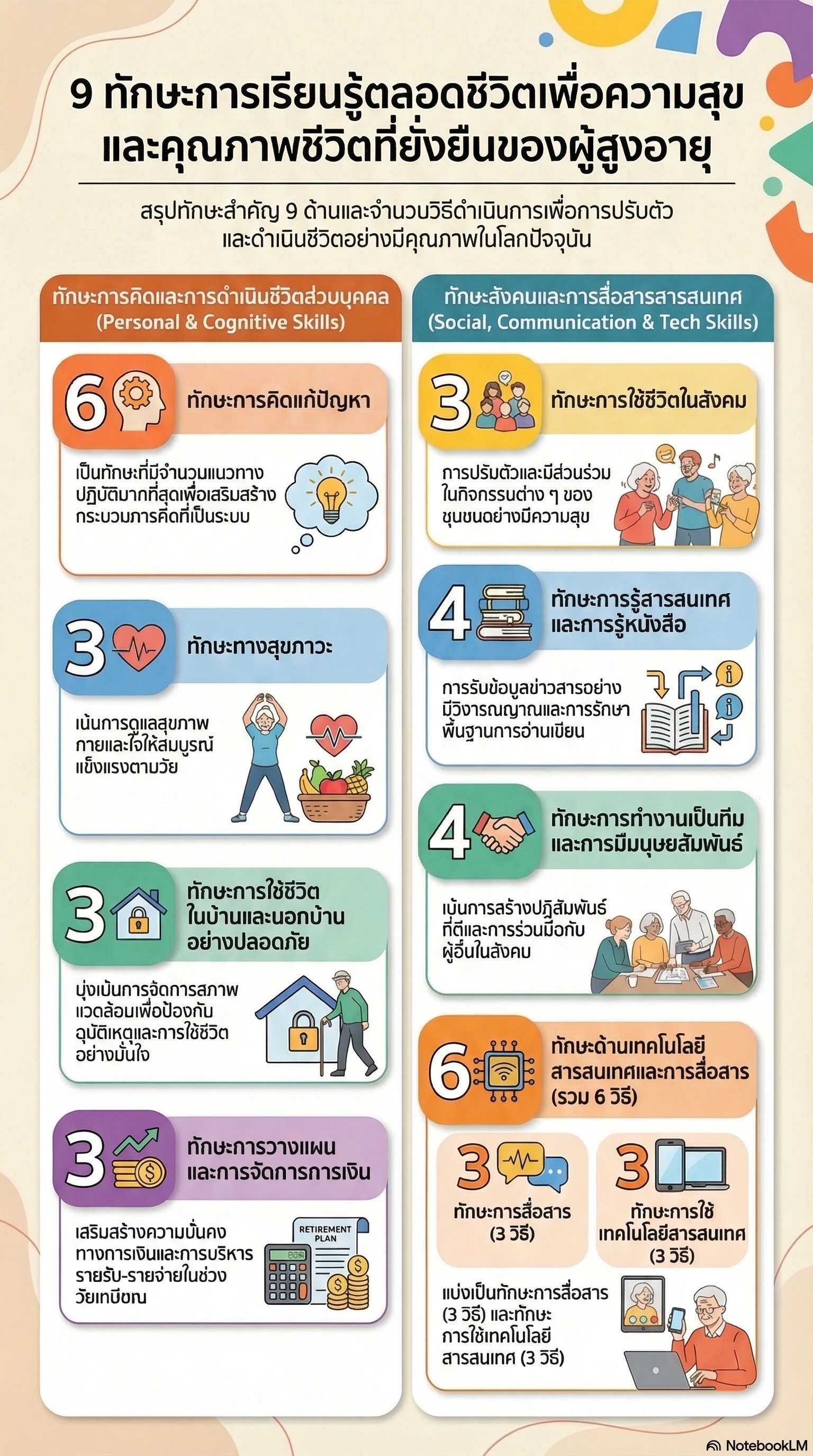
2. The guidelines for developing lifelong learning skills among the elderly consisted of 9 approaches and 32 operational procedures, covering the following skill areas: problem-solving thinking, social living, well-being, financial planning and management, information literacy and reading literacy, communication, safe living at home and in public, teamwork and interpersonal relations, and information technology.
References
กรมกิจการผู้สูงอายุ. (2569). สถิติผู้สูงอายุ. เข้าถึงได้จาก https://www.dop.go.th/en/know/1
กิตติ์ธเนศ สว่างวรนาถ และชมสุภัค ครุฑกะ. (2561). การพัฒนาหลักสูตรฝึกอบรมทักษะทางปัญญาของผู้สูงอายุ. วารสารพยาบาลทหารบก, 20(1), 207-215.
ไทยรัฐออนไลน์. (2566). 5 ทักษะจำเป็นกับการใช้ชีวิตของผู้สูงอายุในยุคดิจิทัล. เข้าถึงได้จาก https://www.thairath.co.th/lifestyle/lifestyle45plus/2696057
บุญชม ศรีสะอาด. (2560). การวิจัยเบื้องต้น. (พิมพ์ครั้งที่ 10 ฉบับปรับปรุงใหม่). กรุงเทพฯ: สุวีริยาสาส์น.
ภัทรพล รงลอง. (2567). ทักษะดิจิทัลกับสังคมผู้สูงอายุ: การเชื่อมต่อเพื่อคุณภาพชีวิตในยุคดิจิทัล. เข้าถึงได้จาก https://blog.think-digital.app/2024/12/16/digital-aging-society/
มหาวิทยาลัยหัวเฉียวเฉลิมพระเกียรติ. (2566). การเรียนรู้ตลอดชีวิต (Lifelong Learning). เข้าถึงได้จาก https://www.hcu.ac.th/article/(Lifelong%20Learning)
ศูนย์การศึกษานอกระบบและการศึกษาตามอัธยาศัยกลุ่มเป้าหมายพิเศษ. (2565). แนวทางการดำเนินงานและรูปแบบการจัดกิจกรรมพัฒนาทักษะชีวิตผู้สูงอายุใน 4 มิติ. กรุงเทพฯ: สำนักงาน กศน. สำนักงานปลัดกระทรวงศึกษาธิการ.
สำนักงานเลขาธิการสภาการศึกษา. (2566). ทักษะและสมรรถนะที่จำเป็นสำหรับผู้สูงอายุ. เข้าถึงได้จาก http://www.onec.go.th
สิรินธร สินจินดาวงศ์ และผุสดี กลิ่นเกษร. (2563). การเรียนรู้ตลอดชีวิตสำหรับผู้สูงวัย. การประชุมวิชาการและเผยแพร่ผลงานวิจัยคัดสรร สาขาวิชาศึกษาศาสตร์ระดับชาติ ครั้งที่ 4 หัวข้อ “การศึกษายุค Digital Disruption”, 1-2 กุมภาพันธ์ 2563 (หน้า 70-83). นครราชสีมา: โรงแรมชาโต เดอ เขาใหญ่. เข้าถึงได้จาก https://dspace.spu.ac.th/handle/123456789/6712
สุบิน ไชยยะ. (2562). การพัฒนาทักษะการเรียนรู้ตลอดชีวิตของนักศึกษาในศตวรรษที่ 21. วารสารวิชาการศึกษาศาสตร์, 20(1), 168-180.
อรอำไพ บุรานนท์. (2554). แนวทางการส่งเสริมการเรียนรู้ตลอดชีวิตตามความต้องการของผู้สูงอายุศูนย์บริการผู้สูงอายุดินแดง สังกัดกรุงเทพมหานคร. (ปริญญานิพนธ์การศึกษามหาบัณฑิต). กรุงเทพฯ: มหาวิทยาลัยศรีนครินทรวิโรฒ.
Krejcie, R. V., & Morgan, D. W. (1970). Determining sample size for research activities. Educational and Psychological Measurement, 30(3), 607-610.