A Study of Guidelines for Being a Happy Organization of Educational Institutions under the Kalasin Primary Educational Service Area Office 2
Keywords:
Development guidelines;, Happy organization in schoolsAbstract
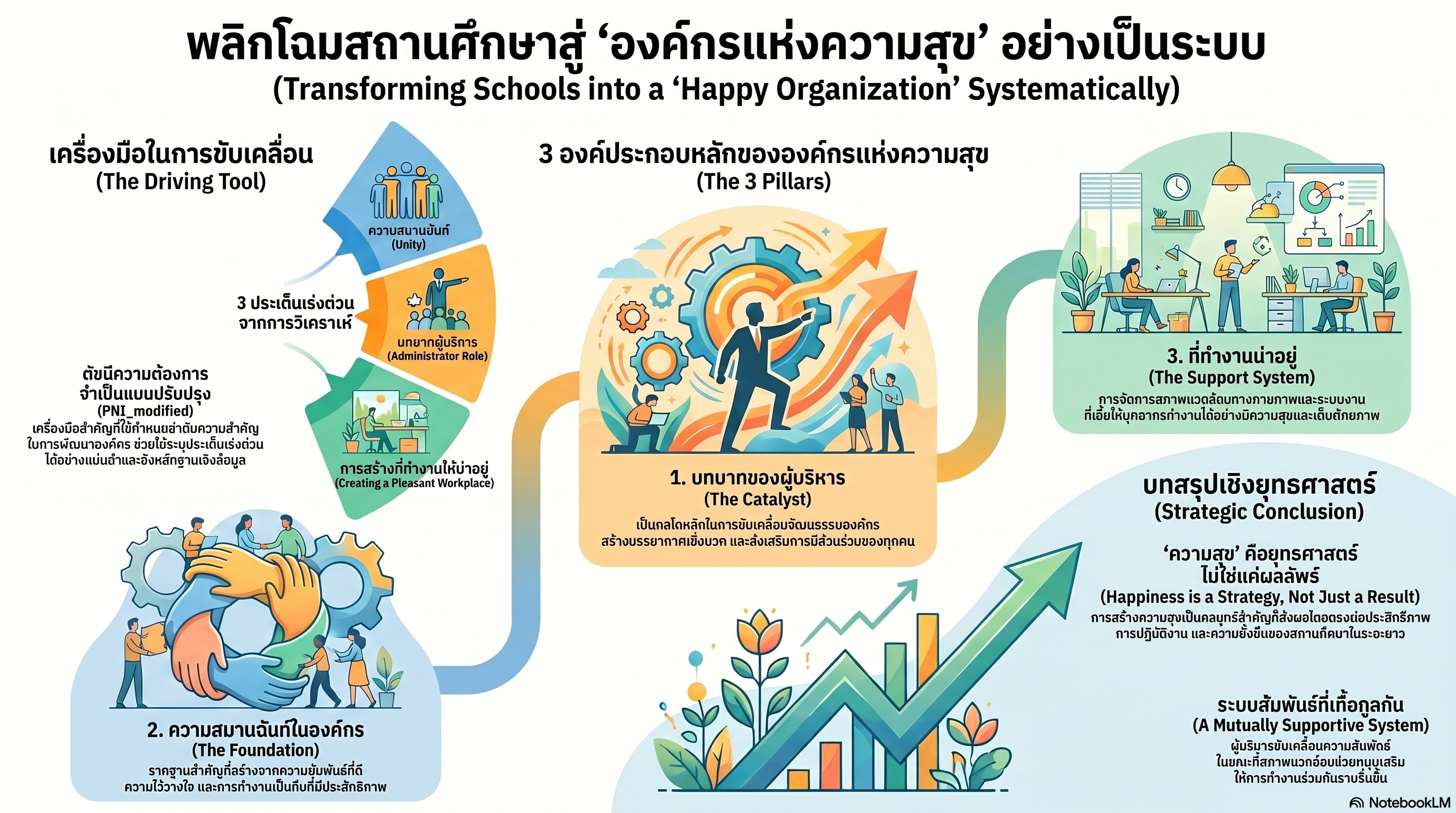
This study aimed to: (1) examine the current and desirable states of being a happy organization in educational institutions under the Kalasin Primary Educational Service Area Office 2, (2) analyze the priority needs, and (3) investigate guidelines for developing a happy organization. The research employed a mixed-methods approach. The sample consisted of 306 school administrators and teachers, selected through disproportionate stratified random sampling, and five key informants selected by purposive sampling. The research instruments included five-point rating scale questionnaires on the current state (discrimination indices ranging from 0.76 to 0.99, reliability coefficient = 0.99) and the desirable state (discrimination indices ranging from 0.76 to 0.93, reliability coefficient = 0.99), as well as a semi-structured interview. Data were analyzed using descriptive statistics, including frequency, percentage, mean, standard deviation, and the Priority Needs Index (PNI_modified).
The results revealed that:
1. The current state of being a happy organization was at a high level overall.
2. The desirable state was at the highest level overall
3. The priority needs, with indices higher than the overall mean, were organizational harmony, administrators’ roles, and a pleasant working environment.
4 The guidelines for developing a happy organization comprised three dimensions with 20 approaches, which were evaluated as having the highest levels of appropriateness and feasibility. In conclusion, the development of a happy organization in educational institutions should emphasize enhancing organizational relationships, strengthening administrators’ leadership, and improving the working environment conducive to well-being, in order to increase work efficiency and ensure organizational sustainability.
References
กอปรลาภ อภัยภักดิ์. (2563). บรรยากาศองค์กรแห่งความสุข: คนเบิกบาน งานสำเร็จ. วารสาร มจร มนุษยศาสตร์ปริทรรศน์, 6(1), 315-331.
จินดาวรรณ รามทอง. (2560). โมเดลปัจจัยเชิงสาเหตุความสุขในการทำงานของบุคลากรสายสนับสนุนในมหาวิทยาลัย. วารสารพัฒนบริหารศาสตร์, 57(2), 59-82.
ชาญวิทย์ วสันต์ธนารัตน์. (2559). มาสร้างองค์กรแห่งความสุขกันเถอะ (ฉบับปรับปรุง 2559). กรุงเทพฯ: แอทโฟร์พริ้นท์.
เด่นชัย อาทิตย์เจริญชัย. (2558). องค์กรแห่งความสุขของโรงเรียนศรีบุญยานนท์. (วิทยานิพนธ์ศึกษาศาสตรมหาบัณฑิต). กรุงเทพฯ: มหาวิทยาลัยศิลปากร.
นันท์สินี ทวิสุวรรณ. (2562). สุขภาวะองค์กรของโรงเรียนบ้านเขาอ่างแก้ว. (วิทยานิพนธ์ศึกษาศาสตรมหาบัณฑิต). กรุงเทพฯ: มหาวิทยาลัยศิลปากร.
อนุพงศ์ รอดบุญปาน และนุชนรา รัตนศิระประภา. (2562). องค์กรแห่งความสุขของโรงเรียนอนุบาลกุยบุรี (วัดวังยาว). วารสารการบริหารการศึกษา มหาวิทยาลัยศิลปากร, 10(2), 245-257. https://so02.tci-thaijo.org/index.php/EdAd/article/view/241098
Claypool, K. K. (2017). Organizational success: How the presence of happiness in the workplace affects employee engagement that leads to organizational success. (Doctoral dissertation). Malibu, CA: Pepperdine University.
Helliwell, J. F., Layard, R., & Sachs, J. D. (2022). World happiness report 2022. Sustainable Development Solutions Network. Retrieved from https://worldhappiness.report/ed/2022/
Herzberg, F., Mausner, B., & Snyderman, B. B. (1959). The motivation to work. (2nd ed.). New York, NY: John Wiley.
Krejcie, R. V., & Morgan, D. W. (1970). Determining sample size for research activities. Educational and Psychological Measurement, 30(3), 607-610.
Maslow, A. H. (1943). A theory of human motivation. Psychological Review, 50(15), 370-396. http://dx.doi.org/10.1037/h0054346