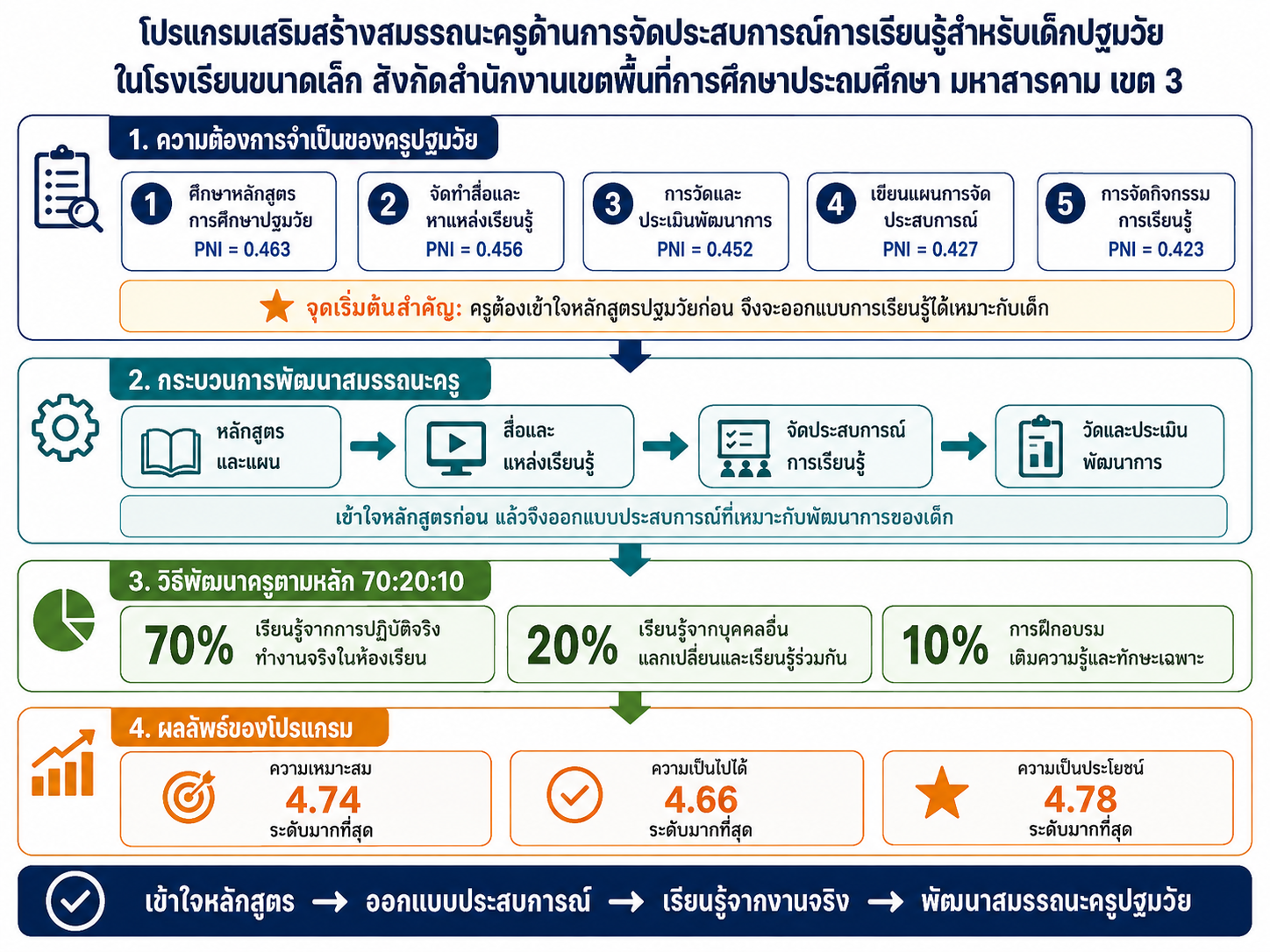
The TEAHER COMPETENCY ENHANCEMENT PROGRAM IN ORGANIZING EARLY CHILDHOOD LEARNING EXPERIENCES IN SMALL SCHOOLS UNDER THE OFFICE OF THE PRIMARY EDUCATIONAL SERVICE AREA, MAHASARAKHAM AREA 3
Keywords:
Program, Teacher Competency, Early Childhood Education, Learning Experience Organization, Small SchoolsAbstract
This research employed a Mixed-Methods Research design with the following objectives: 1) To investigate the components, current conditions, desirable conditions, priority needs, and guidelines for enhancing teacher competencies in organizing learning experiences for early childhood children in small schools under the Maha SarakhamPrimary Educational Service Area Office 3. The quantitative sample consisted of 86 early childhood teachers, selected through stratified random sampling based on district proportions. The research instrument was a questionnaire with a reliability of 0.98 and a Content Validity (IOC) ranging from 0.60 to 1.00. For the qualitative phase, semi-structured interviews were conducted with 6 experts. Data were analyzed using percentage, mean (𝑥̅) standard deviation (S.D.), Modified Priority Needs Index (PNImodified), and content analysis techniques. 2) To validate the teacher competency enhancement program for early childhood learning experience organization in small schools under the aforementioned office. The informants for this phase included 5 experts selected through purposive sampling for a focus group discussion. The instruments utilized included current and desirable condition questionnaires, interview forms, focus group discussion protocols, and evaluation forms assessing suitability, feasibility, and utility. Statistical analysis was performed using percentage, mean, standard deviation, and the Priority Needs Index.
The results were as follows : 1) The overall current state of teacher competency was at a moderate level, while the desirable state was at the highest level. 2)The highest-ranked priority need was the study of the early childhood education curriculum.Thedeveloped and validated program consists of 5 components: 1) Principles, 2) Objectives, 3) Content, comprising 4 operational steps: 1 developing early childhood curricula and experience plans, 2 creating media and identifying learning resources, 3 organizing learning experiences, and 4 measuring and evaluating development; 4) Development guidelines based on the 70:20:10 learning model and competency enhancement methods; and 5) Evaluation guidelines. The program was rated at the highest level of suitability, feasibility, and utility.