Strategic Management in Primary Education Institutions in Chiang Mai Province to Reduce Educational Inequality in Accordance with the National Strategic Goals
Keywords:
Strategic Educational Management;, Educational Inequality;, School Leadership;, SDG 4Abstract
This research aimed to: (1) examine the current state of strategic management in basic education institutions in Chiang Mai Province for reducing educational inequality in accordance with the National Strategy; (2) analyze key factors and strategic implementation approaches of school administrators aligned with the National Strategy (2018-2037); and (3) synthesize and propose a strategic management framework for reducing educational inequality. A mixed methods research design was employed. Quantitative data were collected from 60 school administrators using a five-point Likert scale questionnaire and analyzed using mean and standard deviation. Qualitative data were obtained from in-depth interviews with 10 administrators and analyzed through content analysis.
The findings revealed that:
1. The overall level of strategic management was high ( = 4.30, S.D. = 0.56). The highest mean score was found in stakeholder participation, followed by educational equity outcomes, strategic planning, monitoring and evaluation, and resource allocation, respectively.
2. Key factors and strategic approaches included the use of information and communication technology in management, such as Learning Management Systems (LMS), teacher development through Professional Learning Communities (PLC), and instructional supervision, which effectively reduced learning gaps between urban and rural students.
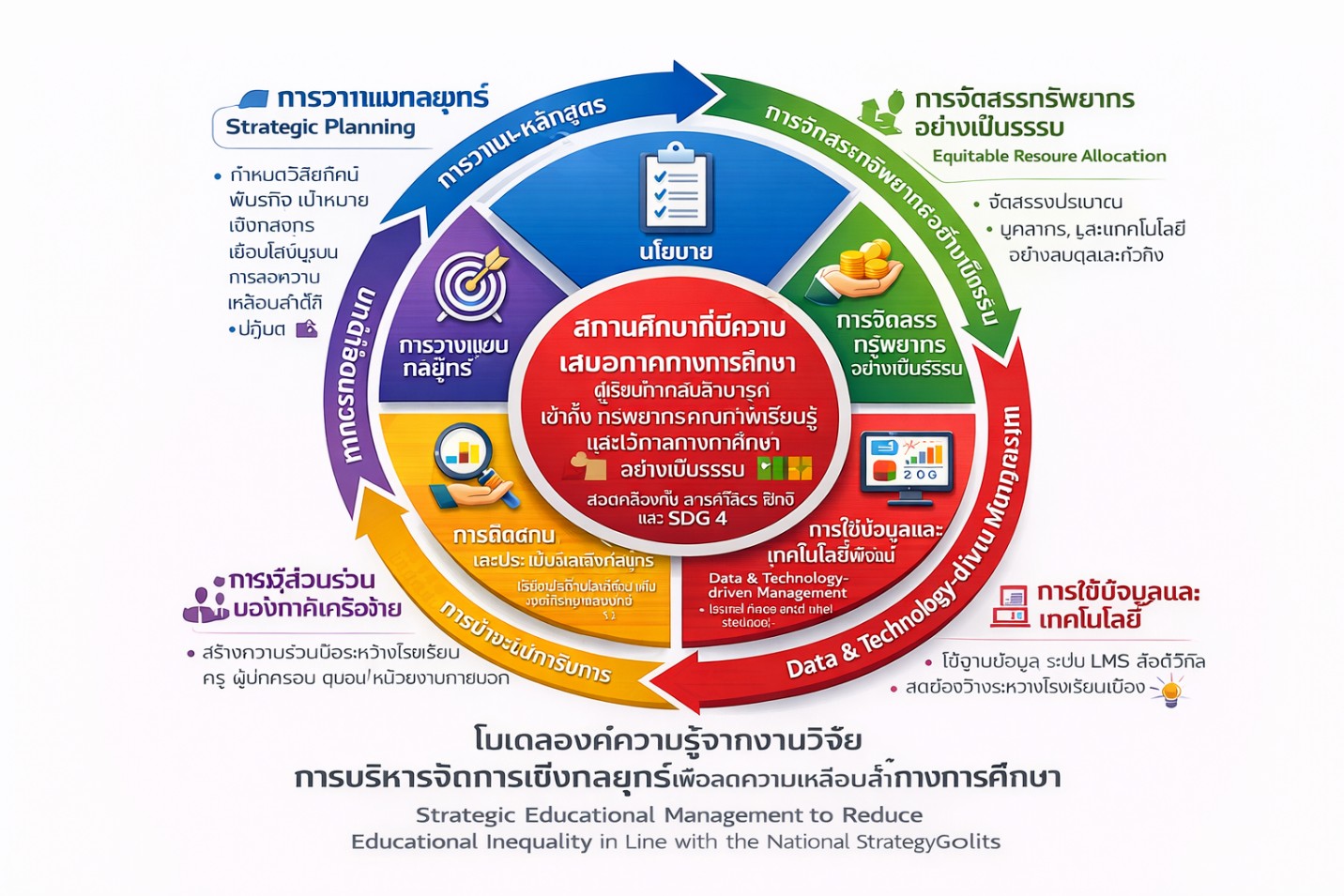
3. The synthesized strategic management framework comprised five key components: strategic planning, resource allocation, monitoring and evaluation, data and technology utilization, and stakeholder participation. These components were systematically interconnected and contributed to educational equity outcomes. In conclusion, strategic management at the school level plays a critical role in reducing educational inequality and supports the achievement of Sustainable Development Goal 4 (SDG 4) in a concrete manner.
References
สำนักงานสภาพัฒนาการเศรษฐกิจและสังคมแห่งชาติ. (2566). รายงานสถานการณ์ทางเศรษฐกิจและสังคมของประเทศไทย. กรุงเทพฯ: สำนักงานสภาพัฒนาการเศรษฐกิจและสังคมแห่งชาติ.
Bryson, J. M. (2018). Strategic planning for public and nonprofit organizations: A guide to strengthening and sustaining organizational achievement. (5th ed.). Hoboken, NJ: John Wiley & Sons.
Fullan, M. (2019). Leading in a culture of change. (2nd ed.). San Francisco, CA: Jossey-Bass.
Kaplan, R. S., & Norton, D. P. (1996). The balanced scorecard: Translating strategy into action. Boston, MA: Harvard Business School Press.
Leithwood, K. (2021). A review of evidence about equitable school leadership. Toronto, ON: Ontario Institute for Studies in Education.
OECD. (2022). Education at a glance 2022: OECD indicators. Paris: OECD Publishing.
World Bank. (2023). Thailand economic monitor: Inequality of opportunity. Washington, DC: World Bank.