Dynamics of Public Fiscal Administration under Public Debt Constraints: An Analysis of Thailand’s Economic Stimulus Policy in Fiscal Year 2026
Keywords:
Public Fiscal Administration;, Public Debt;, Economic Stimulus Policy;, Fiscal Sustainability;, Fiscal GovernanceAbstract
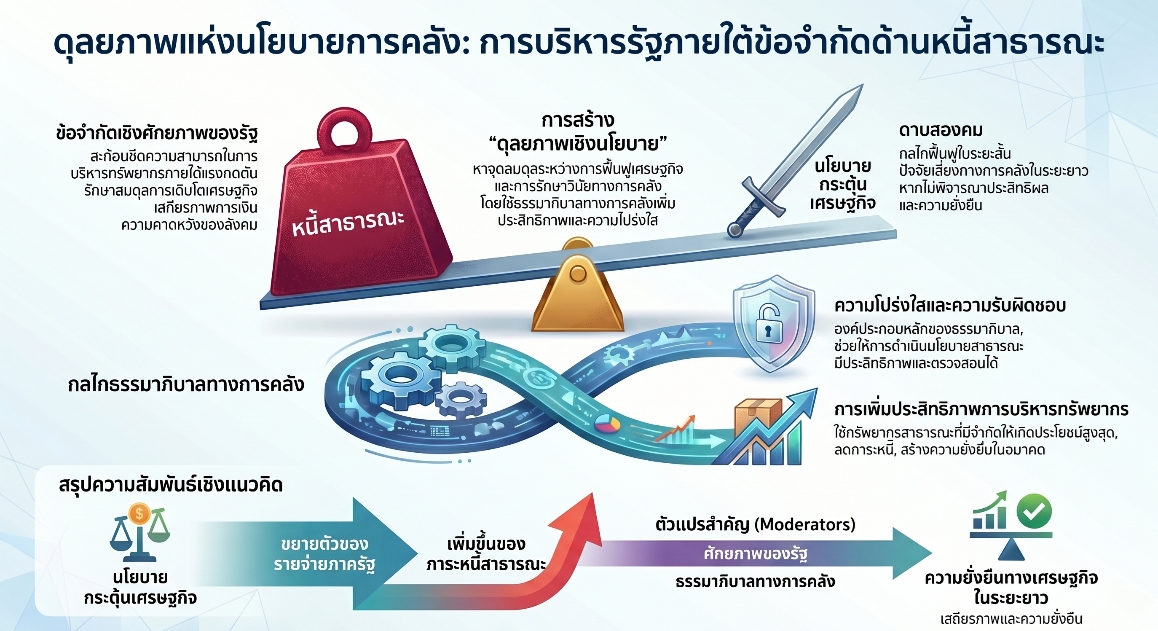
Thailand’s public finances are facing increasing constraints as public debt rises while the economy continues to rely on government measures to support recovery. These constraints involve not only public debt but also revenue capacity, expenditure commitments, and future fiscal space. This academic article aims to: 1) analyze public fiscal administration under public debt constraints; 2) examine the effects of economic stimulus policies on fiscal sustainability; and 3) propose approaches to fiscal management that are appropriate to Thailand’s long-term economic and fiscal conditions. The analysis draws on academic literature, research studies, government economic and fiscal reports, and policy documents issued by domestic and international institutions. The discussion is framed by the concepts of public fiscal administration, fiscal discipline, fiscal governance, and fiscal sustainability.
The analysis shows that Thailand’s fiscal position has become more constrained by rising public expenditure, persistent budget deficits, and increasing public debt. Although expansionary fiscal policy can support aggregate demand, employment, and economic recovery in the short term, prolonged reliance on such measures increases interest obligations and reduces fiscal space for future policy responses. Fiscal sustainability therefore depends not only on the level of public debt but also on the government’s capacity to mobilize revenue, prioritize expenditure, improve the quality of public spending, and ensure transparency and accountability in fiscal management.
The article argues that fiscal management under public debt constraints should address revenue, expenditure, and debt management together. Key measures include improving revenue collection, reviewing non-essential expenditure, allocating budgets according to national priorities, and managing debt structure and interest costs at manageable levels. Greater transparency and systematic policy evaluation are also required to preserve the government’s capacity to respond to future economic conditions.
References
ธนาคารแห่งประเทศไทย. (2568). รายงานภาวะเศรษฐกิจไทย ปี 2568. กรุงเทพฯ: ธนาคารแห่งประเทศไทย.
สำนักงบประมาณ. (2569). งบประมาณโดยสังเขป ประจำปีงบประมาณ พ.ศ. 2569. กรุงเทพฯ: สำนักงบประมาณ สำนักนายกรัฐมนตรี.
สำนักงานคณะกรรมการวินัยการเงินการคลังของรัฐ. (2568). รายงานสถานะการเงินการคลังภาครัฐ ปีงบประมาณ 2568. กรุงเทพฯ: กระทรวงการคลัง.
สำนักงานบริหารหนี้สาธารณะ. (2568). รายงานหนี้สาธารณะคงค้างของประเทศไทย ปี 2568. กรุงเทพฯ: กระทรวงการคลัง.
สำนักงานสภาพัฒนาการเศรษฐกิจและสังคมแห่งชาติ. (2569). ภาวะเศรษฐกิจไทยไตรมาสที่สี่ ทั้งปี 2568 และแนวโน้มปี 2569. กรุงเทพฯ: สำนักงานสภาพัฒนาการเศรษฐกิจและสังคมแห่งชาติ.
Alesina, A., & Perotti, R. (1996). Fiscal discipline and the budget process. The American Economic Review, 86(2), 401-407.
Blanchard, O. J. (1990). Suggestions for a new set of fiscal indicators. OECD Economics Department Working Papers, 79, 1-32.
Bovaird, T., & Löffler, E. (2009). Public management and governance. (2nd ed.). London: Routledge.
Dunn, W. N. (2018). Public policy analysis: An integrated approach. (6th ed.). New York, NY: Routledge.
Evans, P. (1995). Embedded autonomy: States and industrial transformation. Princeton, NJ: Princeton University Press.
International Monetary Fund. (2023). Fiscal monitor: On the path to policy normalization. Washington, DC: International Monetary Fund. https://doi.org/10.5089/9798400234026.089
International Monetary Fund. (2024). World economic outlook, April 2024: Steady but slow Resilience amid divergence. Washington, DC: International Monetary Fund.
Keynes, J. M. (1936). The general theory of employment, interest and money. London: Macmillan.
Krugman, P. (2009). The return of depression economics and the crisis of 2008. New York, NY: W. W. Norton & Company.
Musgrave, R. A., & Musgrave, P. B. (1989). Public finance in theory and practice (5th ed.). New York, NY: McGraw-Hill.
Organization for Economic Co-operation and Development. (2021). Government at a glance 2021. Paris: OECD Publishing.
Peters, B. G. (2018). Advanced introduction to public policy. Cheltenham: Edward Elgar Publishing.
Reinhart, C. M., & Rogoff, K. S. (2010). Growth in a time of debt. The American Economic Review, 100(2), 573-578. https://doi.org/10.1257/aer.100.2.573
Rubin, I. S. (2016). The politics of public budgeting: Getting and spending, borrowing and balancing. (8th ed.). Washington, DC: CQ Press.
Schick, A. (1998). Why most developing countries should not try New Zealand’s reforms. The World Bank Research Observer, 13(1), 123-131.
Stiglitz, J. E., & Rosengard, J. K. (2015). Economics of the public sector. (4th ed.). New York, NY: W. W. Norton & Company.
Stone, D. (2012). Policy paradox: The art of political decision making. (3rd ed.). New York, NY: W. W. Norton & Company.
World Bank. (2022). Thailand economic monitor: Building resilience for future growth. Washington, DC: World Bank.