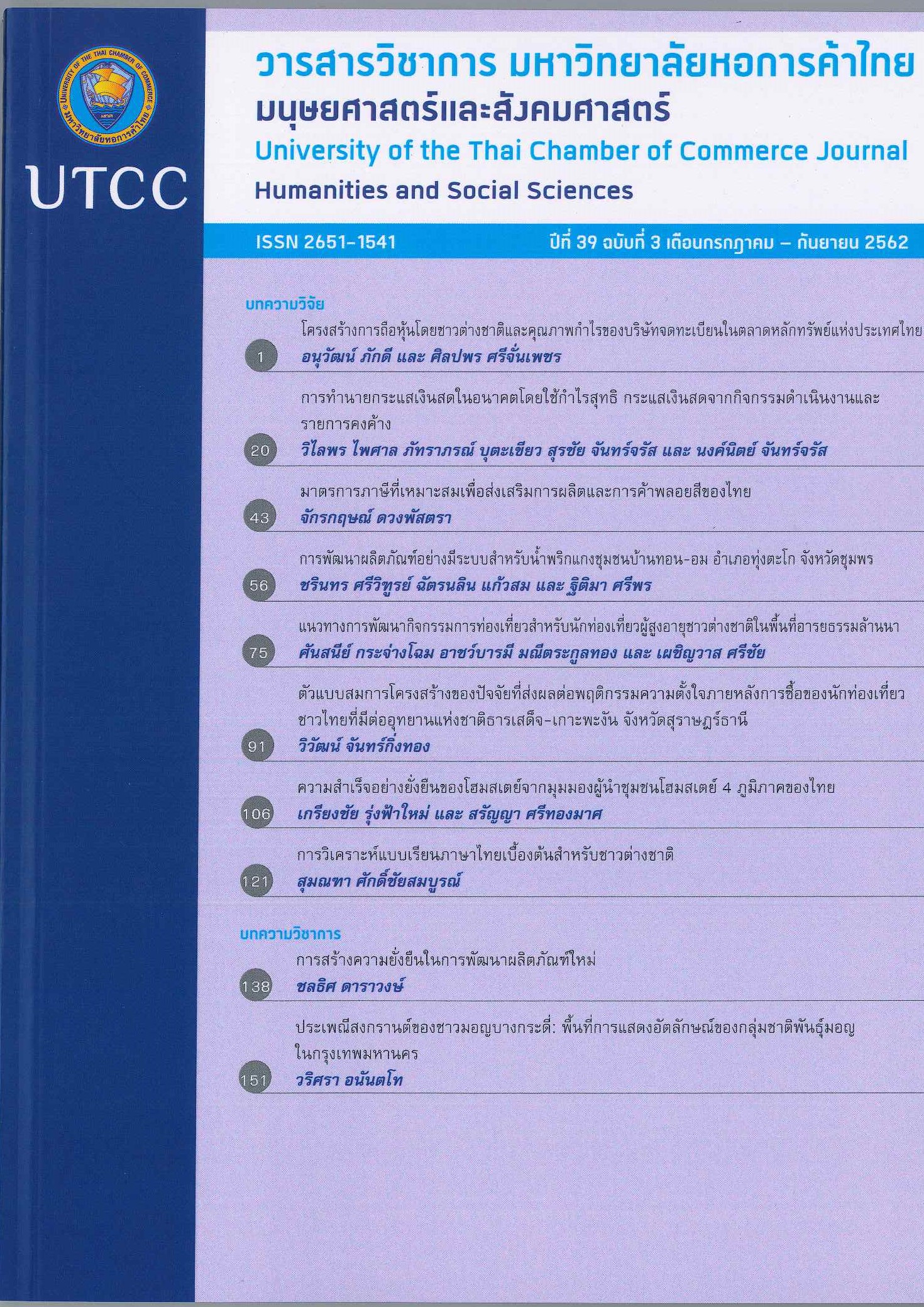
Sustainability Enhancement in New Product Development
Article Sidebar
Main Article Content
Abstract
The objective of this article is to collect and present the information relating to sustainability enhancement in new product development. New product development is considered as the most important component for all businesses since they help manufacturing companies improve competitive advantage in all industries. The manufacturing companies not only put efforts to serve consumer needs, but they also have to get along with nearby society or community and environmental surroundings. Sustainable new product development can be generated in three ways; environmental, social, and economical. It can also be enhanced in every stage of new product life cycle, consisting of production stage, distributions stage, utilization stage, storage stage, and end of life stage. In addition, Top management should emphasize driving factors, including 1) cross-functional work 2) top management involvement 3) marketing planning, and 4) formalized processes.
Article Details
ลิขสิทธิ์ของบทความ
ผลงานที่ได้รับการตีพิมพ์ถือเป็นลิขสิทธิ์ของมหาวิทยาลัยหอการค้าไทย ห้ามมิให้นำเนื้อหา ทัศนะ หรือข้อคิดเห็นใด ๆ ของผลงานไปทำซ้ำ ดัดแปลง หรือเผยแพร่ ไม่ว่าทั้งหมดหรือบางส่วนโดยไม่ได้รับอนุญาตเป็นลายลักษณ์อักษรจากมหาวิทยาลัยหอการค้าไทยก่อน
References
ชลธิศ ดาราวงษ์. (2558). การจัดการความรู้ในทีมพัฒนาผลิตภัณฑ์ใหม่เพื่อความสำเร็จของผลิตภัณฑ์ใหม่. วารสารวิชาการ มหาวิทยาลัยหอการค้าไทย, 35(2), 161–173.
ชลธิศ ดาราวงษ์. (2559). การบริหารความขัดแย้งระหว่างวิศวกร/ นักวิจัยและพัฒนา และนักการตลาดในกระบวนการพัฒนาผลิตภัณฑ์ใหม่. วารสารนักบริหาร, 36(1), 3–13.
รพีพรรณ วงศ์ประเสริฐ. (2556). การสร้างคุณค่าร่วม แนวปฏิบัติที่ดีสู่สังคม. วารสารนักบริหาร, 33(3), 75-81.
วรวุฒิ ไชยศร, และบุญสม เกษะประดิษฐ์. (2560). ความรับผิดชอบต่อสังคมขององค์กรธุรกิจกับการพัฒนาที่ยั่งยืน: กรณีศึกษาความรับผิดชอบต่อสังคม 6 บริษัท. วารสารปัญญาภิวัฒน์, 9(3), 140-152.
ศิลปะพร ศรีจั่นเพชร. (2552). จริยธรรมทางธุรกิจกับบรรษัทภิบาล. วารสารบริหารธุรกิจ, 32(123), 1-6.
สำนักงานสภาพัฒนาการเศรษฐกิจและสังคมแห่งชาติ. (2544). แผนพัฒนาเศรษฐกิจและสังคมแห่งชาติ ฉบับที่ 9. กรุงเทพฯ: คุรุสภาลาดพร้าว.
หรรษมน เพ็งหมาน. (2559). จริยธรรมทางธุรกิจเพื่อความยั่งยืนของธุรกิจค้าปลีก. Veridian E-Journal, 9(1), 815-828.
อภิรดา ชิณประทีป. (2558). การแสดงความรับผิดชอบต่อสังคมขององค์กรและผลการดำเนินงานทางด้านการเงิน. วารสารการบริหารท้องถิ่น, 9(1), 118-132.
Akroush, M.N., & Awwad, A.S. (2018). Enablers of npd financial performance: The roles of npd capabilities improvement, npd knowledge sharing and npd internal learning. International Journal of Quality & Reliability Management, 35(1), 163-186.
Ayers, D.J., Gordon, G.L., & Schoenbachler, D.D. (2001). Integration and new product development success: The role of formal and informal controls. Journal of Applied Business Research, 17(2), 133-148.
Choi, J.K., Nies, L.F., & Ramani, K. (2008). A framework for the integration of environmental and business aspects toward sustainable product development. Journal of Engineering Design, 19(5), 431-446.
Cooper, R.G. (2016). Agile–stage-gate hybrids: The next stage of product development. Research–Technology Management, 59(1), 21-29.
Darawong, C. (2018). Dynamic capabilities of new product development teams in perfoming radical innovation projects. International Journal of Innovation Science, 10(3), 333-349.
Doane, D., & MacGillivray, A. (2001). Economic sustainability: The business of staying in business. Retrieved from https://projectsigma.co.uk/RnDStreams/RD_economic_sustain.pdf
Docherty, P., Forslin, J., & Shani, A.B. 2002. Creating sustainable work systems: Emerging perspectives and practice. London, England: Routledge.
Driessen, P.H., Hillebrand, B., Kok, R.A.W., & Verhallen, T.M.M. (2013). Green new product development: The pivotal role of product greenness. IEEE Transactions on Engineering Management, 60(2), 315-326.
Fish, L. (2015). Recommendations for implementing sustainability into new product development for supply chain management. The BRC Academy Journal of Business, 6(1), 58-87.
Genç, E., & Di Benedetto, C.A. (2015). Cross-functional integration in the sustainable new product development process: The role of the environmental specialist. Industrial Marketing Management, 50, 150-161.
Gmelin, H., & Seuring, S. (2014a). Achieving sustainable newproduct development by integrating productlife-cycle management capabilities. International Journal of Production Economics, 154,166-177.
Gmelin, H., & Seuring, S. (2014b). Determinants of a sustainable new product development. Journal of Cleaner Production, 69(1), 1-9.
Goodland, R. (1995). The concept of environmental sustainability. Annual Review of Ecology and Systematics, 26(1),1-24.
Gordon, O., & Oades, L. (2018). Social marketing of wellbeing. In M. Slade, L. Oades, & A. Jarden (Eds.), Wellbeing, recovery and mental health (pp.331-323). Cambridge: Cambridge University Press.
Jansen, J.J.P., Bosch, F.A.J.V.D., & Volberda, H.W. (2006). Exploratory innovation, exploitative innovation, and performance: Effects of organizational antecedents and environmental moderators. Management Science, 52(11), 1661-1674.
Krishnan, V., & Ulrich, K.T. (2001). Product development decisions: A review of the literature. Management Science, 47(1), 1 - 21.
May, G., Taisch, M., & Kerga, E. (2012). Assessment of sustainable practices in new product development. In F. Jan, & Laugen B. T. (Eds.), Advances in production management systems; Value networks: Innovation, technologies, and management (pp. 437-447). Berlin, Germany: Springer.
Olin, T., & Shani, A.B. (2003). Npd as a sustainable work process in a dynamic business environment. R&D Management, 33(1), 1-13.
Pujari, D. (2006). Eco-innovation and new product development: Understanding the influences on market performance. Technovation, 26(1), 76-85.
Siegel, D.S. (2009). Green management matters only if it yields more green: An economic/strategic perspective. Academy of Management Perspectives, 23(3), 5-16.
Sutcliffe, L.F.R., Maier, A.M., Moultrie, J., & Clarkson, P.J. (2009, August). Development of a framework for assessing sustainability in new product development. Paper presented at the International Conference on Engineering Design, ICED'09, Standford, CA.
Um, K.-H., & Kim, S.-M. (2018). Collaboration and opportunism as mediators of the relationship between npd project uncertainty and npd project performance. International Journal of Project Management, 36(4), 659-672.
Vink, E.T.H., Rábago, K.R., Glassner, D.A., & Gruber, P.R. (2003). Applications of life cycle assessment to natureworks polylactide (pla) production. Polymer Degradation and Stability, 80(3), 403-419.
WCED. 1987. The world commission on environment and development, our common future. New York, NY: Oxford University Press.
