
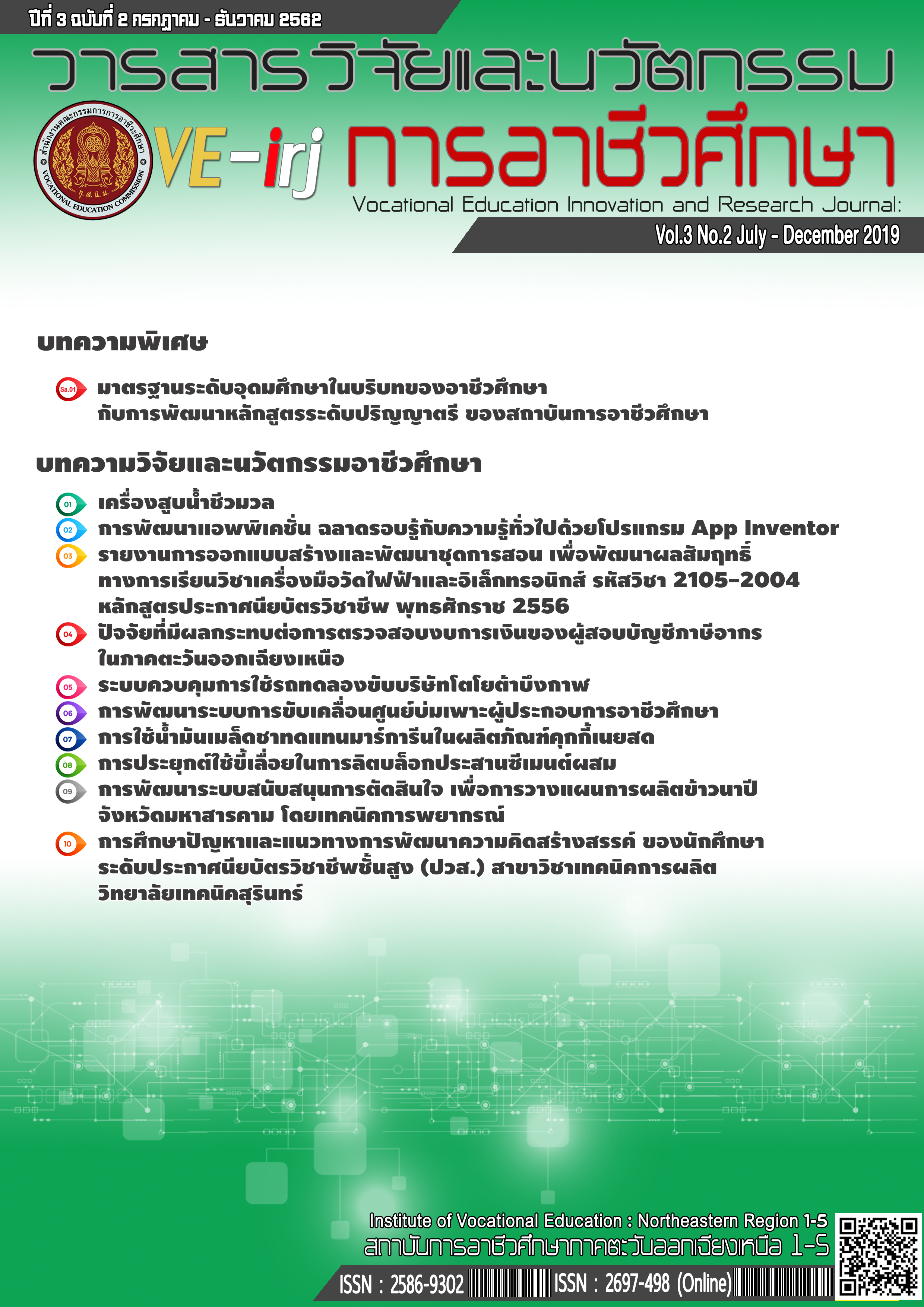
การศึกษาปัญหาและแนวทางการพัฒนาความคิดสร้างสรรค์ ของนักศึกษา ระดับประกาศนียบัตรวิชาชีพชั้นสูง (ปวส.) สาขาวิชาเทคนิคการผลิต วิทยาลัยเทคนิคสุรินทร์
Article Sidebar
Main Article Content
บทคัดย่อ
การวิจัยการศึกษาปัญหาและแนวทางการพัฒนาความคิดสร้างสรรค์ วิชาโครงการของนักศึกษา ระดับประกาศนียบัตรวิชาชีพชั้นสูง (ปวส.) สาขาวิชาเทคนิคการผลิต วิทยาลัยเทคนิคสุรินทร์ มีวัตถุประสงค์ 1) เพื่อศึกษาปัญหาและแนวทางการพัฒนาความคิดสร้างสรรค์ของนักศึกษา 2) เพื่อสร้างชุดแนวทางในการพัฒนาความคิดสร้างสรรค์ 3) เพื่อทดลองใช้ชุดแนวทางในการพัฒนาความคิดสร้างสรรค์ การวิจัยเป็นแบบเชิงคุณภาพ โดยการสัมภาษณ์นักศึกษา และวิจัยแบบทดลองการใช้ชุดแนวทางการพัฒนาความคิดสร้างสรรค์
1 หน่วยการเรียน กลุ่มตัวอย่างเลือกแบบเจาะจงนักศึกษาที่เรียนในรายวิชาโครงการ และสุ่มแบบง่าย จำนวน 20 คน เครื่องมือที่ใช้เก็บรวบรวมข้อมูล ได้แก่ แบบสัมภาษณ์แบบมีโครงสร้าง ชุดแนวทางการพัฒนาที่สร้างขึ้น วิเคราะห์ข้อมูลแบบสัมภาษณ์ด้วยการสังเคราะห์เนื้อหา การแจกแจงความถี่ และค่าร้อยละ ส่วนชุดแนวทางการพัฒนาใช้ดัชนีความสอดคล้องและดัชนีประสิทธิผล
ผลการวิจัยพบว่า 1) ปัญหาการพัฒนาความคิดสร้างสรรค์ ด้านความสนใจในวิชาโครงการ มีปัญหาร้อยละ 60 นักศึกษาไม่มีความสนใจ ไม่เข้าใจหลักการ ภายในกลุ่มมีความคิดเห็นไม่ตรงกัน ความไม่พร้อมเพราะเรียนหลายวิชา ส่วนความกล้าของนักศึกษา มีปัญหาร้อยละ 65 คือ ไม่กล้าทำสิ่งใหม่ ไม่กล้าสร้างด้วยตนเอง ไม่กล้าแสดงความคิดเห็น ด้านแนวทางในการพัฒนา และนักศึกษาร้อยละ 60 ได้เสนอให้มีการยอมรับความคิดสร้างสรรค์
Article Details
สงวนสิทธิ์ โดย สถาบันการอาชีวศึกษาภาคตะวันออกเฉียงเหนือ 1
306 หมู่ 5 ถนนมิตรภาพ หนองคาย-อุดรธานี ตำบลโพธิ์ชัย อำเภอเมืองหนองคาย จังหวัดหนองคาย 43000
โทร 0-4241-1445,0-4241-1447
ISSN : 3027-6861 (print) ISSN : 3027-687X (online)
เอกสารอ้างอิง
ระดับดุษฎีบัณฑิต สาขาวิชาการบริหารการศึกษา
ภาคตะวันออกเฉียงเหนือ ครั้งที่ 6. วันที่ 1 มีนาคม 2557,
เลย : มหาวิทยาลัยราชภัฏเลย, หน้า 5-7, 2557
[2] วิริยะ ฤาชัยพาณิชย์, “ ความคิดสร้างสรรค์ ตอน 2,” หน้า 1, 2556
[ออนไลน์]. เข้าถึงได้จาก www. Eduzones.com
สืบค้น เมื่อ 20 กันยายน 2557
[3] เกรียงศักดิ์ เจริญวงศ์ศักดิ์, “การคิดเชิงสร้างสรรค์
(Creative Thinking),” หน้า 1, 2557 [ออนไลน์]. เข้าถึงได้จาก
www.novabizz.com. สืบค้นเมื่อ 20 กันยายน 2558
[4] อารี พันธ์มณี, “ฝึกให้คิดเป็น คิดให้สร้างสรรค์,” กรุงเทพฯ :
สำนักพิมพ์แห่งจุฬาลงกรณ์มหาวิทยาลัย, หน้า 37,120,122, 2557
[5] กรมเจรจาการค้าระหว่างประเทศ, “ถามตอบรอบรู้ AEC 360
องศา,” กรุงเทพฯ: กรมเจรจาการค้าระหว่างประเทศ
กระทรวงพานิชย์, หน้า 52,2555
[6] สำนักมาตรฐานการอาชีวศึกษาและวิชาชีพ, “หลักสูตร
ประกาศนียบัตรวิชาชีพชั้นสูง พุทธศักราช 2546,” กรุงเทพฯ:
สำนักงานคณะกรรมการการอาชีวศึกษา. หน้า 52, 2546
[7] บุญชม ศรีสะอาด, “การวิจัยเบื้องต้น,” ครั้งที่ 2, กรุงเทพฯ : สุวีริยา
สาส์น จัดพิมพ์, หน้า 42, 2535
[8] เกริก ท่วมกลาง และจินตนา ท่วมกลาง, “การพัฒนาสื่อนวัตกรรม
ทางการศึกษาเพื่อเลื่อนวิทยฐานะ,” หน้า 12, 2555. [ออนไลน์].
สืบค้นจาก https://www.satapornbooks.co.th/imgadmins/
product_pdf/PdfProduct_20150401175913.pdf
[9] เผชิญ กิจระการ, “ดัชนีประสิทธิผล,” เอกสารประกอบการสอน.
มหาสารคาม : ภาควิชาเทคโนโลยีการศึกษา คณะศึกษาศาสตร์
มหาวิทยาลัยมหาสารคาม. หน้า 2, 2546.
[10] ภูมี จันทลังสี, “การพัฒนาขบวนการคิดเชิงสร้างสรรค์เพื่อการ
การเรียนรู้อย่างมีประสิทธิภาพ.” หน้า 10, 2556. [ออนไลน์].
เข้าถึงได้จาก https://chanthalangsy.blogspot.com/ สืบค้น
เมื่อ 2 กันยายน 2557.
[11] กรรณิการ์ สุขุม, “ความคิดสร้างสรรค์,” หน้า 145, 2533
[ออนไลน์]. สืบค้นจาก https://119.46.166.126/self_all/
selfaccess9/m3/553/lesson1/Page13.php.
สืบค้นเมื่อ 25 มีนาคม 2559
[12] ภูมี จันทลังสี, “การพัฒนาขบวนการคิดเชิงสร้างสรรค์เพื่อการการ
เรียนรู้อย่างมีประสิทธิภาพ,” 2556 [ออนไลน์]. สืบค้นจาก
https://chanthalangsy.blogspot.com/ สืบค้น
เมื่อ 2 กันยายน 2557
[13] วิริยะ ฤาชัยพาณิชย์, “ความคิดสร้างสรรค์ ตอน 2,” หน้า 3, 2556
[ออนไลน์]. สืบค้นจาก www. Eduzones.com สืบค้น
เมื่อ 20 กันยายน 2557
[14] ศิวาพร นวลตา, “การพัฒนาศักยภาพทางความคิด และความคิด
สร้างสรรค์ (Creative Thinking),” หน้า 7, 2554
[ออนไลน์]. เข้าถึงได้จาก https://pksasitonr.blogspot.com
เมื่อ 20 ธันวาคม 2558
[15] Guilford, J.P. (1956 : 151). Structure of Intellect Psychological.
New York : McGraw-Hill Book Co.
[16] ไกรยส ภัทราวาท, “10 ทักษะ ที่ตลาดแรงงานโลกต้องการในอีก 4
ปีข้างหน้า” สำนักงานส่งเสริมสังคมแห่งการเรียนรู้และคุณภาพ
เยาวชน (สสค.), หน้า 1. 2559 [ออนไลน์]. เข้าถึงได้จาก
kroobannok.com สืบค้นเมื่อ 25 มกราคม 2559
[17] อารี พันธุมณี, “ฝึกให้คิดเป็น คิดให้สร้างสรรค์,” กรุงเทพฯ :
สำนักพิมพ์แห่งจุฬาลงกรณ์มหาวิทยาลัย. หน้า 15-16, 2557
[18] อภิชาติ เนินพรหม, “การพัฒนารูปแบบกระบวนการเรียนการสอน
เพื่อเสริมสร้างความสามารถทางการคิดสร้างสรรค์ ประเภทวิชา
ช่างอุตสาหกรรม. (ดุษฎีนิพนธ์ปรัชญาดุษฎีบัณฑิต สาขาวิชาวิจัย
วัดผลและสถิติการศึกษา มหาวิทยาลัยบูรพา), หน้า 203, 2559
[ออนไลน์]. สืบค้นจาก
https://digital_collect.lib.buu.ac.th/dcms/files/53810167.pdf
[19] ประกายฉัตร ขวัญแก้ว พัชรา วาณิชวศิน และสูติเทพ ศิริพิพัฒนกุล,
“ผลของการจัดการเรียนรู้แบบโครงการเป็นฐาน Project-Based
Learning (PjBL) ที่มีต่อความคิดสร้างสรรค์ คณะศึกษาศาสตร์
มหาวิทยาลัยเกษตรศาสตร์” วารสารเทคโนโลยีภาคใต้, ปีที่ 9
ฉบับที่ 1 มกราคม–มิถุนายน 2559 หน้า 4, 2556 [ออนไลน์].
สืบค้น https://journal.sct.ac.th/documents/journal91_1.pdf]
[20] อารี พันธ์มณี, “ความคิดสร้างสรรค์กับการเรียนรู้,”
กรุงเทพฯ: ต้นอ้อแกรมมี่. หน้า 15, 2540
